


What the Wind Knows
A Story from Lumenvale
The wind-charts in Eddan’s satchel were three years old.
He knew this. He had known it since before he left the Isle of Crestholm that morning, when he had spread them across the kitchen table and his daughter had looked at them with the particular expression children used when they had noticed something an adult was pretending not to notice.
“Papa,” she had said — she was nine, and had inherited his wife’s directness without any of the softening that came with age — “the drift-current maps are from before the Reordering. The Crown Isles have moved.”
“The Crown Isles move every season,” he had said. “That’s the nature of the Crown Isles.”
“Yes,” she had said, in exactly the tone her mother would have used, “but three years of moving is a lot of moving.”
He had folded the charts and put them in the satchel anyway. Not because he believed they were accurate. Because they were what he had, and the commission was due, and the family needed the passage fee that would come from delivering Merchant Tolliver’s correspondence to the upper trade ports before the quarter-wind shifted.
That had been six hours ago. He was now three hundred kilometers from Crestholm in a wind-skiff designed for mid-range transit, the amber sky above him deepening toward the gold of late afternoon, and the Isle of Ardenmere — where the upper trade ports sat — was not where his charts said it should be.
He dropped to a lower altitude and read the wind.
This was the skill that separated Aethermoorian navigators into two categories: those who trusted their instruments and those who trusted their education. The instruments measured what was. The education told you what should be. But the wind — the wind carried information that neither category could account for, a running record of everywhere it had been and everything it had moved through, legible to anyone who had spent enough years learning to listen.
Eddan had spent twenty-two years learning to listen.
He let the skiff drift on the hold-current and closed his eyes and felt the air move around him. Temperature differentials. The faint harmonic signature of crystalline architecture — each isle’s towers resonated at slightly different frequencies, identifiable at range the way voices were identifiable without seeing the speaker. The particular quality of turbulence that meant a large landmass was displacing current somewhere within a hundred kilometers.
He found it. Northwest-by-three, lower than the charts suggested, which meant the Reordering had pushed Ardenmere toward the lower drift-lanes rather than the upper ones where it traditionally ran.
He adjusted his heading. He did not consult the charts again.
An hour into the corrected course, the wind shifted.
Not a minor adjustment — a full three-point rotation that meant a system moving in from the eastern reaches, the kind that turned reliable transit corridors into extended negotiations with atmospheric physics. Eddan felt it before his instruments registered it, which was as it should be, and he began the series of micro-adjustments that would let him ride the edge of the system rather than fight through it.
This was the part of navigation nobody could fully teach. You learned the theory. You memorized the patterns. You passed your certification with Crestholm’s Wind-Riders Guild at twenty-three and received your transit license and your first assigned vessel, and none of that prepared you for the specific quality of this particular shift on this particular afternoon, which had no exact precedent in any chart or manual you had ever studied.
You made your best judgment with what you knew. Then you watched what happened. Then you adjusted.
He had been doing this for twenty-two years and he was still not certain, before any given adjustment, whether it was the right one.
His wife Sura had asked him once, early in their marriage, when she had been learning to read the sky alongside him, how he knew what to do when the wind did something the charts didn’t account for.
He had thought about this for a long time before answering.
I don’t know that I know, he had said. I know that I’ve been at this long enough that my body has opinions about it that my mind hasn’t caught up with yet. And I know what I’m trying to get home to. And most of the time those two things together are enough.
She had looked at the sky for a moment. What about the times they’re not enough?
Then I find out what I missed and I know it the next time.
Ardenmere appeared through a break in the cloud-layer at the hour of low amber, when the sky took on the particular color that made every floating isle look momentarily like something from a story older than navigation itself.
The isle had indeed shifted — lower than the charts showed, the trade ports sitting in the mid-range drift lane at an approach angle his three-year-old maps would have sent him past entirely. He would have corrected for it anyway, he knew. The wind had told him where to look before the isle came into view.
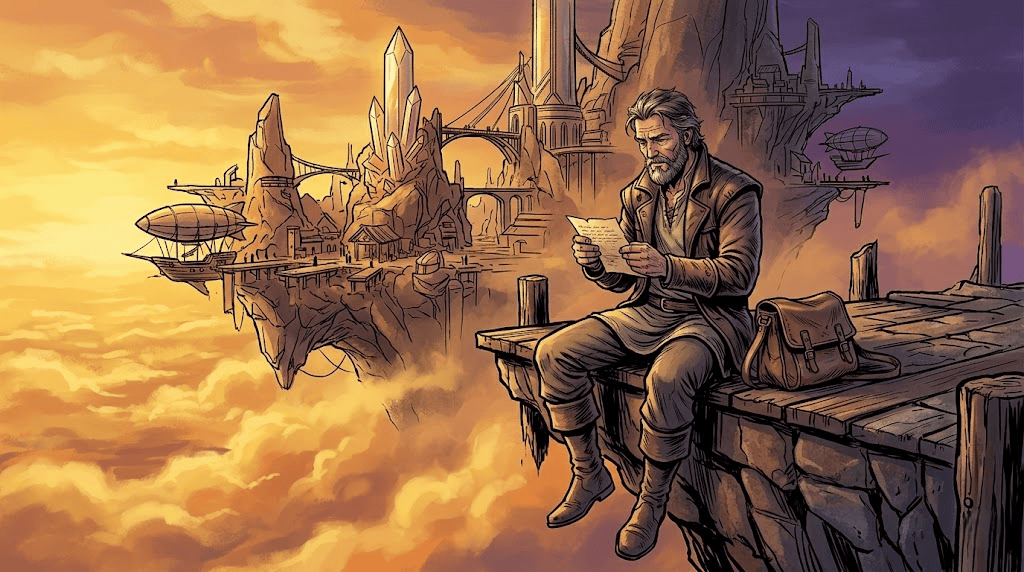
He docked at the upper port as the amber deepened toward violet, delivered Merchant Tolliver’s correspondence to the factor’s office with twenty minutes to spare before the quarter-wind shifted and the transit corridor closed, collected the passage fee in the standard crystal-sealed notes that wouldn’t fluctuate with the exchange rates between here and Crestholm, and then sat on the dock edge with his feet hanging over three hundred meters of amber nothing and ate the bread his daughter had packed into his satchel alongside the outdated charts.
She had put a note with it. She was nine and had recently discovered the pleasure of notes.
Come home safe. Also the charts are wrong. — Mira
He folded the note and put it in his breast pocket, which was where he put things he wanted to keep.
The quarter-wind was shifting — he could feel it in the change of pressure against his face, that particular rotation that meant the transit corridor would be open for return passage for approximately forty minutes before it closed for the night. He had timed it correctly, as he had known he would, as he had been timing things correctly for twenty-two years, not because he always had a plan but because he had learned to stay close enough to the thing he was navigating toward that the adjustments, when they came, were never too large to make.
The thing he was navigating toward was simple and had never changed.
It was a house on Crestholm where his daughter had packed bread into his satchel and written him a note, and where his wife would have the wind-lanterns lit by the time he docked, and where the bread would probably have run out because he had a nine-year-old who always over-estimated how much food a single transit required.
He had no charts for this. He had never needed them.
He untied the skiff and pushed off from the dock and let the wind find him, and turned his heading toward home with the certainty of someone who had discovered, over a long time and many wrong turns, that the direction was never the uncertain part.
The question was always whether you kept moving toward it.
☕ Enjoyed this story? Writing Lumenvale is how I pay my bills. If these stories are worth something to you, a $1 Ko-fi keeps the forge burning — and tells me this world is worth continuing. 👉 Buy Chadwick a coffee


Leave a Reply