


Keep Moving
A Story from Lumenvale
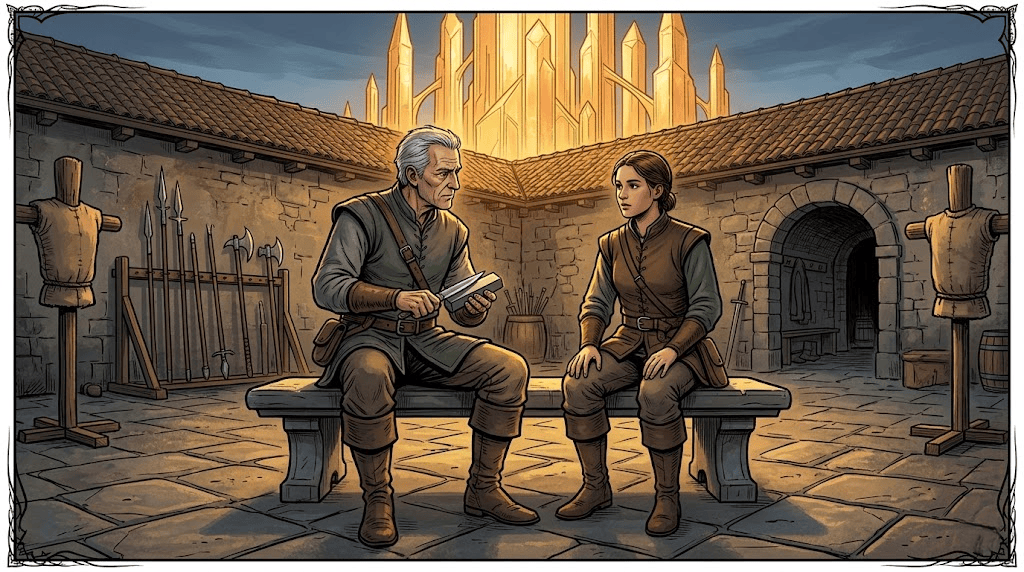
The old soldier was sharpening a knife he didn’t need.
This was something Nessa had observed about veterans — the way their hands required occupation even when the rest of them was at rest. Sergeant Holt had been sharpening this particular knife since before she arrived at the wall-post, and it had been sharp when she found him, and it would be sharp when she left, and the sharpening was not about the knife.
He was sixty-four years old. He had served the city of Lumenvale for forty-one of those years in capacities that the official records described in careful language that communicated nothing about what they had actually required of him. He walked with a lean to the left that never went away, the result of something in his hip that the healers had addressed and the years had not. He had three fingers missing from his right hand — not the sharpening hand — and the scar that crossed his jaw had faded to silver long ago.
Nessa was twenty-two and it was her third week on the wall and she had not slept properly in six days.
“You look terrible,” Holt said, without looking up from the knife.
“Thank you, Sergeant.”
“That’s not a compliment, it’s an observation.” He turned the blade. The whetstone made its soft patient sound. “What’s the matter with you.”
It was not phrased as a question. Holt did not phrase things as questions when he already knew the shape of the answer and was simply waiting for you to fill it in.
“I don’t know if I can do this,” she said.
She had not planned to say it. She had planned to report for the shift change and receive her post assignment and say nothing about the six nights of poor sleep or the way her hands had been unsteady on the third day’s patrol or the specific quality of fear that had taken up residence somewhere below her ribs and had not left since the incident on the eastern approach that had lasted approximately eight seconds and felt like much longer.
Holt set down the whetstone. He looked at her for a long moment with the direct, unhurried assessment of someone who had been looking at young soldiers for four decades and had learned to see past what they presented to what they were actually dealing with.
“Sit down,” he said.
She sat on the wall bench beside him. The city spread below them — the canals catching the last of the afternoon light, the Crystal Spires holding their pre-dusk gold, the Merchant Quarter producing its usual late-afternoon sound that from this height resolved into a single warm murmur. It was a beautiful city. She had always known it was beautiful. This week she had not been able to feel that.
“Tell me about the eastern approach,” he said.
She told him. It did not take long — eight seconds of reality never took long to describe, only long to carry. A figure at the gate who had not been a threat and then briefly had appeared to be and then had not been again, a sequence of events that her body had processed faster than her mind and that her mind had then been processing ever since.
Holt listened. He did not interrupt.
When she finished he picked up the whetstone again and made two passes with it before he spoke.
“How many times have you run that eight seconds since it happened?”
She had not counted. She tried to estimate and abandoned the attempt. “A lot.”
“Of course you have. That’s what eight seconds does — it replays. Your body’s trying to finish something that felt unfinished.” He turned the knife in the last of the afternoon light. “It felt unfinished because nothing happened. If something had happened, your body would have had the resolution. The nothing is what it can’t let go of.”
Nessa looked at the city.
“Does it stop?” she asked.
“The replaying? Eventually. When you’ve had enough subsequent days that your body starts to believe the weight of the ordinary outpaces the weight of the eight seconds.” He set the knife down on the stone beside him. “But that’s not what you asked me before. You asked if you could do this.”
“Yes.”
He was quiet for a moment. Below them the evening shift change was beginning in the lower ward — she could hear the footsteps, the quiet exchange of the handover protocol.
“I’m going to tell you something,” Holt said, “that was told to me by a woman who served forty years before I did, on this same wall, at a post two stations north of this one. She had four campaigns, two of them bad in the way that marks people permanently, and she was sixty years old when I was twenty-two and asking her approximately the same question you just asked me.”
Nessa turned to look at him.
“She said: you don’t get through it. You get through the next part of it.” He looked at the Spires. “She said: the only question that matters, on any given day in this work, is whether you’re still moving. Not whether it’s stopped being hard. Not whether you’re sure you’ll manage the whole of it. Just whether you’re still moving.”
The dusk sequence was beginning — she could hear it before she could see it, the Crystal Spires’ harmonic shifting from their afternoon register toward the lower, warmer frequencies of evening. The light on the canals changed. The city exhaled.
“She called it embracing the weight of the thing,” Holt continued. “Not pretending it isn’t heavy. Not convincing yourself it’s fine. Just — picking it up anyway and taking the next step with it in your arms, because the alternative is to put it down and stop, and stopping is the only thing that actually finishes you.”
Nessa thought about the six nights. The eight seconds playing on their loop. The unsteady hands on the third patrol that she had hidden from everyone and that had steadied themselves by the end of the day not because anything had changed but because she had kept moving through the patrol until they did.
“She said something else,” Holt said. His voice had changed slightly — not softer, but more precise, the way a voice got when it was carrying something with care. “She said the ones who make it to the end of a long career aren’t the ones who were never afraid or never wrong or never had an eight-second moment that replayed. They’re the ones who never stopped moving, even when moving meant dragging themselves through days that had no right to be as hard as they were.”
He picked up the knife and looked at it. Set it back down.
“She served forty years. She walked with a limp from a thing that had happened in her second campaign and she never stopped walking.” He turned to look at Nessa directly. “I have served forty-one years. I walk with a lean and I’m missing three fingers and there are nights when my body runs old replays that I’ve been carrying for thirty years. And I am at this post, on this wall, for this shift.”
The dusk transition was completing — the Spires finding their evening register, the harmonic settling into that lower resonance that Nessa had come to feel in her chest before she heard it properly. The city quieted slightly, the way it always quieted in this interval.
“You’re going to take your post in twenty minutes,” Holt said. “Not because you feel ready. Not because the fear has resolved itself or the sleep has returned or anything in you has decided it’s certain. You’re going to take it because you’re still moving.”
He stood. The lean to the left was there, as it always was, as it would always be.
“That’s the whole of it,” he said. “Everything else is detail.”
He picked up the knife — sharp, had been sharp, would remain sharp — and put it in the sheath at his belt. The efficiency of a man who had been doing this for forty-one years and had stopped wasting motion somewhere in the middle decades.
Nessa stood as well.
Her hands were steady.
Not because anything had changed. Because she had been still long enough to hear what she needed to hear and now she was moving again, and moving was the only answer there had ever been, and the wall was there and the shift was there and she was still in it.
“Sergeant,” she said.
“Mmm.”
“The woman who told you that. What was her name?”
Holt was already walking toward the north post. He paused without turning.
“Doesn’t matter,” he said. “She kept moving. That’s what her name means.”
He walked on.
Nessa followed.
☕ Enjoyed this story? Writing Lumenvale is how I pay my bills. If these stories are worth something to you, a $1 Ko-fi keeps the forge burning — and tells me this world is worth continuing. 👉 Buy Chadwick a coffee


Leave a Reply