


The Weight of a Mark
A Story from Lumenvale
The voting hall had been a grain warehouse before the Eastwatch Petition changed everything.
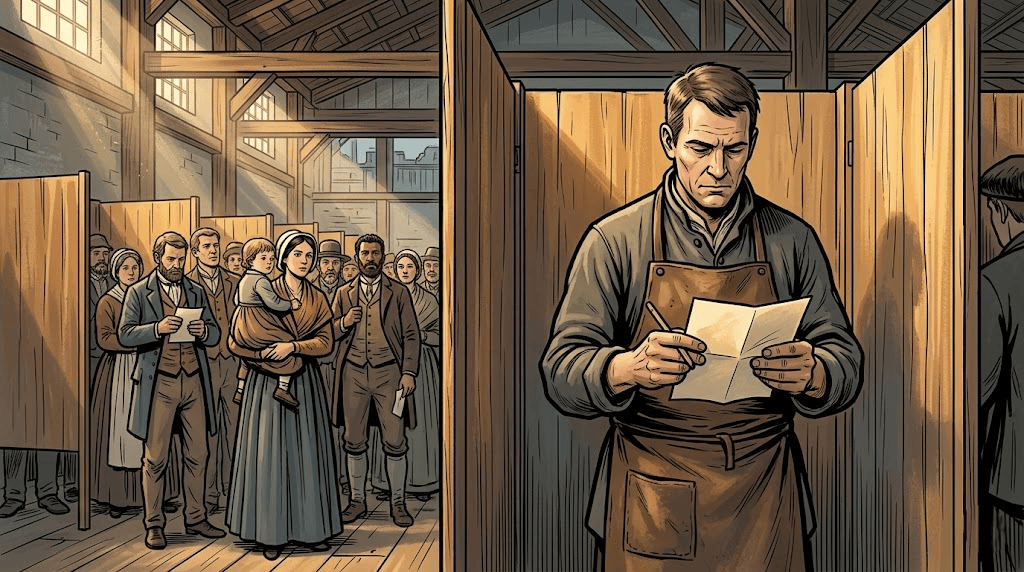
Delwyn knew this because his father had worked its loading docks twenty years ago, hauling sacks from canal barges before the Merchant Guilds had consolidated the northern trade routes and made the warehouse unnecessary. The building still smelled faintly of its original purpose — dry grain and rope and the particular mineral quality of river-soaked timber — beneath the newer smell of fresh-cut cedar from the temporary partitions that divided the floor into orderly lanes.
He arrived early. Not because he had anywhere pressing to be afterward, but because the thing felt like it deserved earliness. His wife Brea had laughed at him for that when he left the house — not unkindly, just with the particular warmth of a woman who had been watching her husband treat ordinary things with ceremony for seventeen years.
You’re going to vote in a guild election, she had said. Not consecrate a Spire.
First time for anything is worth being early, he had said.
She had handed him his coat and said nothing further, which was how she expressed agreement when she didn’t want to encourage him too much.
The queue was already a dozen people long when he arrived, which was longer than he had expected given the hour and shorter than he had hoped, because the length of the queue was the only visible evidence that this was a real thing happening to real people and not simply a theoretical exercise the Council had authorized to quiet the guilds and then quietly forgotten about.
A woman ahead of him in the queue had a child on her hip — four years old, maybe five, with the unfocused curiosity of that age applied to everything in the building. The child pointed at the partitioned lanes with one small finger and looked at her mother for an explanation.
We’re marking a paper, the woman said. To say what we think should happen.
Does it work? the child asked.
The woman was quiet for a moment. Sometimes, she said. And sometimes it takes a while.
The child accepted this with the equanimity of someone who had not yet learned to be dissatisfied with incomplete answers.
The guild election was specific in its scope — which Delwyn understood was intentional, part of the compromise framework that Master Chronicler Emberhill had helped negotiate between the Council and the Eastwatch petitioners over three months of careful drafting. Not a vote on governance. Not a vote on who held power. A vote on a specific question of trade regulation: whether the northern canal tariffs should be adjusted to accommodate the smaller independent merchants who had been squeezed by the consolidated guild rates over the past decade.
A question, in other words, that directly affected Delwyn’s life.
He ran a small cooperage in the Artisan Quarter — barrels and casks, mostly, for the canal trade that moved goods between districts. The consolidated guild rates had been eating into his margins for four years in a way that was not yet catastrophic and was consistently worsening. He had opinions about this. He had always had opinions about this. What he had not previously had was anywhere to put them that would count for anything beyond the ears of people who already agreed with him.
The queue moved forward. He moved with it.
He had thought, in the weeks since the voting day had been announced, about what it would feel like. He had tried to imagine it as something large — consequential, historic, the way the Chronicle Tower records spoke of significant moments in the city’s governance. He had read the Eastwatch Petition and the Council’s response and the compromise framework, and he had tried to feel the weight of it.
What he had not anticipated was how quiet it would be.
No fanfare. No ceremony. A clerk at the partition entrance who checked his name against the guild rolls and handed him a folded paper and a marking stick. A small booth inside the partition, barely wide enough for one person. A single question on the paper, stated in plain language without the elaborating clauses and conditional frameworks of the official documents. A box to mark.
He stood in the booth for a moment before marking anything.
He was not uncertain about his answer — he had known his answer for four years, in the specific way you knew things that lived in your margins and your monthly tallies and the quiet calculations you did at the end of each quarter. He was uncertain about something else, something harder to name.
He thought about his father on the loading docks of this same building, hauling grain for wages that were set by people who had never asked him what he thought they should be. He thought about Brea at the market, negotiating with suppliers whose prices moved with the consolidated rates whether she negotiated or not. He thought about the child in the queue pointing at the lanes and asking if it worked.
Sometimes, her mother had said. And sometimes it takes a while.
He marked the box.
The paper went into the collection box at the lane’s end, indistinguishable from every other folded paper in it, which was the point. He walked back out through the partition and past the queue that had grown longer behind him and out through the warehouse’s main doors into the morning air of the canal district.
The Crystal Spires were doing their mid-morning shift — the particular quality of light that came when the harmonic frequency adjusted for the sun’s angle, the city brightening slightly in a way that had no practical consequence and was simply beautiful. The canal below the bridge ran its usual silver, carrying its usual traffic.
Nothing had changed. Everything felt slightly different, in a way he would have struggled to explain to anyone who hadn’t just done the same thing.
He thought about what the vote would produce. He didn’t know. The compromise framework had built in review periods and conditional implementations and a dozen qualifying clauses that made the outcome uncertain even in the event of a strong majority. It might work immediately. It might take a while. It might produce something other than what any individual who marked a box had intended.
He was still glad he had marked the box.
Not because he was certain it would change things. Because the marking was the act of saying — in a form that was recorded and counted and treated as information worth considering — that he was here, and he had opinions, and the city was a place he had a stake in, and he was not simply a person to whom things happened.
That, he thought on the walk home, was worth being early for.
☕ Enjoyed this story? Writing Lumenvale is how I pay my bills. If these stories are worth something to you, a $1 Ko-fi keeps the forge burning — and tells me this world is worth continuing. 👉 Buy Chadwick a coffee


Leave a Reply