
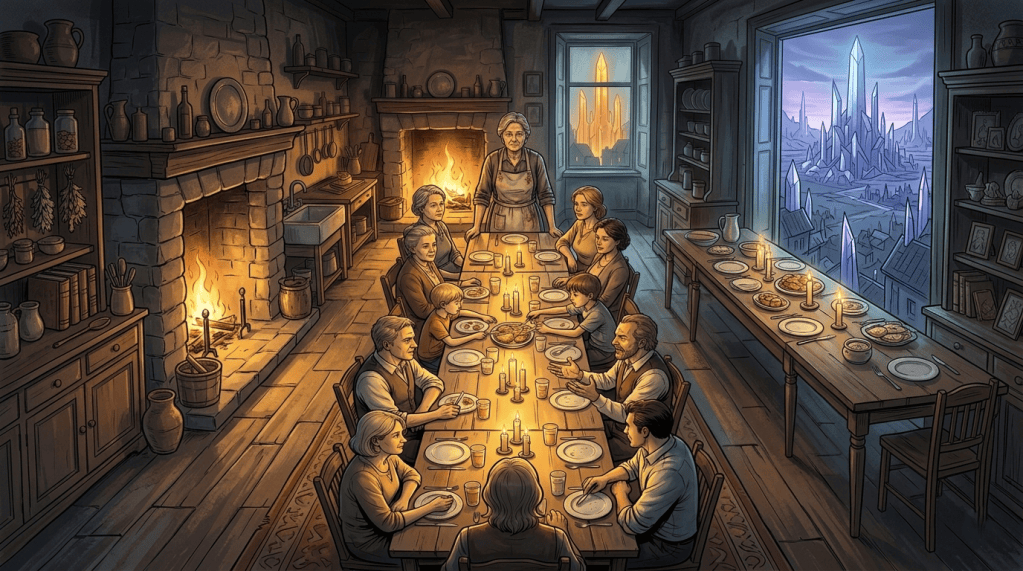


The Between-Season Table
A Story from Lumenvale
Nobody had officially declared it a holiday.
That was the thing about the Between-Season Table — it had no name in any guild calendar, no recognized status in the Festival Records at the Chronicle Tower, no official date. It fell somewhere between the Harvest Festival and the Festival of Ascending Lights, in the narrow corridor of weeks when the city was catching its breath between celebrations. The first gathering had happened forty-three years ago because Hessa Caldwell had looked at her family scattered across three districts and decided, without ceremony, that they were going to eat together.
They had been eating together every year since.
Cael arrived early, as he always did, because arriving early meant a few minutes alone with his mother in the kitchen before the rest of the world showed up.
Hessa was already at the stove. This was a constant of Cael’s life — she had been at this stove every morning of his childhood, every holiday of his adult years, every occasion that required feeding more people than the table could comfortably hold. The kitchen in the house on Amber Lane smelled exactly as it had smelled when he was seven: woodsmoke and roasted root vegetables and the specific sweetness of the spiced cider that simmered on the back burner from mid-morning onward.
“You’re early,” she said, without turning around.
“I’m always early.”
“Your father is still asleep. You know how he is before the family arrives.”
Cael poured himself a cup of cider and leaned against the counter and watched her work. She moved through the kitchen the way she had always moved — with the unhurried efficiency of someone who had made this particular meal enough times that her hands knew it independently of her attention. She was seventy-one years old and had been making the Between-Season Table since before he was born and she showed no signs of delegating any part of it.
“Linden is bringing the honey bread,” he offered.
“I know. She told me three times.” Hessa adjusted something at the back of the stove without looking. “And Brisa is bringing the children early so they can help set the table, which means they will scatter everything that was already set and we’ll start from the beginning.”
“Brisa’s children are seven and four.”
“Yes.”
“That’s what seven and four does.”
“I know what seven and four does.” She turned to look at him over her shoulder with the expression that had never changed in forty years — fond and direct and not particularly patient with obvious statements. “I also know that your father will give them each a piece of sweet-root from his pocket the moment they arrive and they will be completely unmanageable for the next two hours, and I know that Linden’s husband will spend the first hour standing in the corner nearest the door because he still doesn’t know where to put himself in a room this full of people, and I know that your Uncle Harwick will arrive last and claim it was the canals when it was the tavern.” She paused. “I know all of this. I have known all of this for decades. I make the table anyway.”
Cael looked at his cider.
“Is there something you wanted to help with?” she asked.
“I wanted to see you before it started.”
She turned back to the stove. A moment passed. “The root vegetables need turning in about twenty minutes.”
They came in the way families came — not all at once, not in any particular order, with the loose coordination of people who had been doing this long enough that the logistics had resolved themselves into something organic.
Brisa arrived first, as promised, with her two children who immediately located their grandfather in the sitting room and extracted sweet-root from his pocket within forty seconds of entering the house. Amos Caldwell, sixty-eight years old and retired from the Artificer’s Quarter, distributed the candy with the expression of a man who understood exactly what he was doing and had no intention of stopping.
Linden arrived with the honey bread and her husband Pol, who positioned himself near the door with the careful unobtrusiveness of a man still learning the specific gravity of this particular gathering. Cael’s wife Rue came in behind them with their daughter on her hip and the particular expression of someone mentally calculating how many people were going to want more wine than had been brought.
Then the aunts. Then the uncles. Then the cousins who were old enough to come without their parents and young enough to immediately form a separate group in the back garden despite the cold.
The house on Amber Lane was not large. This had never been a problem because the Between-Season Table had always understood itself to be a matter of proximity rather than space. People ate in the kitchen and the sitting room and on the stairs and wherever a surface presented itself. Children sat on laps. Cousins shared chairs. The table itself, extended with the boards that lived under the stairs all year waiting for this occasion, seated twelve if everyone was willing to be slightly closer to each other than was strictly comfortable.
Everyone was always willing.
Cael found himself, as he always found himself at some point in the middle of the afternoon, standing in the narrow corridor between the kitchen and the sitting room, watching both rooms from the middle.
In the kitchen his mother and his two sisters were engaged in a simultaneous argument about whether the roasted marrow needed more salt and a conversation about something that had happened at the Harvest Festival that he had apparently missed. The argument and the conversation were happening at the same time and involved the same three people and neither was impeding the other.
In the sitting room his father had his youngest niece on his knee and was telling her something that made her eyes go wide. His Uncle Harwick, who had arrived forty minutes ago blaming the canals, was asleep in the corner chair with a plate still in his hand. Pol had migrated from the door to the edge of the sitting room group, which was progress. Rue was talking to one of the aunts with the ease of someone who had done this enough times that it no longer required effort.
The cousins had come in from the garden cold and been absorbed into the various rooms without disrupting anything essential.
The table had been set and scattered and reset twice and was currently set correctly, as far as Cael could tell, with the mismatched plates that had accumulated over forty-three years of Between-Season Tables — the ones that had survived from his grandmother’s house, the ones his parents had bought when they first married, the ones Linden had contributed after an estate sale three years ago. No two were the same pattern. This had never been considered a problem.
His mother appeared at his elbow with a plate.
“Eat something before service,” she said. “You always forget to eat during service.”
He took the plate. “How long until we sit?”
She looked at the room. Something passed across her face — not quite calculation, not quite feeling, but something that combined both. “Twenty minutes. When your Aunt Dessa finishes telling the story about the spice merchant. She tells it every year and it takes exactly the same amount of time.” She paused. “Though she adds a detail or two each year, so I suppose it’s not entirely the same story.”
“Do you ever get tired of this?” he asked, and then felt immediately that it was the wrong question, or at least imprecisely stated, because he did not mean it as it had come out.
She looked at him with the same expression from earlier. “No.”
“Even the parts that are the same every year?”
“Especially those parts.” She looked out at the sitting room, where his father was now teaching the youngest grandchild a handclap game that Cael recognized from his own childhood. “The sameness is the point, Cael. The sameness is what you’re making when you do this every year. A thing that exists in more than one time. A thing they’ll all carry.”
He looked at the mismatched plates. At his sleeping uncle. At Pol, who had moved another foot closer to the center of the room without appearing to notice.
“Go eat,” his mother said, and went back to the kitchen.
They sat at service the way they always sat — too many people, not enough chairs, every problem solved in the improvised way that had become its own tradition. The food came out of the kitchen in relays and was distributed with the organized chaos of people who had been doing this together long enough to have developed a system that looked like no system at all.
Hessa sat at the head of the table, as she had always sat. Amos sat at the other end, as he had always sat. Between them the generations arranged themselves in whatever order they landed.
Before the meal began, Hessa did the thing she had done every year for forty-three years.
She looked down the length of the table. She looked at all of it — the mismatched plates and the too-many people and the youngest grandchild who was already negotiating with the oldest cousin about something that would require adult adjudication before the meal was over. She looked at Pol, who had ended up in the middle of the table and appeared, for the first time since Cael had known him, to be exactly where he was supposed to be.
She did not say anything. She simply looked.
Then she picked up her fork, and the Between-Season Table began.
After the meal, after the plates had been cleared in the same improvised relay that had brought them out, after the children had been retrieved from whatever they’d gotten into and the uncles had resumed their argument about a topic Cael had never been able to follow, he found his mother at the kitchen window.
The house was still full of noise. It was a specific kind of noise — layered and warm, the particular sound of people who had been close long enough that their voices had learned to occupy the same space without competing.
“Same time next year?” he asked.
“Same time every year,” she said.
Outside, the city was settling into its between-festival quiet, the Crystal Spires holding their amber dusk-frequency in the darkening sky. The canal below the lane caught the last of the light.
Hessa watched it for a moment.
“The table doesn’t happen by itself,” she said, to no one in particular, or perhaps to him, or perhaps to the forty-three years of tables behind her that had each required the same choosing. “Someone has to decide that the people they love are worth the trouble of gathering them.”
She turned from the window. There were dishes to do, and Linden had already started, and Brisa’s children had gone suspiciously quiet in the direction of the pantry.
“Come on,” she said. “The evening isn’t finished yet.”
☕ Enjoyed this story? Writing Lumenvale is how I pay my bills. If these stories are worth something to you, a $1 Ko-fi keeps the forge burning — and tells me this world is worth continuing. 👉 Buy Chadwick a coffee
New chapters every Monday — get them free by email
📅 Chronicles of the Giantess returns Monday, November 23, with a new chapter every Monday. Subscribe free and new chapters and stories come straight to your inbox.
New here? Start Here → · More Lumenvale stories · All series


Leave a Reply