

The Question at the Bottom of Everything
A Story from Lumenvale
The argument had started, as the best ones did, over something small.
A footnote. Specifically, a footnote on page four hundred and twelve of a pre-Convergence text on harmonic theory that Osric had found wedged behind a loose shelf-panel in the Archive’s seventh sub-level, which was the level that existed partially outside conventional time and therefore contained books that had not been written yet and books that had been written in futures that no longer applied. Osric had been down there for three days, which in the seventh sub-level meant somewhere between three hours and three weeks in the levels above.
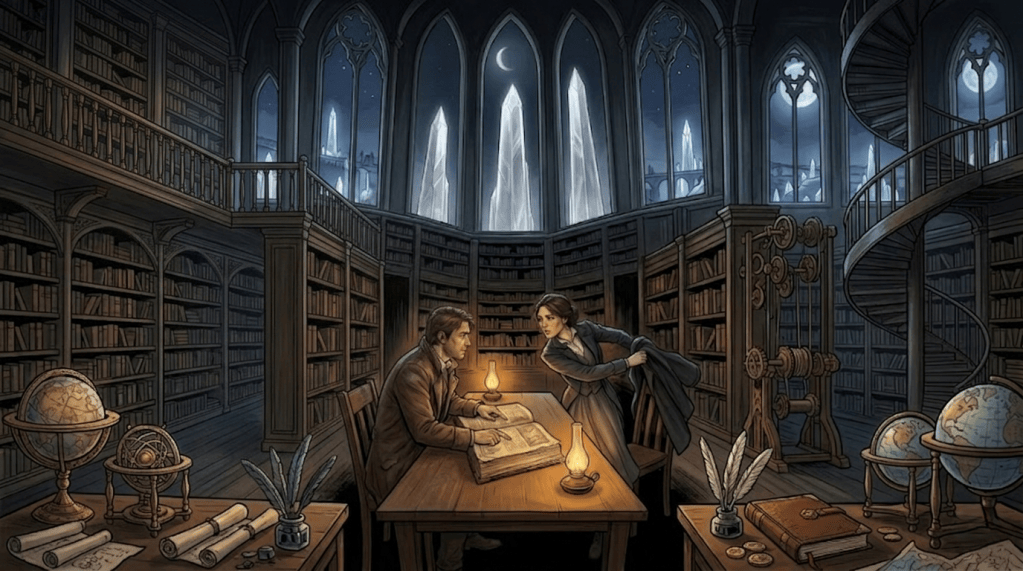
He had emerged into the main reading room at midnight, dust on his coat and a look on his face that his colleague Devna had learned, over eleven years of shared research, meant he had found something that was either going to keep them both awake until dawn or change the fundamental framework of everything they thought they understood about the Crystal Spires.
He set the book on the table between them without a word and pointed at the footnote.
Devna read it twice. Then she set down her tea.
“That can’t be right,” she said.
“I know.”
“The Spires predate the city by at least four centuries. The harmonic record goes back that far. This is saying they predate the harmonic record itself.”
“I know.”
“Which would mean —”
“That the Spires weren’t built.” Osric sat across from her, his long fingers laced together on the table. “That they grew.”
The reading room was empty at this hour except for the two of them and the Archive’s ambient presence — that particular quality of attention that the seventh sub-level gave to the whole building, as if the structure itself was listening. The lamps burned low and steady. Outside, the city had reached its quietest hour, the canals running dark and the Crystal Spires holding their rest-frequency, that deep sustained note that the Resonance Keepers maintained through the night watches.
Devna stood and went to the long window that faced the Spire District. Three of the towers were visible from here, their crystal faces pale in the moonlight, running the faint silver-white of full rest.
“Walk me through it,” she said.
Osric opened the book to the footnote again, though by now he had it memorized. “The pre-Convergence scholar who wrote this — unnamed, which in itself is strange for a text of this provenance — is discussing the origin of harmonic resonance as a natural phenomenon versus a constructed one. The mainstream argument has always been that resonance is a property of certain crystalline structures that early Lumenvale architects learned to harness.”
“Correct.”
“This footnote suggests the relationship is inverted. That harmonic resonance is not a property the Spires were built to produce. That harmonic resonance is what the Spires are — at the most fundamental level — and that the crystal is simply the form that property has chosen to take in this physical realm.” He paused. “The way water takes the form of ice when the temperature drops. The ice is not the thing. The water is the thing.”
Devna was quiet for a long moment. Below, a canal boat made its slow passage along the night route, its lantern drawing a long thread of reflection across the dark water.
“If that’s true,” she said, “then the Spires aren’t a structure. They’re an event.”
“A continuous event. An ongoing occurrence rather than a made thing.”
“Which means the Resonance Keepers aren’t maintaining the Spires.” She turned from the window. “They’re participating in them.”
Osric looked at her with the expression he reserved for moments when the argument arrived somewhere he had not quite reached himself. “Say that again.”
“The Keepers don’t service the Spires the way you service a machine. They don’t maintain a structure. If the Spires are a continuous harmonic event, then the Keepers are —” She searched for the language. “Contributors. Every dawn and dusk transition isn’t maintenance. It’s participation in something that has been occurring since before the city existed.”
The lamp between them wavered slightly in a draft from the high windows. Neither of them moved to adjust it.
“Which raises the question,” Osric said slowly, “of what the harmonic event is for.”
“Structures are built for purposes. Events occur for reasons.” Devna returned to her chair. “Or they occur without reasons, which is its own kind of answer.”
“The pre-Convergence scholar doesn’t address this directly. But the footnote references an earlier text — which I have not been able to locate, it may be in a sub-level below the seventh — that apparently theorizes the harmonic frequency of the Spires is not generated by them but rather received by them.”
Devna went very still. “Received from what?”
“That,” Osric said, “is precisely the question.”
They sat with it for a while. This was how their best arguments worked — not as contests to be won but as territories to be mapped, with the understanding that the interesting parts of any map were the edges where the known gave way to the unknown and the cartographer had to decide whether to write here there be dragons or simply leave it blank.
“If the frequency is received,” Devna said at last, “then the Spires are antennae.”
“Or ears.”
“Ears implies a listener.”
“Yes.” Osric looked at the window, at the pale crystal faces of the towers in the night. “It does.”
The implications of this expanded between them in the way that the largest ideas always expanded — not with noise or drama but with the particular silence of something too large to be spoken all at once. It needed to be approached from multiple directions, tested against known facts, held up to the light of every adjacent discipline until its shape became clearer.
“The Whispering Gardens,” Devna said.
“The trees that speak to the unborn.”
“If the Spires are receiving something — if there is a frequency being broadcast into this world from whatever is outside it — then everything in Lumenvale that exhibits anomalous harmonic behavior might be a receiver of the same signal.” She pulled a fresh sheet of paper toward her and uncapped her pen. “The gardens. The Grand Archive’s temporal properties. The Luminescent River. The way memory-stones hold impressions. All of it might be —”
“One system,” Osric said. “Different receivers. Same broadcast.”
Devna was already writing. The pen moved quickly, the way it moved when she was racing to capture something before the shape of it shifted. Osric watched her and did not interrupt. This was the other thing he had learned in eleven years — when to press the argument forward and when to let it breathe.
The Archive breathed around them. The lamps burned. The Spires held their rest-note in the night outside.
“The question at the bottom of everything,” Devna said without looking up, “has always been the same question. Is the universe a mechanism or a message?” She paused her writing. “Mechanism implies no sender. Message implies one.”
“And Lumenvale,” Osric said, “is built on top of something that might be the most sophisticated receiving array in the known world.” He looked at the book. “With nobody, as far as we know, listening for what it’s receiving.”
“Until now.” Devna set down her pen. She looked across the table at him with the expression he recognized as the end of the mapping phase and the beginning of something harder — the part where the theory had to decide if it wanted to be tested. “We need to get into the seventh sub-level. Below the sub-level. Whatever is below that.”
“I’ve found two staircases that don’t appear on any Archive chart.”
“Of course you have.” She stood, reaching for her coat. “We’ll need materials. Recording instruments calibrated for sub-conventional frequencies. Someone from the Resonance Keepers who won’t immediately report us to the Magisterium.” She paused. “Cassian Dawnweaver owes me a conversation.”
Osric closed the book carefully, with the particular care of someone handling something that has changed the size of the room they are standing in.
“This could be nothing,” he said. “A pre-Convergence scholar with an eccentric theory and no peer review.”
“Yes.” Devna buttoned her coat. “Or it could be that this city has been receiving a message for four centuries and we have never thought to ask what it says.”
She said this with the quality of someone who had already decided and was simply being honest about the uncertainty for the sake of rigor. Osric had always admired this about her — the way she held the possibility of being wrong with the same grip she held the possibility of being right. It was the only honest way to do the work.
He stood and followed her toward the Archive’s deeper stacks.
The lamps burned behind them. The Spires held their note.
Outside, the city moved through its quiet hours, unaware that in the seventh sub-level of its oldest library, two scholars with a footnote and a working theory were beginning to ask a question that the city had been built, perhaps, to eventually answer.
☕ Enjoyed this story? Writing Lumenvale is how I pay my bills. If these stories are worth something to you, a $1 Ko-fi keeps the forge burning — and tells me this world is worth continuing. 👉 Buy Chadwick a coffee


Leave a Reply