
The Two Names She Needed
A Story from Lumenvale
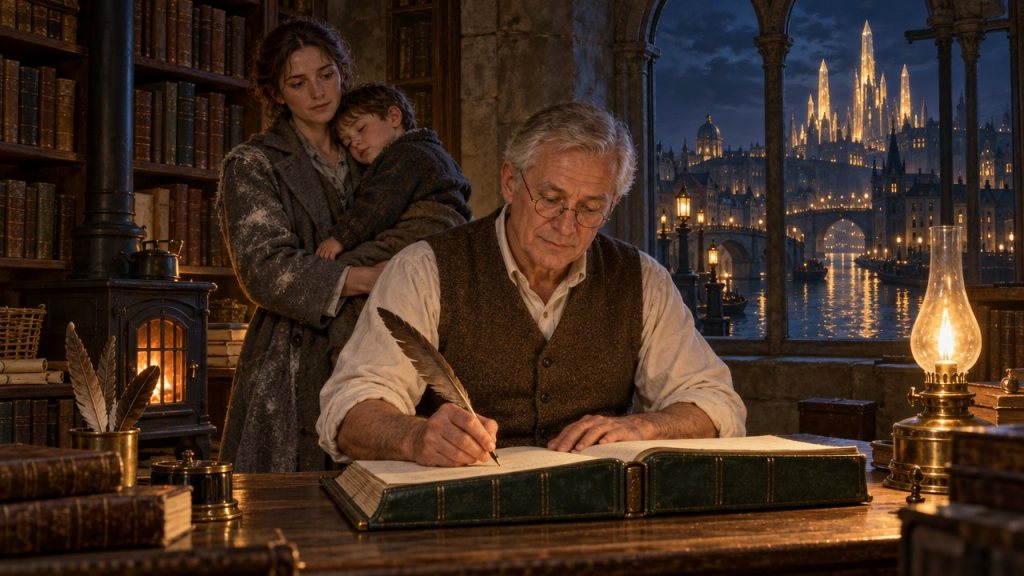
Odell Pruitt kept the Book of Names on the fourth floor of the Chronicle Tower, and at half past the seventh bell a woman put a petition on his desk with two empty lines at the bottom.
He knew what was missing before he picked it up. Every new name in Lumenvale needed two householders born in the city to sign for it. Those were the empty lines.
“I need a third copy?” she asked. “The man downstairs said bring three copies.”
“You brought three,” Odell said. “It’s the signatures.”
She had a boy with her, seven or eight, with flour in the creases of his knuckles. The woman had flour on her too, on the shoulder of her coat where she must have carried a sack. Her name on the form was Nadia Karsk. Place of birth: Tull’s Landing, in the Fen country. Lived in Lumenvale: one year, seven months. Trade: night baker, Cobble Wharf.
The Book closed at the tenth bell on Founders’ Night, and it did not open again for a year. Odell had kept it for thirty-one years. He had never once kept it open late.
“Tull’s Landing,” he said. “That went under in the spring floods. Two years back.”
“Yes.”
“I’m sorry.”
She nodded. She did not want to talk about Tull’s Landing. He could see that.
There was another line on the form, above the signatures. Every petition had it. It had been on the forms since the city was founded, and most people wrote something quick there, about the Spires or the canals or the bread. What makes you proud of this city?
She had left it blank too.
“You can’t leave that empty,” he said.
“I don’t know it well enough yet,” Nadia said. “I don’t want to write something I don’t mean.”
Odell set the petition down. His knees hurt. They always hurt by the seventh bell, from the stairs, a hundred and twelve of them, which he climbed twice a day. He had been looking forward to tonight all week. Once the bell rang he could lock the Book and go home to his sister’s soup and put his feet on the fender.
“Who did you ask to sign?” he said.
“Master Corwin. The baker I work for. He said he would. He died three weeks ago.” She said it flatly. “His son has the shop now. His son was born in Hallam, up the coast. He can’t sign.”
“Anyone else?”
“I work nights. I sleep days. I don’t know many people.”
The boy was looking at the Book. It sat open on its stand by the window, a great slab of a thing bound in green leather, with thirty-one years of Odell’s handwriting in it and three hundred years of other people’s before that.
“What happens if you don’t get in this year?” Odell asked.
Nadia put her hand on the boy’s head. “Pim sits the school examination in the spring. The Artificers’ school. They only take boys and girls with a name in the Book.” She looked at Odell. “He’s good with numbers. Better than me.”
“I’m better than her,” Pim said, and his mother almost smiled.
Odell looked at the clock over the door. The hands were brass and someone had polished them once, a long time ago. Half past seven. Two and a half hours.
He thought about his sister’s soup.
The rule said two householders born in the city, signing in front of the Keeper of the Book, before the tenth bell. Odell had read that rule more times than he had read anything except Scripture. It did not say the householders had to climb the Tower.
There was a walking ledger in the cabinet by the stove. It was a small flat case with an inkwell set into the lid and a page holder inside. The Keepers used it for the sick and the very old, people who couldn’t make the stairs. Odell had carried it out maybe a dozen times in thirty-one years.
He got it out. He blew the dust off it and checked the inkwell.
“Put your coat back on,” he said.
Clerk-Master Dunmore was in the corridor when they came out, eating an apple. He looked at the case and he looked at Nadia and the boy.
“Pruitt,” he said. “It’s Founders’ Night.”
“I know what night it is.”
“You’re going out?”
“I’m taking the walking ledger to two householders,” Odell said. “That’s in the rules.”
Dunmore finished chewing. “You’ll be back before the bell?”
“That’s in the rules too.”
Dunmore shrugged and went back into his office. He was not a bad man. He just liked things simple, and Odell had liked things simple too, for most of his life.
The stairs were worse going down. Odell held the rail. Pim went ahead, two steps at a time, and then waited on each landing with his hands in his pockets. On the third landing he asked where the privy was, and Odell pointed him to the little door under the window, and he and Nadia stood there with nothing to say while they waited.
“You don’t have to do this,” she said finally.
“No,” Odell said. “I don’t.”
Outside, Founders’ Night had started. Lanterns hung on every bridge, and the bakers on Silk Street were selling honey twists from carts, and somebody on a barge was playing a fiddle badly. The Crystal Spires were lit gold at the top. Odell didn’t look at them much anymore. He had lived under them too long.
“Where do you live?” he asked.
“Wicker Lane. Behind the Ninth Lock.”
They walked. Odell’s knees settled down once they were moving on flat stone. Nadia walked fast and then kept slowing down for him, and he pretended not to notice.
The first door on Wicker Lane belonged to a cooper. He was Lumenvale-born and owned his house. He looked at Nadia’s petition and said he didn’t know her.
“I live four doors down,” Nadia said.
“Lots of people live four doors down.” He shut the door.
The second house was dark. At the third a woman leaned out of an upstairs window and said she was born in Hallam too, sorry, love, try old Amos.
“Who’s old Amos?” Odell said.
“The lock-keeper,” Nadia said. She hesitated. “I don’t think he likes me.”
Amos Kettering had kept the Ninth Lock for forty years and he lived in the lock house beside it, a narrow stone building with a stovepipe that leaned. He opened the door with a blanket around his shoulders. He was coughing.
“You,” he said to Nadia.
“Evening, Master Kettering.”
“You’re the one who kept putting coal in my stove.” He looked at Odell. “Three weeks I had the fever. She comes off her shift at the bakery at dawn and she lets herself in and builds up my stove and leaves bread on the table. Never asked. Never knocked. I told her I’d have the Watch on her.”
“You did,” Nadia said.
“I didn’t mean it.”
“I know.”
Amos looked at the walking ledger. “What’s that?”
Odell explained. Amos listened with the blanket held tight under his chin. When Odell was done he held out his hand for the pen.
“Born in that room,” he said, and pointed behind him with it. “Right there. My father kept this lock before me.” He signed slowly and pressed hard, then blotted it on his blanket before Odell could stop him. “There. One.”
“Thank you,” Nadia said.
“Who’s your second?”
Nobody said anything.
Amos coughed. “Ask Greta Hollin,” he said. “Upstairs over the dye shop.”
“She doesn’t like me either,” Nadia said.
“Greta doesn’t like anybody,” said Amos. “Ask her anyway.”
The dye shop was at the corner where Wicker Lane met the canal. The water there ran a little blue, and a little red, depending on the day. The stairs to the flat went up the outside of the building.
Odell looked at them. Twenty-two steps, steep and wet.
Lord, he prayed, my knees, and then her paper. In that order if You have to choose.
He went up.
Greta Hollin was sixty or so, broad in the shoulders, with forearms stained blue to the elbow. She stood in her doorway and read the whole petition without inviting anyone in. Then she handed it back.
“No,” she said.
“Mistress Hollin,” Odell said, “I’m the Keeper of the Book of Names.”
“I know who you are. You’ve got a stamp on your hat.” She folded her arms. “I don’t sign for people I don’t know. She’s lived across the lane a year and a half. She’s never said ten words to me.”
“I work nights,” Nadia said quietly.
“So do the rats.” Greta looked at Pim, who was standing on the step below his mother. “No. I’m sorry for the boy. No.”
The door shut.
Nadia stood there a moment. Then she turned and went down the stairs, holding Pim’s hand, and Odell followed her with the walking ledger under his arm.
At the bottom she said, “It’s all right. Thank you. We’ll try again next year.”
“There’s an hour and a half yet,” Odell said.
“I don’t know anybody else.”
Odell didn’t either. He knew the names of half the city, written in green leather, and he couldn’t think of one person on Wicker Lane who would sign. He stood there by the blue water and felt every one of his sixty years.
They went back up the Tower slower than they had come down. Pim was tired now and didn’t run ahead. On the landings Odell stopped to rest and nobody hurried him.
The Book was where he had left it. He lit the lamp beside it and sat down and looked at the clock. Twenty minutes to the tenth bell.
Nadia stood by the desk. She had one name on her petition, and the blank line under it, and the blank line above it.
“May I ask you something?” she said.
“Go on.”
“What did you write? On your form. The proud line.”
Odell didn’t answer right away. Then he got up and went to the shelves at the back, where the old Books were kept, and ran his finger down the spines until he found the year. He brought it back to the desk and opened it, turning pages until he found the one.
His mother’s handwriting. She had always written very small, to save paper.
Hanna Pruitt, widow, from Brennick on the lower river. With her son Odell, age nine. Two signatures below it. Neither name meant anything to anyone now.
And above the signatures, the proud line. They opened the lock for us at night.
“We came up on a grain barge,” Odell said. “In the dark. The locks close at sundown. We would have sat out on the river all night, with the barge leaking and my mother wrapped around me to keep me warm. The lock-keeper heard us. He came out in his nightshirt and opened the gates. He didn’t have to.” Odell touched the page. “I don’t remember his face. I remember the gates opening.”
Nadia looked at the old page a long time.
“Half the Tower thinks I was born on Lantern Street,” Odell said. “I don’t tell people otherwise.”
“Why not?”
He thought about it. “I don’t know,” he said honestly. “Habit.”
Out in the corridor, somebody was coming up the stairs. Somebody heavy, breathing hard, swearing under her breath at every landing.
Greta Hollin came through the door with her hand on her side. Her face was red. She had put on a coat over her apron, and the coat was buttoned wrong.
“A hundred and twelve stairs,” she said. “Who builds a hundred and twelve stairs?”
Nobody answered her.
“Give it here.” She held out her blue hand. Nadia handed her the petition, and Greta looked at Odell. “Do I sign it, or do you?”
“You sign it,” Odell said. “I witness.”
Greta dipped the pen. She stopped with it over the line.
“My mother came off a barge too,” she said, not looking at anybody. “From the Fens. Somebody signed for her. I never knew who.” She signed. “I don’t like owing people. God help me, I’ve owed somebody my whole life.” She put the pen down. “There. Two.”
“Thank you,” Nadia said.
“Don’t thank me. Come say good morning sometime. Ten words. That’s all I ask.” Greta looked at Pim, who was asleep on the bench by the stove with his mouth open. “Your boy snores.”
“He gets it from his father.”
“Mine did too.” Greta went out. They listened to her going down the stairs, slower this time. She was still swearing.
There was one line left.
Nadia sat at the desk with the pen. Odell went to stand by the window so he wouldn’t watch her write it. Out over the city, the Founders’ Night lanterns were burning on every bridge. Down by the Ninth Lock he could just see the lock house, and a light in its one window. Old Amos, awake with his cough.
He heard the pen scratch. He heard her blot the paper.
The clock over the door said four minutes to the tenth bell.
Odell copied the petition into the Book by lamplight, in his best hand. Nadia Karsk, widow, from Tull’s Landing in the Fen country. With her son Pim, age seven. He copied the two signatures, Amos Kettering and Greta Hollin. Then he came to the proud line, and read it.
Greta Hollin came down the stairs. Then she came up them.
He copied that too.
The bell in the top of the Tower began to ring. It rang ten times, and on the tenth Odell closed the Book of Names and laid his hand flat on the green leather.
Nadia picked up her sleeping boy. He was too big to carry and she carried him anyway, with his head on her shoulder.
“Go careful on the stairs,” Odell said.
“I will.” She stopped at the door. “Master Pruitt. Will you be at the Ninth Lock tomorrow? At dawn?”
“Why?”
“I bake the first bread at dawn. Master Kettering gets a loaf.” She shifted Pim higher. “There’ll be one for you.”
Then she went down. He listened until he couldn’t hear her anymore.
Odell put the walking ledger back in the cabinet. He turned down the lamp. Then he took his mother’s old Book back to the shelf, and before he put it away he opened it one more time to her small handwriting.
They opened the lock for us at night.
“Thank You,” he said, to nobody in the room.
His sister’s soup would be cold. He found he didn’t mind.
☕ Enjoyed this story? Writing Lumenvale is how I pay my bills. If these stories are worth something to you, a $1 Ko-fi keeps the forge burning — and tells me this world is worth continuing. 👉 Buy Chadwick a coffee
👈 Previous Story: Missed the last tale from Lumenvale? Catch up now — Read The Lens That Cracked
📖 Read next: Neighbors make room for each other at a shared table in The Between-Season Table. Or browse every free story in Lantern & Shadow: Stories from Lumenvale.
A First Light in Lumenvale
Three free stories from Lumenvale — yours when you join the newsletter. No spam, and you can unsubscribe anytime.
New chapters every Monday, Wednesday, and Friday — get them free by email
📅 Chronicles of the Giantess has new chapters every Monday, Wednesday, and Friday. Subscribe free and new chapters and stories come straight to your inbox.
New here? Start Here → · More Lumenvale stories · All series


Leave a Reply