
The Lens That Cracked
A Story from Lumenvale
Hollis Brandt made lantern glass on Lantern Street, and he was halfway through a globe for the Ninth Lock bridge when the girl set the broken lens on his bench.
It was a Spire lens. He knew it before she unwrapped it. Thick as a man’s thumb at the rim, ground clear as spring water. Glass like that only went into the great lamps at the top of the Crystal Spires. A crack ran from the rim to the center like a frozen river.
“They said you’d know what went wrong,” the girl said.
She was maybe sixteen. Burn scars on both wrists, the little white ones every glass student gets her first year. Her apron still had the Guild’s blue stitching on it. Her eyes were red, and she had the look of someone who had walked a long way fast so she wouldn’t have to think.
Hollis set his blowpipe in the rack. “Who said?”
“Master Ansel. At the Spires.” She swallowed. “He failed me this morning. My trial piece. That’s it.” She nodded at the lens. “He said if I wanted to know why, I should ask Hollis Brandt on Lantern Street, because Hollis Brandt made the same mistake twenty-two years ago.”
Hollis didn’t answer. The furnace roared behind him. Out on the street a cart rolled past, and somebody laughed.
“Did he,” Hollis said.
Her name was Wilka Kessick. She came from the barley farms past the east locks, and she had been at the Guild for three years on a scholarship from her parish. If she passed the trial, she would have been a journeyman of the Spires. Good wages. A room in the Guild house. Her mother could have stopped taking in washing.
She told him all of this fast, standing up, without taking off her coat.
“And now I go home,” she said. “I go home and tell them I couldn’t do it.”
Hollis picked up the lens. He turned it in the light from the furnace door. He didn’t need long. The crack started at the rim, where the glass was thickest, and it ran clean and straight with no spidering.
“How long did you anneal it?” he asked.
She looked at the floor. “Long enough.”
“How long?”
“Nine hours.”
“Master Ansel told you sixteen.”
“Everyone else was done!” It came out loud, and she flinched at her own voice. “Everyone else was done by supper. I didn’t want to be the last one there. I thought if the oven was hot enough, nine would do it. I thought I was good enough that nine would do it.”
Hollis set the lens down on a folded cloth, gentle, like it could still break worse.
“Yeah,” he said. “That’s what I thought too.”
He made her sit. He made her drink a cup of the black tea he kept on the furnace shelf, so strong it could take paint off a door. Then he went back to the globe for the bridge, because the glass on the end of his pipe didn’t care about anybody’s bad morning.
“Come here,” he said. “Hold this.”
She stood. She took the jacks from him without being told how. Good hands. Steady, even now.
“I was twenty-five,” Hollis said. He turned the pipe, slow. “Best student in my year. Everybody said so. I said so, mostly. Master Ansel was only a journeyman then. He was in my trial group.”
Wilka looked up.
“We had three days to make a Spire lens. I finished mine on the second day. Beautiful thing. I wanted to be the first one done more than I wanted to be right. So I pulled it out of the oven about seven hours early and set it on the cooling rack where everybody could see it.” He shrugged. “Cracked in the night. I heard it. You ever hear glass go in a quiet room?”
“Yes,” she said. “Last night.”
“Then you know.”
He blew into the pipe, and the globe swelled, soft and orange.
“Ansel finished last. Took his whole sixteen hours and then some. He passed. I didn’t.”
“Did you try again?”
“They’d let me sit it the next spring.” Hollis rolled the globe on the marver, the iron table hissing under it. “I didn’t.”
“Why not?”
He was quiet long enough that she thought he wasn’t going to answer.
“I was too proud to sit in a room with first-years,” he said. “That’s the true answer. I told people it was the money. It was pride.”
He finished the globe and put it in his own oven. A plain annealing oven, brick, older than he was. He set the dial and wrote the time on a slate beside it.
“Sixteen hours,” Wilka read.
“For a bridge globe. Half as thick as your lens.” He wiped his hands. “I don’t take chances with it anymore.”
She sat back down on the stool. She looked around the shop for what seemed like the first time. The racks of plain globes, clear and amber and a few soft green. The tin lantern frames hanging from the rafters. The ledger on the counter, the handwriting in it neat and small and not his.
“So you just make these,” she said. Then she went red. “I didn’t mean it like that.”
“Sure you did.” He wasn’t angry. “It’s all right. Twenty-two years ago I’d have meant it like that too.”
He took his coat off the hook.
“Come on. I have to change the globes on the Ninth Lock before dark. You can carry the box.”
They walked down Lantern Street with a crate of globes between them, packed in straw. The afternoon was cold. The canals were low and gray and smelled like wet stone. Bargemen were tying up for the night. Somewhere a bell was ringing for evening prayer.
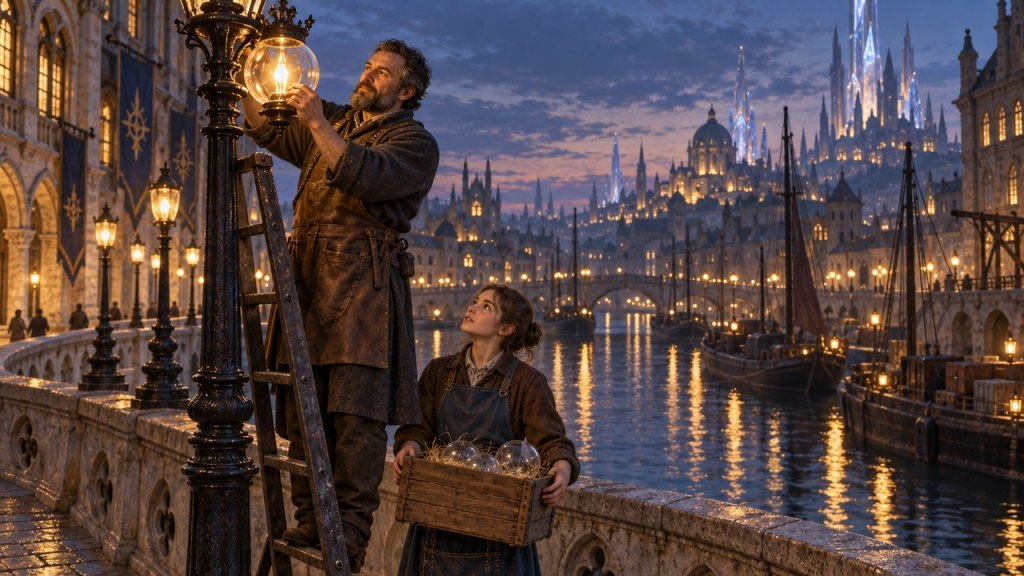
At the Ninth Lock, Hollis set the crate down and climbed the iron ladder up the first lamp post. He unscrewed the old globe, which was scratched and sooty, and handed it down. Wilka handed up a new one.
There were twenty-two lamps on the Ninth Lock bridge. They did all of them.
On the seventh, an old bargeman stopped his cart and waited at the bottom of the ladder until Hollis came down.
“Brandt,” the man said.
“Corliss.”
“These yours? All of them?”
“Most of them.”
The bargeman nodded at the lamp. “Winter before last, my grandson went in the water off this bridge. Fog so thick you couldn’t see your own boots. He was four.” The old man’s voice didn’t change. “The lock-keeper found him because he could see him. Under this light right here. Couldn’t have seen a thing with the old lamps. You remember the old lamps?”
“I remember.”
“Smoked like a chimney fire. Your glass doesn’t smoke.” The man touched his cap. “Just wanted to say so.”
He drove on.
Wilka stood with a globe in both hands and didn’t say a word.
They walked back in the dark. Every lamp on the Ninth Lock was lit behind them, and the light lay on the water in long gold lines.
“How many?” Wilka asked. “How many bridges?”
“In the city? Most of the south side. Hammer Row. Cobble Wharf. The Lantern Street lamps, obviously. Some of the houses.” He thought. “Some of the chapels.”
“And if you’d passed?”
He had asked himself that question for about ten years. Then one day he had stopped asking it, and he couldn’t remember exactly when.
“If I’d passed,” he said, “I’d have made maybe forty Spire lenses in twenty-two years. They’re beautiful. You can see them from the farms on a clear night. I used to look at them and want to be sick.”
“And now?”
“Now I look at them and think they’re beautiful.”
They turned onto Lantern Street. The shop windows glowed. Through the front glass of his own shop, Hollis could see his wife, Ruth, at the counter with the ledger and a pencil behind her ear.
“I met her the second week I had the shop,” he said. “She came in to buy a globe for her father’s boat. Argued with me about the price. Said I was charging too much because I thought too much of myself.” He almost smiled. “She was right.”
“And if you’d passed?”
“I’d have been in the Guild house at the top of the Spires. She’d never have walked up all those stairs to argue with me.” He stopped at the door. “We have three kids. My oldest is about your age.”
Wilka looked at the door. Then at him.
“Do you think God made you fail?” she asked.
It wasn’t the question he expected. He took his time.
“I think I made me fail,” Hollis said. “I pulled it out early. That was me. I was proud, and the glass doesn’t care who’s proud.” He opened the door, and warm air came out with the smell of soup. “But I prayed that night. Angry. Real angry. Told Him I’d given Him everything and He let it crack. And He didn’t answer me that night.” He held the door for her. “He answered me about twenty-two years’ worth, one lamp at a time.”
Ruth fed them both. She didn’t ask questions until the soup was gone, which was Ruth’s way, and then she asked all of them. Wilka answered. She cried a little, and Ruth gave her a handkerchief, and nobody made a big thing of it.
Wilka slept on the cot in the back room by the warm wall of the furnace.
Hollis did not sleep much. He lay awake and listened to the shop. Old habit. Twenty-two years and he still listened for glass at night.
Nothing cracked.
In the morning he opened the oven at the sixteenth hour exactly. Wilka was beside him, already awake, already in her apron.
He used the tongs and lifted out the bridge globe. He held it up to the window. Clear all the way through. He tapped it with his fingernail, and it rang, high and clean.
“Your turn,” he said.
She looked at him.
“Master Ansel sent you to me for a reason,” Hollis said. “I don’t think it was just to hear an old man talk about his mistakes. The next trial’s in the spring. That’s five months.” He nodded at his pipe rack. “I can’t teach you Spire glass. I never made a good one. But I can teach you sixteen hours. I’ve had a lot of practice at sixteen hours.”
“I can’t pay you.”
“I have a hundred and forty globes due on Hammer Row by the end of winter. My hands aren’t what they were.” He held up the right one, which shook a little in the mornings now. “You can pay me that way.”
Wilka looked at the pipe rack. She looked at the cracked lens, still on its folded cloth on the bench, where she had left it.
“What if I fail again?”
“Then you’ll fail on a full anneal,” Hollis said. “That’s a different kind of failing. You can live with that kind.”
She picked up a blowpipe. She checked the end of it for chips first. Somebody at the Guild had taught her that, and he liked that she did it without thinking.
“Sixteen hours,” she said.
“Sixteen hours.”
She wrote to her mother that afternoon. Hollis didn’t read it. He did see her walk it down to the post at the corner, and he saw her come back slower than she went, looking at the lamps along Lantern Street.
Two evenings later he climbed the ladder at the Ninth Lock again. He went up the seventh post, Corliss’s lamp, and took down the globe he had hung there two days before. There was nothing wrong with it. He handed it down to Wilka and reached for the one in her other hand.
She had made it herself the morning before. He had watched her do it. She had been slow, and she had been careful, and the oven had held it for a full sixteen hours.
He screwed it into the frame. He lit the wick. The light came up gold and clear, without a trace of smoke, and lay out over the water.
Below him on the bridge, Wilka Kessick stood with her face turned up, watching her first light come on.
☕ Enjoyed this story? Writing Lumenvale is how I pay my bills. If these stories are worth something to you, a $1 Ko-fi keeps the forge burning — and tells me this world is worth continuing. 👉 Buy Chadwick a coffee
👈 Previous Story: Missed the last tale from Lumenvale? Catch up now — Read The Skates He Bought for Himself
📖 Read next: Another master and apprentice share the work of fire in The Last Hour of the Forge. Or browse every free story in Lantern & Shadow: Stories from Lumenvale.
A First Light in Lumenvale
Three free stories from Lumenvale — yours when you join the newsletter. No spam, and you can unsubscribe anytime.
New chapters every Monday — get them free by email
📅 Chronicles of the Giantess returns Monday, November 23, with a new chapter every Monday. Subscribe free and new chapters and stories come straight to your inbox.
New here? Start Here → · More Lumenvale stories · All series


Leave a Reply