
The Same Picture
A Story from Lumenvale
Harlan Cassel was up in the booth with a cloth in one hand and a bottle of lamp oil in the other when the boy from the Chronicle Tower asked him the question.
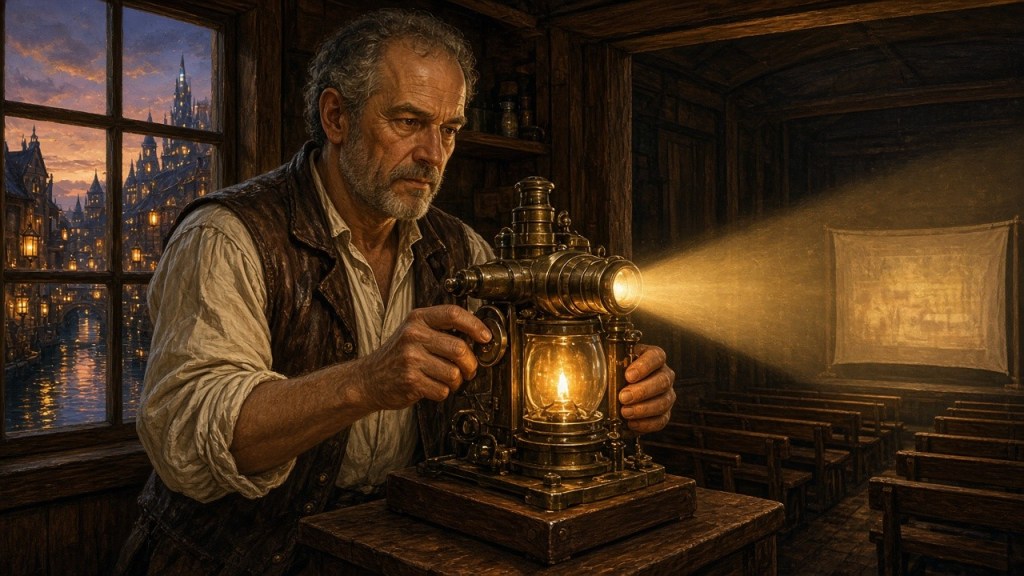
The Gilded Frame sat on Cobble Wharf, two doors down from a net-mender and across the canal from a bake shop that put out honey twists at first light. It was not a large house. Twenty-eight benches. A cloth screen that had been patched twice. A brass lantern in the booth that was older than Harlan and still ran true if you treated it like it mattered.
The boy had a slate and a stub of charcoal and the look of someone who had already been to four other picture-houses that morning. He stood in the aisle with his cap in his hand, waiting until Harlan came down the ladder.
“Len, is it?” Harlan said.
“Yes, sir. Chronicle Tower. We’re putting together a page for the Festival of Ascending Lights. Favorite pictures in the city. Operators and regulars. If you had to name one. The one you’d keep, if you could only keep one.”
Harlan wiped his hands on the cloth. The booth still smelled of hot brass and the sweet oil he used on the plate hinges.
“The Girl Who Kept the Lamp,” he said.
Len wrote it down, then looked up as if he hoped he had heard wrong.
“The old one?” he said. “With the harbor stair?”
“That’s the one.”
“They still run that?”
“Sundays,” Harlan said. “Midafternoon.”
Len’s charcoal hovered. “The new Aethermoor pictures have been drawing well on Silk Street. And there’s a Pyrrhia cycle at the Upper Ward house that people have been lining up for. I thought you might name one of those.”
“You asked what I’d keep,” Harlan said. “That’s what I’d keep.”
He said it without heat. He had run the loud pictures too. He ran them most nights, and he ran them properly, and he was glad when the benches filled. The Aethermoor flying scenes were fine work. The desert pictures made the cloth glow like a forge. He could see that well enough. Neither was the picture he would keep.
Len thanked him and went back out into the canal light, already turning toward the next house on his list. Harlan climbed back into the booth and finished oiling the hinges.
The plate for that night’s picture was a Mechanicus adventure, all clockwork streets and a chase across a thinking bridge. The glass was clean. The colors were still deep. He set it in the rack and trimmed the wick down to a short, even crown, just as his first operator had shown him thirty years ago.
“Short enough to be steady,” the old man had said. “Long enough to last the last scene. Don’t get greedy with the flame.”
Harlan still heard it when he struck the match.
That evening the house filled. A new picture had been up on the board for three days, and that usually did it. Couples. A knot of apprentices from the Artificer’s Quarter. Two older women who came every Thursday no matter what was playing. Harlan took the tickets himself, since Nedda, who usually sat the stool, had gone upriver to see her sister.
“Is it the flying one?” a girl asked, holding her coin out with both hands.
“Not tonight,” Harlan said. “Tonight it’s the clockwork city. The flying one is Saturday.”
She looked briefly disappointed, then went in anyway, which was how most of those conversations ended.
He dimmed the house lamps. He lit the lantern. The first plate caught, and the cloth took the light, and the city on the screen began to move. From the booth it was all work. Heat on his knuckles. The faint tick of the advance wheel. A plate that wanted to stick on the third change, which he eased with a thumb and a little more oil.
He did not watch the picture so much as keep it. That was the job. If the light held and the plates changed on time and no one in the back row talked over the quiet parts, he had done it right.
When it was over he brought the house lamps up slow, so the room would not feel like it had been dropped. People stood and stretched and argued, friendly, about whether the thinking bridge had been a trick or a true working. Harlan collected the coins from the tin, swept the aisle, and carried the plates back to their felt-lined box.
Only then, when the last of the apprentices had gone laughing out onto the wharf, did he take the other box down from the high shelf.
The wood was darker than the new ones. The latch was a simple hook. Inside, the plates for The Girl Who Kept the Lamp lay in their old order, each one labeled in a hand that was not his. The seventh plate had a hairline crack through the upper corner. When the lamp on the stair flared in that scene, the light on the cloth stuttered once, like a held breath.
He had meant, for years, to have a picture-wright pour a new plate from the old. He had never done it. The stutter had become part of the thing, and he was superstitious about parts like that, though he would not have used that word if asked.
He closed the box and set it on the bench for morning.
Harlan had been eleven the first winter his mother started taking him on Sundays.
His father worked the barge line on the Luminescent River and was gone more weeks than he was home. The work took him, and there was no unkindness in that, only the job. The house on the back lane stayed quiet those weeks, and the quiet got into everything, even the soup. Ada Cassel was not a woman who filled quiet with talk. She filled it with tasks. Mending. Bread. A walk when the rooms got too small.
One Sunday she put his coat on him and said, “Come on. We’re going to see a picture.”
The Gilded Frame had a different operator then, a thin man with stained cuffs who sold them two seats in the third row for a coin and a half. The house was warmer than the lane. It smelled of oil and wet wool and the orange peel someone had dropped under a bench. Harlan sat with his cap in his lap and tried not to kick the seat in front of him.
Then the cloth lit, and the girl came out of the little stone house at the edge of the harbor, and she climbed the lamp-stair with a can of oil in one hand and her skirt held clear of the steps with the other.
It was not a long picture. There was a storm. There were boats that should not have been out. The wick in the harbor lamp kept going dark, and the girl kept climbing back up to feed it, her hair flat to her head with rain. Once she fell on the stair and the oil can rang against the iron, and a woman two rows up made a sound like she had been hit herself. The girl got up. She lit the lamp again.
In the last scene the boats came in under that shaky light, one after another, and the girl’s father was on the third one. She did not run. She stood at the foot of the stair with the empty can and waited until he reached her, and then she leaned her forehead against his coat and stayed there.
Harlan’s mother did not cry. She watched without looking away, same as she watched a kettle. When the house lamps came up she sat a moment longer than the people around them, then put her hand on Harlan’s shoulder and they went out into the cold.
If she had a coin left, she bought him a honey twist from the bake shop across the canal. If she didn’t, they walked home anyway, and she said the air was good for them, which was true enough.
They went back the next Sunday. And the one after that. The picture changed some weeks, but when The Girl Who Kept the Lamp was up, that was the week they did not miss. His mother never said why. Harlan did not ask. He came to know the plates by heart. The fall on the stair. The stutter in the lamp, even then. The third boat.
His father came home in the spring and stayed three weeks, and they did not go to the picture-house those Sundays because there was a man in the house again and the quiet had somewhere else to go. When the barges took him back, the Sunday walk returned, as if it had only been waiting in the coat by the door.
Ada Cassel died in a fever year when Harlan was thirty-two. He was already working at the Frame by then, hired on to carry plates and sweep and learn the wick. She had come to a Tuesday showing once, late in her life, and sat in the last row, and afterward she told him the booth looked like honest work. That was as close as she came to a speech.
He bought the house from the old operator eight years later, with money he had put aside a little at a time and a loan from a lender on the Merchant Quarter who liked pictures and did not mind being paid on a slow schedule. The benches were the same. The screen had not yet been patched the first time. The old box was already on the high shelf.
“You can retire that one,” the old operator had said, tapping the lid. “Nobody asks for it but the older folk, and even they ask less.”
Harlan had nodded, and left it on the shelf, and the first Sunday he held the keys in his own name he ran it anyway.
Fourteen people came. He counted them from the booth. It was enough to light the wick.
Sunday came in clear and cold, the kind of canal morning that put a skin of brightness on the water and made the Crystal Spires look sharper than they were. Harlan got to the house early. He swept. He wiped the benches. He hung the small board out on the hook:
THE GIRL WHO KEPT THE LAMP Sunday, midafternoon One showing
A man walking a dog read it and smiled as if he had been reminded of a cousin. He did not come back for the showing, but the smile was something.
Before Harlan lit the lantern he stood a moment in the booth with his hand on the brass and his head down.
“God,” he said, quiet, when he said it at all, “let the light hold.”
He had no further remarks for the ceiling. He struck the match.
They trickled in. The two Thursday women, in different coats. A bargeman with his cap pulled low, who paid with a worn coin and took the end of the first bench. A young couple who looked as if they had come in to get out of the wind and then stayed when they saw there was a picture. Seven, eight, nine.
Then, late, a woman with a boy about ten, the boy already arguing with the door, as boys did when they had been promised something else. She bought two seats and guided him to the third row, Harlan’s old row, and got him sitting with a patience that looked practiced.
Harlan dimmed the lamps.
The first plate caught. The little stone house. The harbor. The girl coming out with the can.
From the booth he could see the boy’s knees stop bouncing about the time she reached the third turning of the stair. The woman set her hand on the back of the seat in front of her and left it there.
The storm came. The boats should not have been out. The lamp went dark, and the girl climbed, and the oil can rang on the iron, and the woman two benches up (one of the Thursday women, it was always one of them) made the same small sound. The girl got up. She lit it again.
On the seventh plate the harbor light stuttered, same as it had for forty years. Harlan’s thumb was already on the wheel, ready if the crack decided this was the day it would go. It did not go. The light held, shaky, and the boats started in.
He watched the third boat. He always did. He could have timed the whole picture by his pulse, and still he watched the third boat.
The girl stood at the foot of the stair with the empty can. She did not run. Her father reached her. She leaned her forehead against his coat and stayed there.
In the third row the boy had gone still. The woman did not look at Harlan, and Harlan did not look at her for long. He brought the house lamps up slow.
People stood in the ordinary way. The bargeman nodded once toward the booth, a small nod, and went out into the afternoon. The Thursday women folded a scarf and talked about soup. The young couple left holding hands, which they had not been doing when they came in, though Harlan would not have sworn to that in either direction.
The woman in the third row helped her boy into his coat. At the door the boy turned around and looked at the blank cloth as if some part of the harbor might still be on it. Then he went out, and she went with him, and the door settled in the frame.
Harlan let the lantern cool. He boxed the plates in their old order and set the box back on the high shelf, hook latch turned. He swept the aisle. He took the board in off the hook so the wind would not work the nail.
Across the canal the bake shop was still open. He stood on the wharf a minute with the canal moving under the planks and the Spires taking on their late color. He thought about a honey twist and then bought one, because he had the coin and the air was cold, and because some walks home were better with something in your hand.
He ate it on the way up the lane. He did not name what he had kept. He already knew. The house would be there tomorrow, and Saturday he would run the flying picture, and the benches would fill, and that would be right too.
Sunday, midafternoon, he would take the old box down again.
☕ Enjoyed this story? Writing Lumenvale is how I pay my bills. If these stories are worth something to you, a $1 Ko-fi keeps the forge burning — and tells me this world is worth continuing. 👉 Buy Chadwick a coffee
👈 Previous Story: Missed the last tale from Lumenvale? Catch up now — Read The Case That Never Closed
A First Light in Lumenvale
Three free stories from Lumenvale — yours when you join the newsletter. No spam, and you can unsubscribe anytime.
New chapters every Monday — get them free by email
📅 Chronicles of the Giantess returns Monday, November 23, with a new chapter every Monday. Subscribe free and new chapters and stories come straight to your inbox.
New here? Start Here → · More Lumenvale stories · All series


Leave a Reply