The Letters Set Backward
A Story from Lumenvale
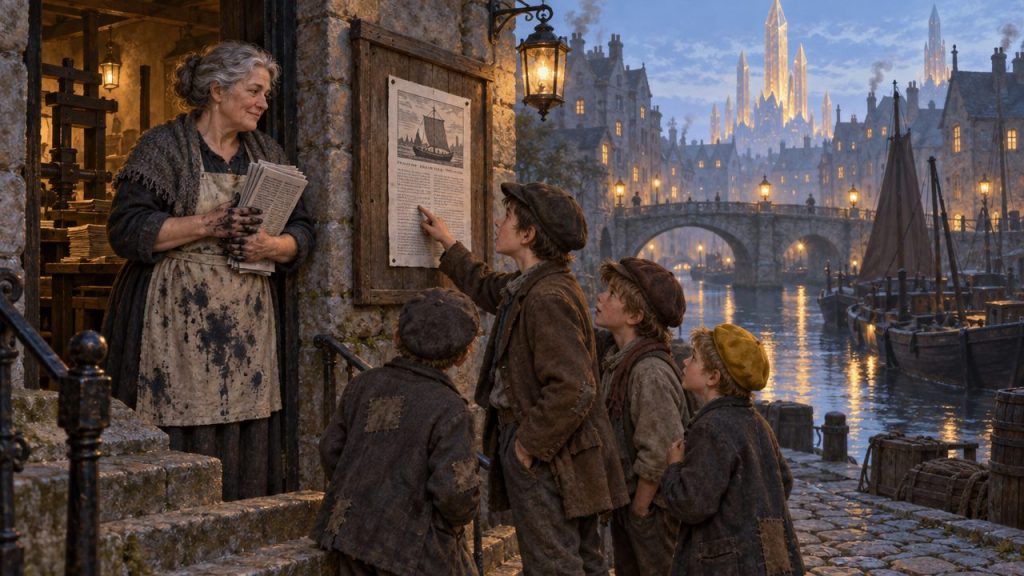
Agnes Rudd had printed the Wharf Leaf in the same cellar on Ropewalk Lane for twenty-six years. On the first cold morning of the winter she climbed the cellar steps at noon and counted the copies still hanging on the hook.
Thirty-one. She had printed forty.
The hook hung by the cellar door under a little slate roof Walt had built the year they married. Folk took a Leaf and dropped a copper in the box. There were nine coppers in the box. Down at the corner of Cobble Wharf, three boys in yellow caps were shouting the Spire Crier, and their satchels were already empty.
“SEA SERPENT SEEN IN THE THIRD CANAL!” the smallest one yelled. “GHOST OF THE OLD LOCKMASTER WALKS AGAIN!”
There was no serpent in the Third Canal. Agnes had walked along it at dawn. There were two ducks and a drowned boot.
The Crier was printed on the far side of the Spires in glow-ink, a pale green that shone in the dark for a day and then faded out. People bought it to read in bed without lighting a candle. By the next evening it was blank paper, and they used it to start their stoves. Agnes thought that was the most honest thing about it.
Her Leaf was black ink on gray paper. One sheet, front and back. Lock times, barges due and where from, the grain hall prices, lost and found, births and burials. Walt used to say a bargeman needed to know when the Ninth Lock opened a lot more than he needed a serpent.
Walt had been gone four years. Bargemen still needed the lock times. They just read them off the chalkboard at the lock house now, for free.
On Monday Mr. Fenwick from the paper yard had come by about the winter ream. He was sorry. Mr. Fenwick was always sorry. He could not carry her account past the new year. Agnes had done the sums that night at the kitchen table. Sixty copies a day would pay for paper and ink, with a little left over for coal. Thirty-one would not.
She took the board copy down to replace it. Every morning she pasted one Leaf on the board beside the hook, free, for anybody who couldn’t spare a copper. That was Walt’s rule too. She was starting to wonder how many of her readers were reading it off the board.
The boy was there again.
He had been there every morning for two weeks. He was eleven or twelve, thin, with tar on his hands and shiny burn scars across both palms where the hemp ran through them. A ropewalk boy. He stood in front of the board copy with his hands jammed in his armpits for warmth and stared at it. He stood there a good while. Then he went off. He had never once put a copper in the box.
Agnes had decided on the third morning that she didn’t care for him.
“You’ll wear the ink off,” she said.
He jumped. “Sorry, missus.”
“What’s so good in it today?”
He looked at the Leaf. He looked at her. “The barge,” he said.
At the top of every Leaf was a woodcut of a barge under sail. Walt had carved it their first year. It was a good carving, but it was the same barge every day.
“What about the barge?”
“It’s a good barge,” the boy said, and he went down the lane at a trot toward the ropewalk.
Agnes stood there holding thirty-one Leaves. Then she went down into the cellar, sat on the stool by the press, and thought about the last two weeks of mornings. She had watched him a lot, mostly out of spite.
A reader’s eyes went across the line and dropped and went across again. His eyes never moved. They stayed on the barge.
That night she tried to write a headline.
She sat at the type case with a lamp and a composing stick, and she set it in the big wooden letters Walt kept for fair days: WHAT LURKS UNDER THE SILK STREET BRIDGE?
Nothing lurked under the Silk Street Bridge. Old Hennick fished there on Saturdays and fell asleep. Agnes looked at the line in the stick. In a printing shop everything was set backward, so it came out right on the paper, and she had read backward type so long she didn’t notice it anymore. Tonight she noticed. The question mark was turned the wrong way, and it looked like a hook.
She sat there until the lamp needed trimming.
Walt used to say a prayer before every run, with his hand flat on the bed of the press. It was the same prayer every time. Lord, let it be true, and let somebody read it. She had kept saying it after he died. Lately she had been saying the second half louder.
She took the letters out of the stick one at a time and put each one back in its box.
Then she sat a while longer and thought about ropewalk boys. They started on the walk at eight years old and worked from the seventh bell till dark. Nobody taught them letters. Nobody had taught Agnes either, until she was nineteen and a skinny printer’s son on Ropewalk Lane offered to show her, using the type case. She had married him two years later. She still wasn’t sure which had been his plan.
In the morning she waited at the board with her shawl on.
He came at the usual time. When he saw her he slowed down, and she thought he might turn around.
“What’s your name?” she said.
“Jory, missus. Jory Coombs.”
“You can’t read it, can you, Jory Coombs.”
His ears went red. He looked at the board. He looked down the lane. Then he lifted his chin, and she liked him a little better.
“I can read the numbers,” he said. “Some.”
“Why do you come and stand here, then?”
He shrugged. “Everybody else stands here.”
That stopped her. She didn’t say anything for a bit. Down at the corner a Crier boy was shouting about the lockmaster’s ghost again.
“I need a pair of hands,” Agnes said. “Somebody to ink the forme and fold the sheets. An hour before your shift. I can’t pay you.”
“Then why would I…”
“I’ll teach you your letters.”
Jory looked at the burns on his palms. “I don’t need letters to twist rope.”
“No,” Agnes said. “What would you read, if you could read?”
He thought about it. She could see him deciding whether to tell the truth.
“Something with a fight in it,” he said. “Like what the bargemen tell. About the Night Barge. And Big Ollie Brannock that threw two smugglers in the Ninth Lock with his bare hands.”
“That’s a tall tale.”
“So’s the serpent,” Jory said.
Agnes opened her mouth and shut it again.
“Seventh bell’s at the ropewalk,” she said. “Be here at the sixth.”
He came at the sixth bell the next day, and the day after that.
She started him on the type case. The case was a big shallow drawer full of little boxes, a box for every letter, and the lead letters were cast backward on the ends of small square bars. Jory held one up to the lamp and frowned.
“It’s wrong.”
“It’s backward. It comes out the right way on the paper. That’s an R.”
“How’s anybody supposed to learn it backward?”
“You learn it both ways,” Agnes said. “Walt said that makes you twice as smart as anybody else.”
He mixed up the b’s and d’s for a week. He mixed up the p’s and q’s for longer. When Agnes told him that was where the old saying came from, mind your p’s and q’s, he laughed so hard he had to sit down on the coal box. She hadn’t heard anybody laugh in the cellar since Walt.
His hands were the surprise. They were quick and sure, and they didn’t fumble the small type. He could feel the nick on the side of each letter in the dark, which took most apprentices a year. Agnes figured you didn’t run hemp for four years without learning what your fingers were for.
On the third morning he asked where the privy was. She told him out the back door and over the little bridge, and to watch the latch, which stuck.
He was gone a while. When he came back his face was pink and he was grinning.
“There’s words on the door,” he said.
Agnes had painted them herself, years ago, after a bargeman locked himself in for half a morning. She waited.
“Mind,” Jory said. He held up one finger and then another. “The. Latch.”
She looked at him.
“I read it,” he said. “Missus Rudd. I read the privy door.”
“Well,” said Agnes, and she had to go and look at the press for a bit, and adjust a screw that didn’t need it.
The Leaf had always had a little empty space at the bottom of the back side, after the burials. Walt used to fill it with a verse from Scripture, or a recipe, or a joke about the Lockmasters’ Guild that got him in trouble.
Agnes went down to Cobble Wharf on her free afternoon and bought three bargemen a pint of cider apiece at the Tar Barrel. She asked them about Big Ollie Brannock and the Night Barge. She wrote down everything they said in a notebook. They all said different things. One of them said Ollie was seven feet tall. One said six. One said he had known Ollie’s cousin, and Ollie was about Agnes’s height but very broad.
She went home and wrote it in the plainest words she knew. Short lines. Words a boy could sound out with his finger under them. At the top she set:
BIG OLLIE AND THE NIGHT BARGE. PART ONE.
As told by men who were there, and some who say they were.
She looked at that second line a long time. Then she left it in. It was true.
Part One ended with Ollie on the lock gate in the dark, and the smugglers’ barge coming in with no lantern lit.
She let Jory pull the first sheet. He put his weight on the bar like she had shown him, and the platen came down, and he peeled the sheet off the type and held it up to the lamp. His lips moved.
“Big,” he read. “Ollie. And. The.”
“Night,” Agnes said.
“I know it. I was getting there.”
She said Walt’s prayer with her hand on the bed of the press. When she finished, Jory said “Amen” without anybody asking him to. Then he looked embarrassed about it.
He didn’t go straight to the ropewalk that morning. He stood at the board with his finger under the bottom of the back side, and he read Part One out loud. He read it slowly and he got stuck on smugglers, and Agnes stood in the cellar door and did not help him.
Two other ropewalk boys stopped to see what he was doing. Their names were Wat and Hob. Hob was small, nine at the most. They stood on either side of him. When Jory got to the end, where the barge came in with no lantern, Wat said, “Then what?”
“It’s done,” Jory said. “That’s all there is.”
“That’s not done. He’s on the gate.”
“Part Two’s tomorrow,” Agnes said from the doorway, and all three of them turned around.
The next morning there were five boys. On the fourth morning there were eight, and one of them had a yellow cap. He was the smallest Crier boy, the one who yelled about the serpent. He stood at the back. When Jory came to lockmaster he mouthed it along with him, and Agnes understood. He had been shouting words all month that he’d only ever learned by ear.
She didn’t say anything to him. She put a Leaf aside for him every morning after that, folded small enough to go in a pocket.
On the second Monday a bargeman came up Ropewalk Lane with a Leaf in his fist. He was a big man with a gray beard and a voice that carried.
“It was two smugglers,” he said. “Not three. And the barge had a lantern, it just wasn’t lit.”
“Were you there?” Agnes said.
“I was on the other side of the lock.”
She wrote it down. In Part Five she put a line at the top: Corrected. Two smugglers, says Bargemaster Tedd Harrow, who was on the other side of the lock. Tedd Harrow bought eleven copies to give his crew, and two of the crew bought their own anyway to see if their names were in it.
By the end of the month Agnes was printing sixty Leaves, and the hook was empty most days by the ninth bell. She started printing seventy. The bargemen read the lock times again, because the lock times were on the front and Ollie was on the back and you had to turn the sheet over to get to him.
Mr. Fenwick came by about the ream. He stood in the cellar holding his hat.
“Your orders are up,” he said. “I can carry the account through spring.” Then he looked at the press. “Mrs. Rudd. My wife wants to know if Ollie gets out of the lock.”
“Tuesday,” Agnes said.
“She’ll want to know before Tuesday.”
“Everybody wants to know before Tuesday,” Agnes said, and Mr. Fenwick went away with a Leaf and without an answer.
The last part of Big Ollie ran on the morning of the first snow.
Jory had set most of it himself. He could set type faster than she could now, though he still slowed down on q’s. When the forme was locked up and inked, he asked her if he could put one more line at the very bottom. She said there wasn’t room. He said it was a short line.
She let him.
They pulled the first sheet together. Jory held it up to the lamp, and Agnes found the bottom line, under THE END, in the smallest type in the case.
Set by J. Coombs.
“Is that all right?” he said.
Agnes didn’t answer right away. She looked at it backward in the forme, and then the right way round on the paper. Walt used to put W. Rudd, Printer in that same place, when there was room.
“It’s spelled right,” she said.
She put her hand on the bed of the press and said the prayer, and Jory said Amen at the end, and this time he didn’t look embarrassed.
When the run was done he went up the steps first. She heard him stop at the top. She came up behind him, slowly, with her knees complaining, and saw what he was looking at.
There were fourteen boys at the board. Some had tar on their hands and some had flour, and the little one at the back had a yellow cap. Two bargemen were waiting behind them, pretending they weren’t.
“Go on,” Agnes said. “They’re waiting on you.”
Jory went to the board and put his finger under the first line. He read it out loud, slow and clear, and nobody hurried him.
Agnes stood in the cellar door with ink on her hands. She left the hook alone. She did not count it.
☕ Enjoyed this story? Writing Lumenvale is how I pay my bills. If these stories are worth something to you, a $1 Ko-fi keeps the forge burning — and tells me this world is worth continuing. 👉 Buy Chadwick a coffee
👈 Previous Story: Missed the last tale from Lumenvale? Catch up now — Read The Two Names She Needed
📖 Read next: An old craftsman and the apprentice who learns his trade in The Last Hour of the Forge. Or browse every free story in Lantern & Shadow: Stories from Lumenvale.
A First Light in Lumenvale
Three free stories from Lumenvale — yours when you join the newsletter. No spam, and you can unsubscribe anytime.
New chapters every Monday, Wednesday, and Friday — get them free by email
📅 Chronicles of the Giantess has new chapters every Monday, Wednesday, and Friday. Subscribe free and new chapters and stories come straight to your inbox.
New here? Start Here → · More Lumenvale stories · All series


Leave a Reply