


The Wind That Almost Took Him
A Story from Lumenvale
The old man’s name was Solan, and he had been telling this story for forty years.
Not performing it — that was an important distinction, one he made to himself each time the occasion arose. Performing implied an audience assembled for the purpose. What Solan did was different. He told the story when someone earned it. When a young person sat across from him with that particular quality of attention that meant they were standing at the edge of something and needed to know what the edge felt like before they stepped off.
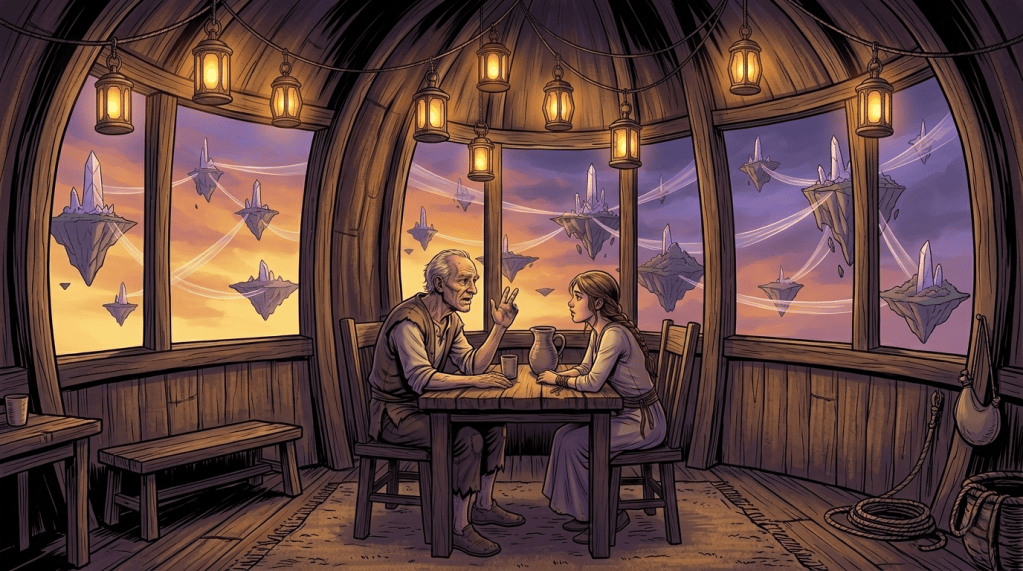
The girl across from him now — Wren, her name was, seventeen years old with her mother’s eyes and her father’s stubbornness and the wind-reader’s cord newly tied at her wrist — had that quality in abundance.
“You said you flew the Shear,” she said. Not a question. An accusation, almost. As if she had been told something impossible and was waiting for him to either confirm it or be reduced in her estimation.
The Shear was what Aethermoorians called the atmospheric boundary between the mid-level drift currents and the high-altitude streams that served the Crown Isles. In good conditions it was turbulent and difficult and required a wind-bridge certified for upper-atmosphere transit or, if you were foolish and young and had run out of other options, a pair of the old-style extended sail-wings that the current generation had largely abandoned in favor of more sensible conveyances.
“I flew the Shear,” Solan said. “Once.”
Wren leaned forward across the table. The wind-lanterns of his dwelling swayed on their cords — they were docked at mid-elevation tonight, the Isle of Crestholm making its slow passage through the amber reaches, the sky outside the windows a deep violet streaked with the last of the day’s gold. “How old were you?”
“Nineteen.” He paused. “Which I mention not to impress you but to explain the decision-making capacity involved.”
She almost smiled at that. Almost.
He settled back in his chair and let the memory come the way he had learned to let it come — not dragged forward, not pushed down, just allowed. Forty years was long enough that the fear had drained out of it. What remained was the shape of the thing. The particular quality of that morning.
He had been nineteen and employed as a runner for the Merchant’s Collective, which meant carrying lightweight parcels between the floating isles on whatever transit was available. The work was beneath his ambitions and suited to his actual qualifications, which at nineteen were modest. He knew the currents. He knew the bridges. He knew how to move fast on the drift-lines without drawing the attention of the sky-wardens who managed air traffic between the major isles.
What he had not known, that particular morning, was that the parcel he was carrying contained documents related to a contract dispute between two families whose animosity predated his birth by three generations.
He had not known this until he was halfway across the mid-level bridge between Crestholm and the Merchant’s Isle and a man in grey robes appeared at the far end of the bridge and made it very clear that the documents were not going to arrive.
Solan had stopped. Done the calculation. The bridge behind him was a twelve-minute run back to Crestholm. The man in grey robes was a four-second walk from where he stood. The bridge below him was the kind that hummed at middle altitude — a comfortable C-sharp, the wind-readers called it — suspended over nothing for three hundred meters in every direction.
Except up.
Above the mid-level bridge, the Shear rolled and churned in the morning light, visible as a line of compressed turbulence where the warm lower currents met the cold upper streams. No sane person crossed the Shear outside of a certified transit vessel. The sail-wings he was carrying — old equipment, issued to him as backup transit — were rated for mid-level use only.
“I looked up,” he told Wren. “That’s all it was, at first. I just looked up at the Shear and thought — if I can get above it, the upper-stream runs directly over Thornhold’s dock, and Thornhold’s dock is where the documents were meant to go, and the man in grey robes was not going to follow me through the Shear in his formal robes.”
Wren was very still across the table. “The old sail-wings aren’t rated for the Shear.”
“No. They are not.”
“What did the Shear do to them?”
He held up his left hand. The last two fingers were shorter than they should be — not missing, just truncated, ended abruptly at the second joint in a way that looked like a sculptor’s error.
“Frostbite,” he said. “From the cold-stream air at the top of the Shear. I lost the grip on the left wing-frame and went into a half-spiral that took me about three hundred meters sideways before I corrected.” He lowered his hand. “The sail-wings held. They should not have held, by any reasonable reading of their specifications. But they held.”
Wren stared at the hand. “And the documents?”
“Delivered. Three minutes ahead of the agreed time, in fact, which is a detail I remain irrationally proud of.”
“And the man in grey robes?”
“Filed a complaint with the Merchant’s Collective. I was fined a week’s pay for using equipment outside its rated parameters.” He paused. “And promoted, which I have always found to be a reasonable summary of how risk tends to resolve.”
Wren was quiet for a moment. The Isle of Crestholm shifted slightly on its drift-current, the kind of small adjustment that ground-dwellers would have noticed as a tremor and that Aethermoorians felt only as a change in the quality of the air — a tightening, a soft rotation of the world underfoot.
“Were you afraid?” she asked.
This was always the question. Forty years and it was always this question.
“I was afraid before,” Solan said. “While I was still deciding. The moment I started moving I wasn’t afraid anymore, which I don’t say to sound brave — I say it because I think that’s simply what happens when you commit to something. The fear lives in the decision. Once the decision is made, there’s only the doing.”
He looked at the wind-reader’s cord at her wrist. New-tied, the fibers still bright, the knot still holding its careful formation rather than the settled ease it would develop after months of wear.
“You’ve been assigned to the Shear transit program,” he said.
It wasn’t a question either. He had known since her mother had asked him to speak with her. The Shear transit program was voluntary, which in Aethermoor meant that only the young and the skilled and the foolish applied, and that the combination of all three was what kept the Crown Isles connected to the rest of the world.
Wren’s jaw was set. “I haven’t decided yet.”
“You’ve decided,” he said, not unkindly. “You’re here asking a seventy-three-year-old man with two shortened fingers about the Shear because you’ve decided and you want someone to tell you the deciding was sound.”
Her chin came up at that — her father’s stubbornness, unmistakably.
“Was it?” she asked. “Sound?”
He thought about the sail-wings and the cold-stream air and the three hundred meters of sideways spiral and the documents delivered three minutes early and the two fingers and the promotion and the forty years since that had included everything a life contained — the good years and the hard ones and the ordinary ones, which were the most numerous and in retrospect the most precious.
“It was mine,” he said. “That’s what I can tell you. I made it with the information I had and the options in front of me, and I’ve lived with it in both directions — the shortened fingers and everything else.”
He stood, slower than he used to, and went to the window. The amber sky had deepened toward violet, and somewhere above them, invisible from this altitude, the Shear rolled and churned and separated the world into the levels it had always occupied.
“The fear lives in the deciding,” he said again. “After that it’s just wind.”
Wren sat with this for a long time.
When she finally left, walking out into the evening drift-current with the wind-reader’s cord new at her wrist and her father’s jaw and her mother’s eyes, Solan watched her go and did not call after her.
She had what she needed.
The rest was hers to find out.
☕ Enjoyed this story? Writing Lumenvale is how I pay my bills. If these stories are worth something to you, a $1 Ko-fi keeps the forge burning — and tells me this world is worth continuing. 👉 Buy Chadwick a coffee
New chapters every Monday — get them free by email
📅 Chronicles of the Giantess returns Monday, November 23, with a new chapter every Monday. Subscribe free and new chapters and stories come straight to your inbox.
New here? Start Here → · More Lumenvale stories · All series


Leave a Reply