What is one way you have grown this year?
BRECK: Stone’s Rest — Chapter Two
What He Let Himself Need
This is Chapter 2 of BRECK: Stone’s Rest, Book Three of the BRECK series — a serialized noble dark fantasy story by Chadwick Rye. New chapters post daily.
The Story So Far
Breck left Lumenvale for the first time in the series, carrying a referral from Adjudicator Caine about a complaint that doesn’t fit any court’s framework — harm done to a realm of walking mountains by a Lumenvale-chartered mining concession. He’s somewhere past Aldenmere now, on a road that no longer leads back to anything he knows.
← Chapter One: The Distance Between Twenty and Now | 📖 Series Index
Chapter Two: What He Let Himself Need
This chapter asks what’s actually changed in a man over a year — and whether he’s willing to let someone else see it before he’s finished proving it to himself.
The Shifting Plains didn’t so much begin as arrive, the way deep water arrives under a boat that’s stayed in the shallows too long to notice the bottom dropping away. One day the road still had the shape of something built — packed earth, the occasional milestone, hedgerows somebody had once bothered to plant — and the next it was simply grass, an ocean of pale gold running to a horizon so flat and so far that Breck’s eyes, trained on rooflines and alley mouths and the particular geometry of a town that could hide a man, kept finding nothing to settle on and sliding straight through to the edge of the world.
The caravan was eleven wagons and forty-some souls — traders mostly, bound for the wind-ports with bolts of dyed wool and crates of forge-iron, and one very nervous cartographer’s apprentice who kept a logbook he wouldn’t let anyone read. Breck had taken first watch every night since the western gate. He hadn’t decided to. It had simply happened, the way certain things about him always simply happened, his body volunteering for a job before the rest of him had finished weighing whether volunteering was necessary.
The caravan master was a woman called Yarrow, sun-cured the color of old saddle leather, with the kind of economical movements that come from forty years of doing the same dozen tasks in the same order so many times the body’s stopped needing instructions. She ran six scouts and a train twice this size when the season demanded it, and she’d clocked Breck by the second night out — not with suspicion, he didn’t think, but with the particular attention of someone cataloguing a type she’d already formed an opinion about.
On the fourth day she rode back along the line until she was level with him and pointed her chin at a stretch of ground off to the south, a long pale scar where the grass grew thin and wrong, the soil beneath it the color of something that had been turned over and never properly settled back.
“Ground crews,” she said, like the words tasted bad going out. “Working past their survey lines again. Third one of these I’ve seen since spring.” She watched it pass the way you watch a wound on someone else’s body — informed, unsurprised, tired in a way that had stopped being anger a long time ago. “Used to be you’d feel one of them coming through here. Three days out, sometimes more — feet in the ground like far-off thunder, regular as a heartbeat. Whole caravan would stop just to watch the grass move.” She didn’t say more than that. She didn’t need to. Breck filed it the way he filed everything that came to him sideways instead of straight on, a fact without a shape yet, waiting for the rest of the picture to arrive and tell him what it was a piece of.
He took first watch again that night, same as every night, and it was Yarrow herself who came to find him at the edge of the firelight a few hours later instead of sending a scout to relieve him.
“You know there’s six other people on this train paid specifically to do what you’re doing right now,” she said. She didn’t sit. She had the look of a woman who’d decided to say a thing and intended to say it standing, so there’d be no mistaking it for a conversation that invited disagreement. “You’ve taken first watch every night since the gate. Either you don’t trust my people, or you don’t know how to let somebody else carry a piece of a thing that isn’t only yours to carry.”
“It’s not about trust,” Breck said.
“I didn’t say it was. I said pick one.” She nodded toward the dark beyond the firelight, where one of her scouts sat half-asleep on a barrel, plainly unneeded. “That’s Coll. He’s good at this. Better than you, probably — he’s done it longer, and he’s done it on this exact ground, which you haven’t. Sending him to bed because you’d rather not need him isn’t strength. It’s just a different way of being too proud to ask.”
She left it there and walked back toward her own fire, and Breck sat with it the way he’d sat with the letter four nights ago — turning it over before deciding whether it was something that needed answering.
He thought about the year behind him. Not in the way men measured years in songs, by what they’d won or lost, but in the smaller, harder-to-name way — by what had actually moved, under the surface, where the change didn’t announce itself until somebody else pointed at it. A year ago in Crestfall he’d done the work of that town with his own two hands and a twelve-year-old’s map, and when it was finished, it had finished because Breck had carried nearly all of it himself, start to end, the way he’d carried everything for as long as he could remember carrying things at all. In Cold Harbor it had been different, and he hadn’t fully understood until just now, sitting in a firelight a thousand miles from either place, how different. Solt hadn’t gone down because Breck broke him. He’d gone down because a widow’s testimony and a registrar’s twenty-two years of honest records and an old clerk’s memory had all arrived in the same room at the same time, and Breck’s part in it had been smaller than he was used to his parts being — important, but not singular. He had let other hands finish something he couldn’t have finished alone, and at the time it had felt like failure, like the job slipping out from under him. He understood now, watching Coll dozing uselessly on his barrel because Breck couldn’t make himself need him, that it hadn’t been failure at all. It had been the first time in longer than he could account for that he’d let a thing be bigger than what he, personally, was capable of holding.
That was the growth, if a man like him was going to call anything by that word. Not patience, not gentleness — he didn’t think he’d gotten meaningfully better at either of those. Just the slow, grinding admission that doing everything himself wasn’t strength so much as a way of refusing to need anyone, and that refusing to need anyone, carried far enough, was its own particular kind of cowardice dressed up as toughness. He’d spent a long time mistaking the two for the same thing.
He got up, walked the dozen yards to where Coll sat blinking against sleep, and told him to take the watch.
Coll looked at him like he’d been asked to do something suspicious. “You sure?”
“Wake me if the ground does anything you don’t like the look of,” Breck said, and went to find his bedroll, and didn’t watch to see whether the boy managed it fine without him. He suspected he would.
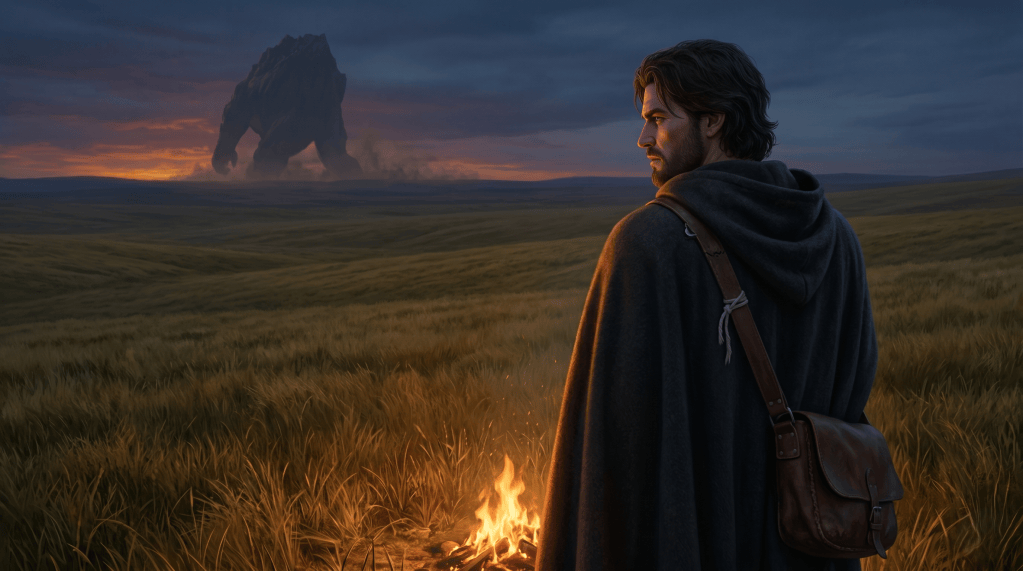
It was two evenings later, with the grass gone the color of old brass under a low sun, that the cartographer’s apprentice stood up so fast in the lead wagon that he nearly went over the side, pointing at the western horizon and saying something none of the traders quite caught the first time he said it. Breck looked where the boy was pointing and saw, at first, nothing — a low irregularity on the skyline that could have been a distant ridge, could have been weather building. Then it moved. Not fast. Slower than anything that size had any right to move, a shift in the horizon line so gradual that if he hadn’t been watching the exact spot in the exact moment, he’d have sworn the land itself had simply always looked that way.
Half the caravan was on its feet by the time the shape had resolved enough to be unmistakably what it was, voices rising into something between awe and disbelief, the apprentice scribbling so fast his hand could barely keep pace with what his eyes were trying to hold onto. Yarrow didn’t stand. She’d seen it before, plainly, more times than this crew combined. But even she watched it a beat longer than strictly necessary.
Breck watched it the way he watched everything — flat, careful, cataloguing — and felt something move under that flatness anyway, some old unused chamber of himself opening half a degree, the way it hadn’t in longer than he could account for either. He didn’t reach for words for it. He just kept watching until the light went and the shape dissolved back into ordinary darkness, and then he sat back down by the fire Coll was tending competently without him, and let somebody else’s watch be enough for one more night.
← Chapter One: The Distance Between Twenty and Now | 📖 Series Index
BRECK: Stone’s Rest is a serialized noble dark fantasy story by Chadwick Rye — Book Three of the BRECK series, crossing from Lumenvale into Nomados. Chapter 2 of 20. The full book is coming soon to Amazon and Kindle Unlimited.
✦ Enjoyed this chapter? “What He Let Himself Need” continues Book Three of the BRECK series — noble dark fantasy, a courier learning, slowly and against his own grain, that some weight was never meant to be carried alone. Browse the full series, subscribe for new stories, or share this with a reader who’s still working on that same lesson.
Keep reading BRECK: Stone’s Rest
Chapters 1 and 2 are free here. The complete book is coming soon to Amazon and Kindle Unlimited; watch the Books page for the release. New to BRECK? Book One, BRECK: Dead Delivery, is out now.
Want to hear when new books and stories go up? Subscribe free below.
📖 BRECK Series — all chapters in order
Never miss a chapter. Get each new chapter by email the day it posts.
☕ Enjoyed this story? Writing Lumenvale is how I pay my bills. If these stories are worth something to you, a $1 Ko-fi keeps the forge burning — and tells me this world is worth continuing. 👉 Buy Chadwick a coffee


Leave a Reply