
The Right Questions


BRECK: Cold Harbor — Chapter One
The Right Questions
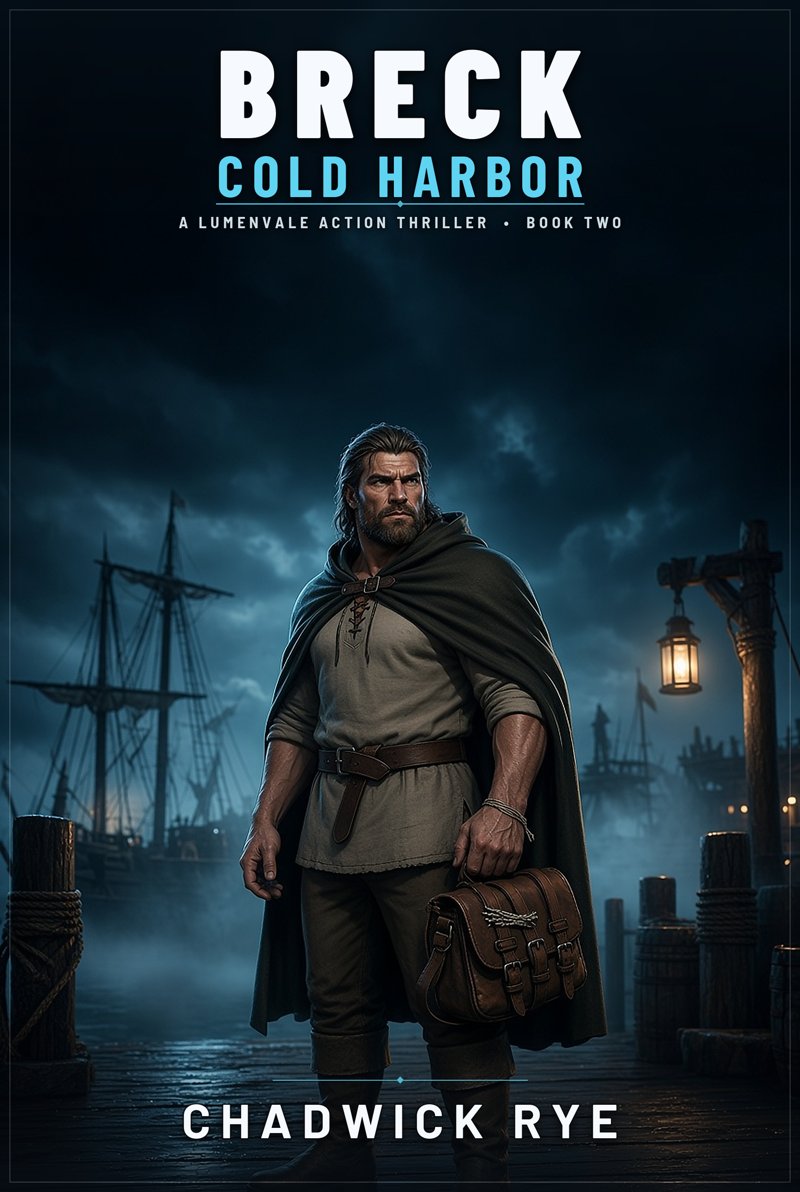
This is Chapter 1 of BRECK: Cold Harbor, Book Two of the BRECK series — a serialized noble dark fantasy story by Chadwick Rye, set in the world of Lumenvale. New chapters post daily.
The Story So Far
BRECK is a veteran courier — 6’5″, 285 pounds, former Crystal Wars special operations — who cannot walk past certain things. In Book One (Dead Delivery), he passed through Crestfall and quietly dismantled a corrupt magistrate’s grip on a river town: gathering evidence, identifying allies, moving at night, leaving a twelve-year-old boy and a widow’s testimony to finish what he started. He didn’t stay to watch it resolved. He picked up the next delivery.
On the road out, Regional Adjudicator Harvel Caine sent him a letter asking if there are other towns in the valley where what he did in Crestfall needs doing. Breck filed it in his document sleeve and kept riding.
Book One: Dead Delivery → | Chapter Two →
Chapter One: The Right Questions
This chapter asks what questions a man carries — and whether he’s willing to find out what the answers cost.
Cold Harbor smelled like salt and old rope and something underneath both of those things that Breck couldn’t name for the first hour and then could: the faint sweet-rot of fish that hadn’t been gutted fast enough, baked into the dock pilings over decades until it was part of the wood itself. Not a bad smell, particularly. Just an honest one. The town had been processing fish long enough that the smell had stopped being a smell and become a fact.
He came in off the coastal road at late afternoon, the light going amber and flat over the water. The harbor itself was active — three vessels at anchor, a fourth being worked at the eastern dock, men moving cargo in the methodical way of men whose bodies had done it long enough to stop asking their minds for help. A salvage crane stood at the far end of the pier, its arm extended over the water, new iron fittings catching what was left of the sun.
Breck noted the crane. Noted the new fittings.
He had a delivery for the harbormaster — a sealed document from a merchant house in Aldenmere, folded twice and pressed with green wax, addressed to one Lomas Tett. Standard commercial correspondence. Two days’ travel. He’d be gone by morning.
He found the inn by following the smell of woodsmoke and the sound of voices that had stopped being careful, which was how you found inns in working port towns once the afternoon shift turned over. The Anchor’s Rest. The sign was newer than the building. He filed that away without meaning to and went inside.
The common room was half full. He ordered hot food and something to drink that wasn’t water and took the table in the far corner with a wall at his back and a clear line to the door, which wasn’t calculation so much as habit that had long since stopped requiring thought.
He’d been eating for perhaps ten minutes when the old man sat down across from him.
Not asking. Not announcing. Just arriving, the way old men in port towns sometimes did — as though social permissions were a concept that applied to other people and had simply never made the journey to wherever he was standing.
“You came in off the Aldenmere road,” the old man said. He was perhaps sixty-five, perhaps more, with white hair gone yellowish at the temples and the particular economy of movement that belonged to men who had been thin for a long time. He had a cup of something already in his hand. “You didn’t come off a boat. Sailors don’t walk like that.”
“Like what,” Breck said.
“Like the ground might not be there.” The old man settled in. “Sailors always walk like the ground might not be there. You walk like it always is.”
Breck ate.
The old man seemed to take this as sufficient encouragement. “I’ve been thinking today,” he said, “about a question I ask every traveler who’ll tolerate me long enough to answer it. If you could sit down to a meal with any man who ever lived — any philosopher, any scholar, any strategist — who would it be?”
Breck considered it. Not for long. “A man named Durren Ash.”
The old man’s eyes moved with something that wasn’t quite recognition and wasn’t quite its opposite. “I don’t know that name.”
“He was a signals officer. Third Karithian advance.” Breck took a drink. “Spent four years running information through occupied territory. Never wrote anything down. Said the only ideas worth keeping were the ones worth memorizing.”
“And you’d want to sit down to eat with him.”
“I’d want to ask him something.”
“What?”
Breck looked at him steadily. “Whether he figured it out. What you do with what you know when the people who need to know it aren’t in a position to do anything about it.”
The old man was quiet for a moment. Then he laughed — not with amusement exactly, but with the particular recognition of a man who has been carrying a question himself and just heard someone else say it out loud. “My name is Fenn,” he said. “I used to be a factor’s clerk. Now I drink in this particular inn and talk to travelers, which is largely the same occupation with less paperwork.”
“Breck.”
Fenn turned his cup slowly in his hands. “I ask that question because the answer tells you what a man cares about. Most say a general. Or a king. Someone who moved large things across a map. You said a man who moved information through the dark. That’s different.”
“Most generals just moved soldiers,” Breck said. “Not the same thing.”
Fenn nodded slowly. He was quiet long enough that Breck thought the conversation might be finished. Then: “There was a scholar here once. Ceth Varrow. Taught letters and logic to anyone who’d pay a copper a week. Wrote a long document — he called it a treatise on the nature of legitimate force. The difference between power a community grants and power a man simply takes.” He paused. “He moved north about eight months ago. I heard he had family there.”
“Do you believe that?”
Fenn looked at his cup. He didn’t answer.
“The eastern crane is new,” Breck said, after a moment. “Those are new iron fittings on the arm.”
Fenn looked at him with a different kind of attention now — a recalibration, like a man quietly adjusting how much weight he believes a bridge can hold. “Solt put that in. Davan Solt. Arrived about three years back with salvage contracts from the guild. Cleared the eastern channel — it had been silting badly, three seasons of poor harbor access. Raised the Meridian’s Fortune off the bottom where she’d been sitting for six years.” He paused. “Before that, the town was fighting over harbor fees. The merchant council and the dock union hadn’t spoken in four years. Solt brokered an agreement. Very fair, people said. Everyone said so.”
“People still say that?”
Fenn looked at nothing in particular across the room. “People say a lot of things.”
Breck watched the common room without appearing to watch it. Three men at the bar who hadn’t spoken to each other once, though they’d been standing within arm’s reach for twenty minutes. A table near the window — four men eating, all of them seated so they faced the door. Not suspicious behavior, exactly. Just the behavior of men who had learned, at some point, to keep track of entrances.
“Ceth Varrow,” Breck said. “Did he go north because he wanted to? Or did someone solve that problem for him too?”
Fenn was quiet for a long time. Long enough that the question settled into the space between them and stopped being rhetorical.
“I don’t know,” he said finally. “That’s the one I keep turning over. And the trouble with that question is that I’m not certain I want to find out.”
He stood. Pushed his chair back with the careful deliberateness of a man whose knees had developed opinions of their own. “Safe roads,” he said. “Whatever you’re delivering.”
He went back to the bar.
Breck finished his meal. He settled the bill, went upstairs, and set his satchel on the small table by the window. The delivery document sat in the outer pocket — green wax seal, Lomas Tett, Harbormaster. He looked at it for a moment without touching it.
Tomorrow. He’d deliver it tomorrow, because that was the job, and the job was still the job.
He pressed his thumb against the bracelet on the strap, worked it back to where it had shifted loose on the road. Sat on the edge of the bed. Outside, the harbor made its sounds — water against pilings, the deep groan of anchor chain, the creak of the crane’s arm turning in the wind off the water.
He didn’t have a plan.
He never had a plan.
He had a question now, though. The kind that didn’t stay quiet once it found somewhere to sit.
He blew out the lamp.
← Book One: Dead Delivery | Chapter Two: The Perfect Ending →
BRECK: Cold Harbor is a serialized noble dark fantasy story by Chadwick Rye, set in Lumenvale — a world of guild magic, working-class lives, and quiet violence. This is Chapter 1 of 20 in Book Two. New chapters post daily.
📖 BRECK Series — all chapters in order
Never miss a chapter. Get each new chapter by email the day it posts.
☕ Enjoyed this story? Writing Lumenvale is how I pay my bills. If these stories are worth something to you, a $1 Ko-fi keeps the forge burning — and tells me this world is worth continuing. 👉 Buy Chadwick a coffee


Leave a Reply