


The morning sun filtered through the grimy window of Balder Jagerson’s rented room above the Broken Shield tavern, painting bars of golden light across his scarred hands as he set down the quill with deliberate finality. The parchment before him bore a single sentence written in the precise, angular script learned during twenty-three years of military service: *Notice of Resignation from the Crimson Company, Effective Immediately.*
Outside, Lumen Vale’s Mercenary Quarter was stirring to life with its familiar cacophony—the ring of steel on steel from training yards, the harsh voices of commanders drilling fresh recruits, the rumble of supply wagons heading toward the city gates where various contracts awaited fulfillment. Sounds that had once quickened his pulse with anticipation now settled into his chest like stones, heavy with the weight of recognition that had been building for years but only recently crystallized into action.
Balder the Fierce, they had called him during his prime. The warrior whose battle-fury could turn the tide of engagements that wiser men had already written off as lost causes. Twenty-three years of service to seven different military organizations, each promising honor and fair compensation, each ultimately revealing themselves to be machines that consumed soldiers and discarded what remained when bodies became too broken or spirits too worn to maintain peak performance.
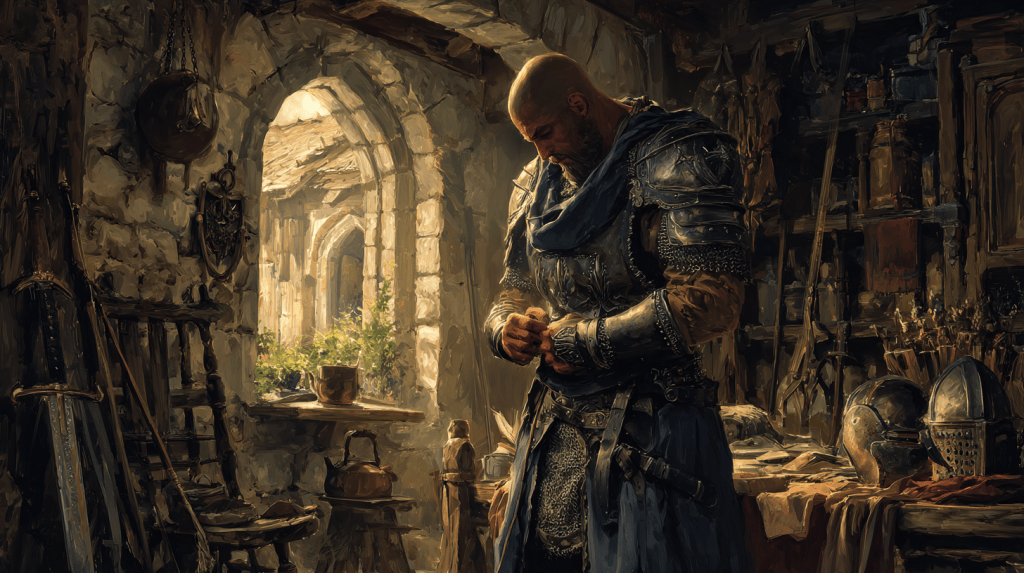
His reflection in the polished steel of his breastplate—still bearing the Crimson Company’s insignia that he would remove before day’s end—showed a man of forty-one who looked a decade older. Gray threaded through the blonde beard that had once earned him comparisons to northern war-gods. His pale blue eyes, still sharp despite the scars that bracketed them, had lost the idealistic gleam that had characterized his younger self. But beneath the weathering and the accumulated damage, something new had taken root: a cold clarity about the nature of the trade he’d dedicated his life to mastering.
The door to his room opened without warning—a violation of privacy that would have been unthinkable in any establishment that catered to clientele with actual power or influence. Rogar Bloodhand, captain of the Crimson Company’s third division, filled the doorway with his considerable bulk, his expression carrying the particular contempt reserved for subordinates who failed to understand their place in hierarchies maintained through intimidation rather than mutual respect.
“Jagerson,” he growled, his breath carrying the sour smell of last night’s drinking. “You missed morning formation. That’s three days’ pay docked, plus stable duty for the next—” His eyes found the resignation letter, and his voice trailed into dangerous quiet. “What’s this?”
Balder rose from his chair with the controlled movements of someone whose body had been trained to respond to threat with measured precision rather than reactive violence. At six feet and two hundred pounds of muscle hardened by two decades of combat, he could have physically dominated the encounter. But he’d learned long ago that displays of strength were the tools of men who lacked better options.
“My resignation,” he said simply, his voice carrying the neutral tone he’d perfected for addressing superiors whose authority he no longer respected. “Effective immediately, as stated.”
Rogar’s face flushed the particular shade of red that preceded either violence or humiliation, depending on whether the target of his rage was in a position to defend themselves. “You can’t just resign, Jagerson. You’ve got two years left on your contract. The Company invested resources in your training, your equipment—”
“The contract that was rewritten six months ago without my consultation?” Balder interrupted, his voice remaining level despite the anger that simmered beneath practiced calm. “The one that extended my term of service and reduced my share of contract payments while increasing the Company’s take? That contract?”
The flush deepened. “Standard adjustment to market conditions. All veterans received the same modifications.”
“All veterans who lacked the leverage to refuse them,” Balder corrected. “All soldiers who had invested so much time and blood that starting over with a new company seemed impossible, even when staying meant accepting progressively worse terms in exchange for the privilege of continuing to risk our lives for others’ profit.”
He could see the moment Rogar recognized that the confrontation had moved beyond the boundaries of standard disciplinary interaction. This wasn’t a subordinate making excuses or seeking mercy—this was someone who had already made a decision and was simply going through the formal process of implementation.
“You’ll never work in this city again,” Rogar threatened, falling back on the intimidation tactics that usually proved sufficient to maintain control over soldiers whose entire identity was bound up in their military service. “I’ll make sure every company commander knows you’re unreliable, that you break contracts when convenient—”
“I’m counting on it,” Balder said, the words emerging with a satisfaction that surprised him with its intensity. “I’m counting on every commander in this quarter knowing that I’m done serving organizations that treat their soldiers as disposable assets to be used up and discarded when maintenance costs exceed replacement expenses.”
The statement hung in the air between them like a blade, sharp with implications that extended beyond personal grievance to indictment of the entire system that had shaped their lives. For a moment, something flickered in Rogar’s expression—not agreement exactly, but recognition. The captain was perhaps ten years older than Balder, his body bearing similar scars earned in service to similar masters, his future equally predictable: continue until injury or age made him useless, then face retirement with whatever meager pension the Company’s accountants determined was sufficient to discharge their contractual obligations.
But the moment of connection passed, driven back by the psychological armor that allowed men like Rogar to function within systems that exploited them. “You’re making a mistake,” he said, though his voice carried less conviction than before. “Twenty-three years of service, and you’re throwing it away over wounded pride.”
“I’m reclaiming it,” Balder corrected, beginning to remove the pieces of his armor that bore the Crimson Company’s marks. “Every year I gave to organizations that never saw me as anything more than a warm body to put between their paying clients and whatever dangers those clients faced. Every contract where I risked permanent injury or death while commanders who never set foot on battlefields collected the majority of the payment. Every moment I told myself that loyalty and hard work would eventually be rewarded with the respect and security I’d earned.”
The breastplate came off, revealing the padded undertunic that bore stains from countless campaigns. Balder set the armor on his bed with the care of someone who understood the value of good equipment even when rejecting the organization that had provided it.
“I believed the lie,” he continued, his voice carrying the particular weight that came from acknowledging painful truths. “The story that if I worked hard enough, proved myself worthy enough, demonstrated sufficient loyalty to the companies I served, that eventually I would achieve the security and respect that made all the sacrifice worthwhile. But that was never how the system was designed to function. It was designed to extract maximum value from soldiers while providing just enough compensation to keep us committed to continued service.”
Rogar’s hand moved toward the sword at his belt—an unconscious gesture that revealed more about his emotional state than any verbal response could have conveyed. But he didn’t draw the weapon, perhaps recognizing that violence would only prove Balder’s point about the fundamental nature of their relationship.
“So what’s your plan?” he asked instead, his tone shifting toward something approaching genuine curiosity. “You think you can make it as an independent? The established companies control all the premium contracts. You’ll be fighting for scraps, competing with every other broken-down veteran who couldn’t cut it in organized service.”
Balder smiled, the expression transforming his weathered features with the first genuine pleasure he’d felt in months. “I’m not planning to compete for their scraps. I’m planning to offer something the established companies can’t provide: a mercenary company that actually values its soldiers, that splits contracts fairly, that treats experienced warriors as partners rather than disposable assets.”
He reached for a leather satchel that sat beside his bed, its contents representing months of careful planning and secret preparation. Inside were documents that would have gotten him dismissed from the Crimson Company if discovered earlier—contracts with smiths and armorers willing to provide equipment at wholesale prices, correspondence with warriors whose skills and frustration mirrored his own, letters from potential clients who had grown disillusioned with the service provided by established companies.
“The Jager Brotherhood,” Balder said, extracting a banner from the satchel and unfurling it across his bed. The design was simple but striking—a wolf’s head in silver against a field of deep blue, surrounded by a circle of seven stars representing the principle that would guide his new organization: equal partnership among those who bore the risks together.
“You’re insane,” Rogar breathed, though his eyes remained fixed on the banner with an intensity that suggested the idea had taken root despite his verbal dismissal. “Starting a new company requires capital you don’t have, connections you haven’t built, reputation that takes years to establish—”
“All things that seemed impossible when I believed the only path forward was continued service to organizations that would never truly value me,” Balder agreed. “But possible when I stopped accepting the narrative that my choices were limited to which master I served and started considering what might be built if experienced soldiers pooled our skills and shared risks equally.”
He began gathering his personal possessions—the weapons he’d purchased with his own coin, the armor pieces that bore no company insignia, the mementos from campaigns that had meant something beyond simple contract fulfillment. Each item represented a piece of identity that transcended any single organization’s claim to his service.
“Six warriors have already committed to the Brotherhood,” Balder continued, his voice carrying the controlled excitement of someone who had spent months planning in secret and was finally able to speak openly about his vision. “Veterans with specializations that complement rather than duplicate each other. We’ve pooled our savings to secure equipment and initial operational funds. We’ve identified a niche that established companies ignore because the profit margins are too small for their overhead: security contracts for merchant caravans, personal protection for scholars traveling to dangerous research sites, training services for noble houses that want competent guards but can’t afford the rates charged by premium companies.”
Rogar’s expression had shifted from contempt to something more complex—a mixture of disbelief, resentment, and what might have been envy. “You’re describing a fantasy,” he said, though his voice lacked the conviction necessary to make the dismissal effective. “A few veterans pooling their resources and dreaming they can compete with organizations that have spent decades building client networks and establishing reputations.”
“Perhaps,” Balder acknowledged, securing his personal weapons—a longsword that had saved his life more times than he could count, a matched pair of throwing axes that bore his personal mark, the hunting knife his father had given him before he’d left home to seek his fortune in military service. “Or perhaps we’re recognizing something the established companies have forgotten: that the actual value in mercenary work comes from the warriors who do the fighting, not from the administrative structures that extract profit from our labor.”
He turned to face Rogar directly, his pale blue eyes meeting the captain’s darker gaze without the deference that military hierarchy had previously demanded. “You could join us,” he said quietly, the offer emerging without premeditation but feeling right as soon as the words left his mouth. “You’re a competent commander, and you understand logistics better than most. The Brotherhood would benefit from your experience, and you’d benefit from actually receiving fair compensation for the value you provide.”
For a moment—just a fleeting instant—Balder saw something kindle in Rogar’s expression. The possibility of escape from a future that had already been written, the chance to reclaim agency that had been surrendered so long ago that its absence had come to seem natural. But the moment passed, crushed beneath the weight of accumulated years and the psychological investment in a system that had consumed too much of Rogar’s life to abandon without admitting that decades of sacrifice had been directed toward someone else’s benefit rather than his own advancement.
“I have responsibilities,” Rogar said, though the words sounded hollow even to his own ears. “The Company depends on experienced officers to maintain standards—”
“The Company depends on experienced officers to maintain control over soldiers who might otherwise recognize that they’re being exploited,” Balder corrected gently, feeling neither triumph nor contempt, only the sad recognition that some men would spend their entire lives serving systems that consumed them because the alternative required confronting truths too painful to acknowledge.
He shouldered his pack, the weight familiar after years of campaigning but feeling different now that it represented departure toward something he was choosing rather than orders he was following. The room that had been his home for three years suddenly seemed smaller, more confining, a space defined by limitations rather than possibilities.
“Tell the quartermaster I’m leaving the Company equipment,” Balder said, gesturing toward the armor and weapons that bore the Crimson Company’s marks. “I bought out my contract violations with the coin I’d saved for retirement—didn’t spend it on drink or dice like they probably assumed veterans would. The paperwork is in order, even if they don’t like the timing.”
Rogar said nothing, his expression locked in the rigid control that prevented any display of emotion that might be interpreted as weakness. But as Balder moved toward the door, the captain’s voice followed him with a question that carried more weight than simple curiosity: “What makes you think your way will work any better? That treating soldiers fairly will somehow prove more successful than the model every established company follows?”
Balder paused in the doorway, considering the question with the seriousness it deserved. “Because the current model only works when soldiers have no other options,” he said finally. “When we believe that our choice is between serving organizations that exploit us or abandoning the profession we’ve dedicated our lives to mastering. But what happens when experienced warriors realize they can pool their skills and share the risks and rewards equally? When clients discover they can hire competent security for reasonable rates from people who actually care about the quality of service because they benefit directly from satisfied customers?”
He smiled again, the expression carrying both challenge and invitation. “The established companies have grown comfortable extracting maximum profit from minimum investment in their actual warriors. We’re going to offer an alternative. And if it fails—if the vision proves impossible or the market rejects the model—at least I’ll have failed on my own terms rather than spending my remaining years grinding myself down in service to someone else’s prosperity.”
The Mercenary Quarter’s morning chaos enveloped Balder as he descended the tavern’s narrow stairs and emerged onto streets that suddenly seemed filled with possibility rather than predetermined routine. Around him, soldiers moved through their assigned patterns—training exercises, equipment maintenance, the endless cycle of preparation and deployment that defined military service. But now he saw them with the clarity that came from stepping outside the system he’d spent decades accepting as inevitable.
So many warriors, their skills honed through years of difficult experience, their labor generating wealth that flowed primarily to commanders and company owners who risked nothing while collecting the majority of contract payments. So many men and women who had believed—as he had believed—that loyalty and hard work would eventually be rewarded, that sacrifice would be recognized and compensated fairly.
The Jager Brotherhood’s headquarters, such as it was, occupied a converted warehouse in the Quarter’s eastern edge, far from the prestigious addresses claimed by established companies but sufficient for an organization that valued function over appearance. Six warriors waited inside—veterans whose paths had mirrored his own, whose disillusionment had reached the critical point where action became preferable to continued acceptance of exploitation.
Kara Ironhelm, a shield-maiden whose defensive techniques had saved countless lives but whose contributions were never reflected in the contract splits that favored commanders over front-line fighters. Torvin Quickblade, whose speed with dual swords was legendary but whose gambling debts had given the Crimson Company leverage to trap him in progressively worse contract terms. Mira Longshot, an archer whose accuracy was unmatched but whose gender meant she was paid less than male soldiers with inferior skills. Garrett Stone-fist, a former sergeant whose attempt to advocate for fair treatment of his troops had resulted in demotion and reassignment to the worst contracts available.
Each carried their own story of realization, their own moment of recognizing that the system they served was designed to extract rather than reward, to consume rather than cultivate. And each had made the same choice Balder had made: to risk everything on the possibility that there might be a better way.
“Brothers and sister,” Balder said as he entered the warehouse, using the deliberately non-hierarchical language that would define their organization’s culture. “The Jager Brotherhood is officially operational. No more planning in secret, no more serving masters who see us as disposable. From this moment, we build something new.”
Kara moved to stand beside him, her weathered face showing the scars of two decades in service to companies that had never valued her contributions equally to her male counterparts. “We’re seven soldiers with minimal capital, no established reputation, and every major company in the Quarter viewing us as either competition to be crushed or foolish idealists who’ll collapse within a year,” she observed, her tone carrying practical assessment rather than discouragement. “What’s our first move?”
Balder unrolled a map across the central table—a detailed rendering of the trade routes that connected Lumen Vale to smaller settlements throughout the surrounding territories. “We start small and build carefully,” he said, his finger tracing a route that the major companies considered beneath their notice. “Merchant caravans carrying goods too valuable to travel unprotected but not valuable enough to justify premium company rates. We offer quality service at fair prices, treat our clients with respect, and build the kind of reputation that comes from actually caring about outcomes rather than just collecting payment.”
Torvin leaned over the map, his quick eyes assessing distances and potential hazards with the tactical awareness that made him valuable despite his personal flaws. “The margins will be tight,” he observed. “Splitting payment seven ways equally means nobody gets rich quickly.”
“But everybody eats regularly and nobody bears disproportionate risk,” Mira countered, her longbow propped against her shoulder like a physical manifestation of her professional competence. “And we control our own schedules, choose our contracts based on actual assessment of risk versus reward rather than orders from commanders who never set foot outside city walls.”
The conversation continued through the morning as they refined their operational strategy, establishing the principles that would guide the Brotherhood’s decisions. Equal vote on which contracts to accept. Fair division of payment based on actual contribution rather than predetermined hierarchy. Transparency about finances and risks. Investment in equipment and training that would benefit all members rather than primarily enriching company owners.
It was radical, perhaps even naive. But as Balder listened to his fellow Brotherhood members debate tactics and share ideas, he felt something he hadn’t experienced in years: genuine hope that his labor might serve his own interests rather than someone else’s profit.
By afternoon, word of the Brotherhood’s formation had spread through the Mercenary Quarter with the speed that characterized any community where gossip was both currency and entertainment. Some responses were predictably hostile—established companies viewing any alternative model as implicit criticism of their practices, commanders whose authority depended on maintaining the illusion that soldiers had no choice but to accept whatever terms were offered.
But other responses surprised Balder with their thoughtful consideration. Junior officers who approached quietly to ask questions about the Brotherhood’s structure. Veteran soldiers whose eyes lingered on the banner that flew above their warehouse, its silver wolf seeming to promise something that transcended mere employment. Even a few clients who had grown frustrated with the inflexible pricing and indifferent service provided by companies that had grown too comfortable with their market dominance.
Three weeks later, the Jager Brotherhood completed its first contract—security for a merchant caravan carrying dyes and spices from coastal ports to inland markets. The payment was modest, the risks minimal, the prestige non-existent by standards that defined success through complexity and danger. But when they returned to Lumen Vale and divided the coin equally among all seven members, Balder felt a satisfaction that transcended mere financial compensation.
This was his labor, fairly rewarded. This was his choice, freely made. This was the beginning of something that might succeed or fail, but that would unfold according to principles he had chosen rather than simply accepting what had been imposed by others.
That evening, as the Brotherhood gathered in their warehouse to share a meal and plan future contracts, Rogar Bloodhand appeared in the doorway. The Crimson Company captain stood in shadow, his expression unreadable, his presence creating a moment of tension that silenced conversation.
“I’ve resigned my commission,” he said finally, his voice carrying the same controlled tone Balder had used three weeks earlier. “If the offer still stands, I’d like to discuss joining the Brotherhood.”
Balder met his gaze steadily, seeing in the older warrior’s eyes the same mixture of fear and hope that must have been visible in his own reflection three weeks ago. “The offer stands,” he said quietly. “But you should understand that we don’t have captains or commanders. We have partners who share risks and rewards equally, whose voices carry equal weight in decisions about our collective future.”
“I understand,” Rogar replied. “That’s why I’m here.”
As the former captain stepped into the warehouse’s warmth, accepted into the circle of warriors who had chosen to reclaim their agency rather than continue serving systems that consumed them, Balder felt the final piece of his transformation crystallizing into certainty. He would never be called Balder the Fierce again—that name belonged to a younger man who had believed that military service to powerful organizations was the only path to honor and security.
But perhaps he could become something better: Balder the Free, founder of an organization that proved veterans could thrive by valuing each other rather than accepting exploitation as the price of practicing the profession they had dedicated their lives to mastering.
The path ahead remained uncertain, filled with challenges that would test their resolve and competence. But it was their path, chosen freely and walked together, each step taken in service of something they had built rather than something that had been imposed upon them.
And that, Balder reflected as the Brotherhood’s laughter filled the warehouse and plans for future contracts took shape through collaborative discussion, made all the difference.
The Fierce Reclaimed
Discover more from Chadwick Rye
Subscribe to get the latest posts sent to your email.


Leave a Reply