
What change, big or small, would you like your blog to make in the world?
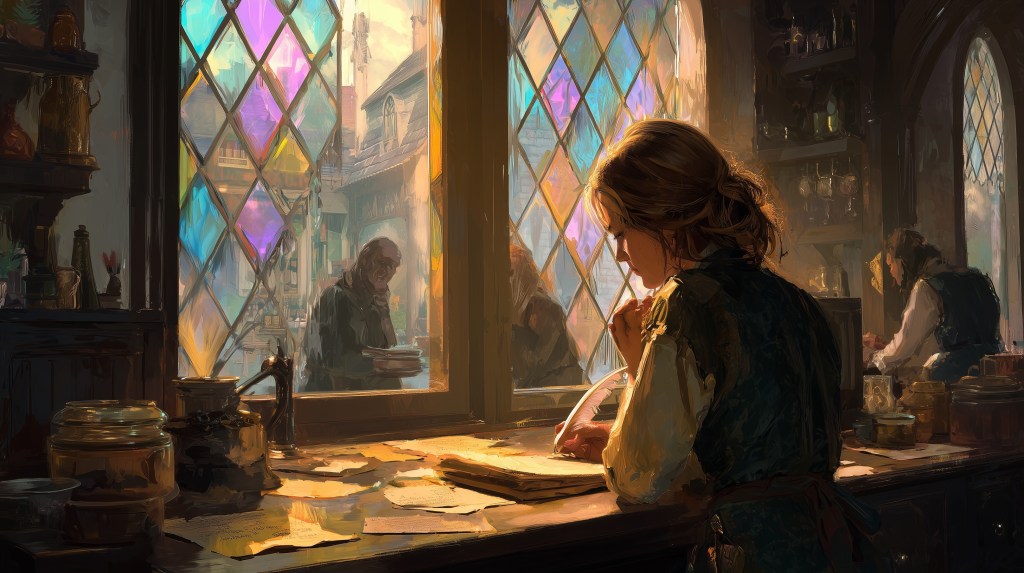
The morning light filtered through the diamond-paned windows of the *Lumenvale Daily Chronicle* newsroom, casting fractured rainbows across sheets of parchment that bore the fresh scars of urgent storytelling. I sat at my desk in the corner—the one closest to the street-facing window, where I could watch the pulse of the city while crafting words meant to capture its heart—and stared at the question that had haunted me through three sleepless nights.
What change did I want my column to make in the world?
Around me, the newsroom hummed with its usual morning energy. Tobias Quillwright, our political correspondent, muttered furiously as he scratched out another draft of his piece on the latest Council taxation debates. Young Meredith Inkwell, barely six months out of the Academy’s journalism program, pecked nervously at her typewriting apparatus while chasing down leads about suspicious activities in the Lower Canal District. The familiar symphony of deadline pressure filled the air—scratching quills, shuffling papers, the occasional frustrated oath when a particularly elegant phrase refused to cooperate with grammatical necessity.
But today, their urgency felt distant, muffled by the weight of Editor Brightquill’s request echoing in my mind.
“Twenty years you’ve been writing ‘Between the Lines,’ Cassandra,” he had said yesterday evening, settling his considerable bulk into the chair across from my desk with the deliberate care of a man who understood that some conversations required proper framing. “Twenty years of observations about daily life in Lumenvale, about the stories that slip between the cracks of official Chronicles and Council proclamations. The column has readers, certainly, but I want to know—what *impact* do you hope it has?”
The question should have been simple. After two decades of writing about the unnoticed corners of our city, surely I had developed some philosophy about the purpose of my work beyond mere entertainment and mild social commentary.
Instead, I found myself confronting the uncomfortable possibility that I had been drifting, content to document the small dramas and quiet beauties of Lumenvale life without considering whether my words actually changed anything at all.
Through my window, the familiar rhythm of morning commerce painted itself across the cobblestones of Chronicle Street. Mrs. Goldfinch from the bakery exchanged pleasantries with Master Thorwick the locksmith while her apprentice arranged fresh loaves in the window display. Three children from the Academy’s preparatory program skipped past, their laughter bright as wind chimes, clutching scroll cases that likely contained essays about mathematics or elementary magical theory.
Ordinary moments. The kind I had built my career observing and translating into the gentle prose that filled the space between more urgent headlines about trade disputes and magical discoveries and the various crises that occupied official attention.
But as I watched Mrs. Goldfinch’s easy interaction with Master Thorwick, I remembered the column I had written eight months ago—a simple piece about the informal networks of support that had emerged in the Artisan Quarter during the harsh winter. How neighbors had quietly coordinated to ensure that elderly residents received daily check-ins and that struggling families found anonymous gifts of firewood and preserved food outside their doors.
Nothing dramatic. Nothing that would reshape the political landscape or alter the course of international relations. Just a community taking care of itself in ways that the official social services had never quite managed to duplicate.
Three days after that column published, I had received my first letter.
*Dear Miss Thornfield,* the carefully formed script had read, *I wanted to thank you for writing about the kindness networks in the Artisan Quarter. My husband passed this winter, and I was struggling to manage on my own, but I was too proud to ask for help directly. Your column made me realize that accepting support wasn’t weakness but participation in something beautiful. I found the courage to let my neighbors know I was struggling, and the response was more generous than I could have imagined. You helped me understand that community is something we build together, not something that just happens to us.*
The letter was signed simply *A Grateful Reader*, and it had been filed away in my desk drawer with dozens of others that had accumulated over the years. Responses to columns about various small observations—the way the Crystal Spires’ light patterns affected the mood of citizens in nearby districts, the quiet heroism of the sanitation workers who kept the city’s canals flowing properly, the mathematical beauty hidden in the flower arrangements that market vendors created without conscious artistic intent.
I pulled out that drawer now, spreading the letters across my desk like pieces of a puzzle I was only beginning to understand. Here was correspondence from a young father who had learned to communicate better with his teenage daughter after reading my piece about the generational differences in magical education approaches. There was gratitude from a small business owner who had restructured her employee relations after a column about workplace dynamics in the Guild system. A letter from someone who had overcome social anxiety by applying insights from my observations about how public spaces could be designed to encourage rather than intimidate interaction.
Twenty years of seemingly small observations. Twenty years of readers taking something meaningful from words I had often written more for my own curiosity than from any grand mission to influence social change.
“Finding something interesting over there?” The voice belonged to Meredith, who had abandoned her typewriting apparatus in favor of investigating whatever had me surrounded by personal correspondence during active deadline hours.
“Maybe,” I replied, holding up a letter from someone who had started a community garden after reading my column about the psychological benefits of shared green spaces. “I’m trying to understand what I’ve actually been doing all these years.”
She perched on the edge of my desk with the casual confidence of youth, scanning the scattered letters with bright eyes that still held the optimism of someone who believed journalism could change the world through sheer force of good intentions.
“Seems obvious to me,” she said after a moment. “You’ve been helping people see differently. Helping them notice things that were always there but somehow invisible.”
Her assessment was so simple, so direct, that it cut through twenty years of accumulated complexity like a blade through silk. I looked again at the letters, then out the window at the street where ordinary life continued its eternal dance, and finally understood what Editor Brightquill was asking me to articulate.
“The change I want my column to make,” I said slowly, testing the words as they formed, “is the smallest and most profound one possible. I want people to notice each other.”
Meredith’s eyebrows rose slightly, inviting elaboration.
“Not in the dramatic sense,” I continued, my voice gaining strength as the understanding crystallized. “Not the grand gestures that make headlines or the political awareness that drives Council debates. I want people to notice the baker who remembers their favorite pastry. The street cleaner who takes pride in maintaining the beauty of public spaces. The elderly neighbor who might benefit from a casual conversation. The child who needs encouragement to pursue an unusual interest.”
I stood and moved to the window, watching Mrs. Goldfinch and Master Thorwick continue their morning ritual of connection—two people who had probably exchanged similar pleasantries for years without recognizing the small miracle of their mutual care.
“The biggest problems in our society,” I said, “aren’t usually solved by legislation or magical innovation, though those have their place. They’re solved by individuals who understand that they’re connected to something larger than their own immediate concerns. By people who notice opportunities to make someone else’s day a little easier, a little brighter, a little more meaningful.”
Meredith nodded thoughtfully, her young idealism apparently sophisticated enough to recognize wisdom that dressed itself in humble clothing.
“So your column is like…” she paused, searching for the right metaphor, “like a lens that helps people focus on things that were always there but somehow out of focus?”
“Exactly.” I returned to my desk, gathering the letters with new appreciation for their collective weight. “I’m not trying to create artificial community or force connections that don’t exist naturally. I’m trying to help people see the community that’s already all around them, waiting to be recognized and nurtured.”
The morning deadline pressure had returned to the newsroom around us, but I felt oddly calm despite having spent three days wrestling with a question that now seemed to answer itself. I pulled a fresh sheet of parchment toward me and began to write.
*Between the Lines: On the Small Changes That Transform Everything*
*This morning, I watched a baker and a locksmith exchange the kind of casual pleasantries that mark the rhythm of neighborhood life throughout Lumenvale. Nothing remarkable about their interaction—just two people acknowledging each other’s presence with the warmth that comes from shared daily experience.*
*But in that simple moment, I saw something that twenty years of column-writing has taught me to recognize: the foundational truth that civilization isn’t built by grand institutions or impressive architecture, but by countless small choices to treat each other with consideration, curiosity, and care.*
*The change I hope this column makes in our world is both humble and ambitious. I want to help readers notice the opportunities for connection that surround us constantly—the chance to express gratitude to someone whose work makes our lives easier, to offer encouragement to someone pursuing a dream, to simply acknowledge the humanity of people whose paths cross ours in the daily navigation of shared spaces.*
The words flowed with unusual ease, as if they had been waiting for years to be written. Outside the window, Chronicle Street continued its ancient dance of commerce and community, while inside the newsroom, my colleagues chased the immediate stories that would fill tomorrow’s edition with information about events and decisions and the various urgencies that drove public discourse.
But in my corner, I wrote about the smaller revolution—the one that happened when people chose to see each other clearly, to extend kindness without calculation, to recognize that the quality of our shared life depended not on what distant authorities decided, but on how we treated the people we encountered in the ordinary course of being human.
The change I wanted my column to make wasn’t measurable in legislation passed or policies reformed. It was measurable in moments like the one outside my window—small interactions that wove the social fabric stronger, one conversation at a time.
Twenty years of writing about the spaces between the official stories. Twenty years of helping readers notice what had always been there, waiting to be seen.
And finally, the understanding that the smallest changes were often the most transformative ones of all.


Leave a Reply