
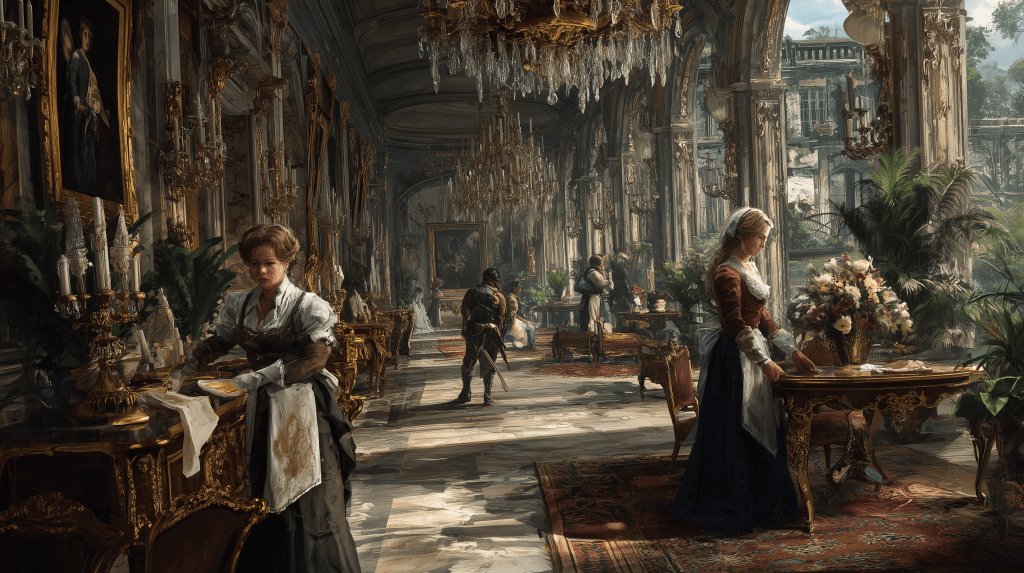


The crystal chandeliers sang their morning harmony as Mira Dustweaver dipped her cloth into the basin of lavender-scented water, the sound threading through the grand hallway like whispered prayers. Around her, the Brightwater Estate breathed with the quiet rhythms of wealth—silk curtains exhaling perfumed air, marble floors reflecting fractured rainbows from the windows above, and somewhere in the distance, the gentle cascade of fountain water over imported stones.
But it was the voices that provided the real soundtrack to her work.
“The Goldbrook engagement is a disaster waiting to unfold,” Lady Brightwater’s voice drifted down from the morning room, sharp with the particular anxiety of mothers orchestrating their daughters’ futures. “That boy has no sense of financial responsibility, and his father’s shipping ventures grow more precarious by the season.”
Mira’s hand never paused in its circular motions across the mahogany side table, though her weathered face creased with the faintest smile. Three years of cleaning these halls had taught her that noble worries weren’t so different from common ones—just dressed in more expensive words and accompanied by the soft clink of silver spoons against porcelain.
Beside her, old Henrik hummed under his breath as he polished the brass fixtures with practiced efficiency. His tune was one of the dock worker songs from his youth, a melody that spoke of early mornings and honest labor, now set to the rhythm of cleaning rags and the subtle percussion of his joints protesting forty years of service. The contrast between his rough sailor’s ballad and the refined conversations echoing from the breakfast chamber created a harmony uniquely their own.
“Did you hear that?” whispered Sara, the youngest of their crew, her voice barely audible as she dusted the portrait frames that lined the corridor. At sixteen, she still possessed the wide-eyed fascination of someone discovering that the wealthy were as petty and insecure as anyone else. “Lord Brightwater owes money to half the trading houses in the Lower Ward.”
Mira shot her a warning glance, though not without understanding. The girl was learning the first rule of household staff—ears open, mouth shut, and never let on how much you actually knew. The conversations they overheard while working weren’t meant for their ears, but they flowed around the cleaning crew like water around stones, as if their presence was so taken for granted that privacy became meaningless.
From the library came the scratching of quills and the rustle of parchment, accompanied by the younger Lord Brightwater’s frustrated sighs as he struggled with his correspondence. His tutor’s voice provided steady counterpoint, explaining grammatical principles with the patient resignation of someone who had long since abandoned hope of genuine improvement.
“The accounts from the eastern properties,” the tutor was saying, “require a more delicate approach. One does not simply demand payment from the tenant farmers—one requests their cooperation in resolving mutual concerns.”
Henrik’s humming grew slightly louder, and Mira recognized the shift to a different song—one she remembered from her own childhood in the Artisan Quarter, where her mother had sung while mending clothes for wealthier families. The melody spoke of dreams deferred and dignity maintained despite circumstances, of finding joy in small moments and pride in work well done.
The music of their labor had its own complex orchestration. The whisper of cleaning cloths against crystal, the soft thud of pillows being fluffed and repositioned, the gentle splash of mop water in buckets, the satisfying snap of bed linens being changed with military precision. These sounds created their own rhythm, a working song that needed no words because it spoke through motion and routine.
“Mira,” came a voice from the grand staircase, and she looked up to see Tobias descending with his arms full of soiled linens. At twenty-two, he possessed the lean efficiency of someone who had learned to move quickly and quietly through spaces where his presence was both essential and unnoticed. “Lady Brightwater wants the blue salon prepared for her garden party committee. Full crystal service, the good silver, and she specifically mentioned that the windows should ‘sparkle like captured starlight.’”
The phrase drew snorts of amusement from Henrik and Sara. Lady Brightwater’s poetic descriptions of her cleaning requirements had become legendary among the staff, though they executed her wishes with professional precision regardless of how they were phrased.
As they moved through the estate’s rooms like a well-rehearsed dance troupe, the soundtrack of their work continued to evolve. In the conservatory, exotic birds provided cheerful chaos that masked their quiet conversations about family concerns and weekend plans. The kitchen offered the percussion of breakfast preparation—the rhythmic chopping of vegetables, the bubble and hiss of porridge, the domestic symphony that fed a household of twenty.
“My daughter’s starting at the Academy next month,” Henrik said quietly as they worked together to move a particularly heavy armoire. “Scholarship program for exceptional students from working families. She’ll be the first in our line to read anything more complex than shop signs.”
The pride in his voice was unmistakable, and Mira felt the familiar warmth that came from witnessing dreams achieved through determination and sacrifice. This was the real music of their work—not just the physical sounds of cleaning and maintenance, but the underlying rhythms of lives being built, families being supported, futures being crafted one day’s wages at a time.
From the drawing room came the sound of Lady Brightwater’s harpsichord, her fingers dancing across keys with the mechanical proficiency of someone who had learned music as a social requirement rather than artistic calling. The melody was technically correct but emotionally hollow, all surface prettiness without the depth that came from genuine feeling.
Sara began humming along, but her version carried different harmonies—the modal variations she had learned from her grandmother, folk ornaments that transformed the rigid classical piece into something with heart and soul. The contrast was striking: wealth could buy lessons and instruments, but it couldn’t purchase the authentic expression that came from lives lived close to struggle and triumph.
“The Silverbrook reception is next week,” Tobias murmured as he carefully arranged fresh flowers in the entrance hall. “Full formal event, which means overtime for all of us. But also means extra wages, and I could use the coin for my sister’s wedding gift.”
The rhythm of their work adapted to accommodate conversation, hands moving with practiced efficiency while minds remained engaged with the human concerns that gave meaning to their labor. They were invisible to the family they served, but visible to each other—a community within a community, bound by shared purpose and mutual understanding.
As the morning progressed, their soundtrack grew richer. The postman’s arrival brought news from distant relatives and business concerns. The delivery of groceries from the market meant fresh gossip from the wider city. The tuning of the grand piano in the ballroom provided an unexpected percussive element as each string was adjusted to perfect pitch.
But beneath it all ran the steady rhythm of their own voices—quiet conversations about children’s schooling and parents’ health, debates about the best methods for removing wine stains from silk, gentle teasing about romantic interests and friendly competitions over who could achieve the most flawless window cleaning.
“You know what I listen to while I work?” Mira said during their brief rest in the servants’ hall, her hands wrapped around a cup of tea that steamed in the afternoon light. “I listen to us. To the sound of honest work being done well, of people taking care of each other while we take care of this place.”
Henrik nodded, understanding flowing between them with the ease of long partnership. “The nobles hear their own voices, their own concerns. But we hear the whole house—every conversation, every worry, every small joy. We know this place better than they do because we listen to all of it.”
Sara looked puzzled for a moment, then her face brightened with comprehension. “Like we’re the house’s memory,” she said. “We hear everything that happens, remember what matters, keep track of the real stories.”
As afternoon yielded to evening and their work neared completion, the soundtrack shifted again. The family’s dinner conversation provided background murmur while they cleaned the unused rooms. The arrival of evening guests brought carriage wheels on gravel and the rustle of formal wear. Soon, the drawing room would fill with carefully modulated laughter and conversations designed to impress rather than communicate.
But in the servants’ quarters, as they cleaned their tools and prepared to return to their own homes, the music was different. Henrik’s sea chanties gave way to lullabies he would sing to his granddaughter. Sara hummed the folk songs her mother had taught her, melodies that connected her to generations of women who had found dignity in domestic labor. Tobias whistled the cheerful tunes that accompanied his evening walks through the Artisan Quarter, where his own people lived and worked and dreamed.
“Same time tomorrow,” Mira said as they gathered their belongings, the words carrying the rhythm of routine that structured their days. “And tomorrow, we’ll hear new stories, new concerns, new pieces of the puzzle that is this family’s life.”
The Brightwater Estate settled into evening quiet as the cleaning crew departed, leaving behind rooms that gleamed with careful attention and surfaces that reflected not just light but the pride of those who had tended them. In the morning, the noble family would wake to spaces that appeared to maintain themselves, unaware of the skilled hands and attentive ears that made such magic possible.
But the cleaning crew knew the truth—that the real music of any household wasn’t the formal entertainment or polite conversation of its owners, but the working songs of those who kept it functioning, who listened to all its voices and found harmony in the complex symphony of lives lived in proximity to each other.
As Mira walked home through the twilight streets of Lumenvale, she carried with her the day’s soundtrack—a composition of overheard secrets and shared songs, of honest labor and quiet pride, of the music that emerged when invisible hands worked together to create something beautiful, even if that beauty was meant for others to enjoy.
Tomorrow would bring new melodies, new rhythms, new voices to add to the endless song of service. And she would listen, as she always did, to all of it—the music of visible privilege and invisible labor, of spoken words and unspoken understanding, of the symphony that played whenever people came together in the ancient dance of caring for each other and the spaces they shared.


Leave a Reply