
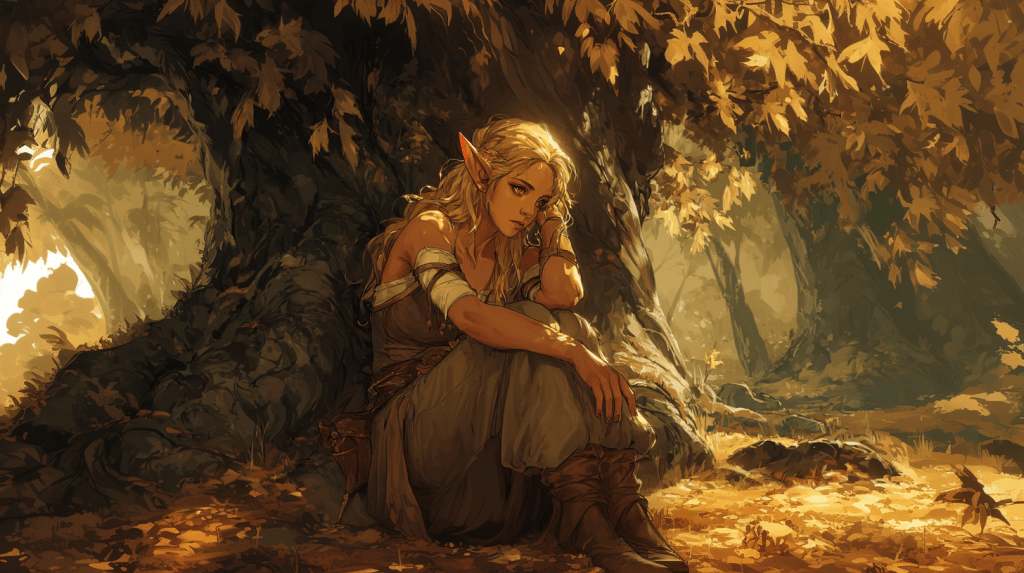
The autumn leaves drifted past her like scattered memories, each one a year she’d watched come and go. Ameria Ianbalar sat beneath the ancient oak, her golden hair catching the dying light as afternoon surrendered to dusk. The weight of centuries pressed against her shoulders, and she found herself wondering, not for the first time, if the endless march of seasons would ever feel like anything more than a slow countdown to solitude.
Her amber eyes traced the horizon where the forest met the sky, watching for nothing in particular. Time had taught her that watching was often all there was—watching friends grow old, watching kingdoms rise and fall, watching the world change while she remained a constant, untouched by the relentless flow of mortal years.
A twig snapped behind her.
“Well now, that’s the saddest sight I’ve seen since I watched a tavern keeper water down his best ale.”
Ameria turned to find a man emerging from the underbrush, dark hair tousled and a roguish grin playing at the corners of his mouth. His leather coat had seen better days, and a collection of pouches and oddments hung from his belt with the casual disorder of someone who lived by wit rather than wealth. But his eyes—warm brown eyes that seemed to dance with perpetual mischief—held a kindness that made her forget, for just a moment, to maintain her usual guarded composure.
“I beg your pardon?” she asked, though something about his easy manner made the formality feel unnecessary.
“A beautiful elf, sitting alone under a tree, looking like she’s carrying the weight of the world.” He gestured dramatically, nearly tripping over a root in the process. “It’s practically a crime against nature. I’m Garrett, by the way. Professional wanderer, amateur philosopher, and part-time solver of mysterious sadness.”
Despite herself, Ameria felt the corner of her mouth twitch. “Part-time?”
“Full-time would be presumptuous. Sometimes people prefer their melancholy.” He settled beside her without invitation, close enough that she could smell leather and something like cinnamon on his clothes. “But in your case, I’m making an executive decision. That level of sadness is far too heavy for someone to carry alone.”
“You don’t know anything about me,” she said, though without the sharp edge she might have used with another stranger.
“True enough. But I know sadness when I see it.” His voice grew gentler. “Lost someone?”
“Everyone,” she whispered before she could stop herself.
The silence that followed wasn’t uncomfortable. Garrett had a gift for letting words settle, she realized, for giving space to thoughts that needed room to breathe.
“How long do elves live?” he asked eventually.
“Long enough to watch everything we love turn to dust.”
“Ah.” He nodded as if this explained everything. “That’s your problem right there.”
She turned to look at him fully. “My problem?”
“You’re thinking about it all wrong.” He pulled something from one of his pouches—an apple, slightly bruised but still sweet-smelling. With a small knife that appeared from nowhere, he began cutting precise slices. “Here’s the thing about apples. You could spend your whole time worrying about how quickly they’ll brown and rot, or you could just enjoy how good they taste right now.”
He offered her a slice. When she hesitated, he added, “I promise it’s not poisoned. I’m many things, but evil stepmother isn’t one of them.”
The apple was perfect—crisp and sweet with just a hint of tartness. She couldn’t remember the last time she’d tasted something so simple and good.
“The secret,” Garrett continued, taking a bite of his own slice, “is learning to love things because they don’t last forever, not despite it. Makes every moment matter more.”
“Easy to say when you have a normal lifespan.”
“Is it though?” He leaned back against the tree, his shoulder brushing hers. “I’ve seen plenty of humans waste decades being miserable. Length of life doesn’t guarantee wisdom. Sometimes the opposite, I think. We get so comfortable with having time that we forget to actually live in it.”
As the stars began to emerge overhead, Garrett told her stories—ridiculous tales of his adventures that were probably half-true at best, but delivered with such infectious enthusiasm that truth seemed beside the point. He spoke of a duchess who kept a pet dragon the size of a housecat, of a village where everyone communicated entirely in limericks, of a mountain that sang opera when the wind hit it just right.
“You’re making all of this up,” Lyralei accused, though she was smiling now.
“Probably fifty percent of it,” he admitted cheerfully. “But the important part isn’t whether it happened—it’s whether it could happen. The world’s full of magic and wonder and absurdity. You just have to know how to look for it.”
When he finally stood to leave, promising to return the next evening with more stories, Ameria found herself looking forward to tomorrow for the first time in decades.
He kept his promise. And the next day, and the day after that. Garrett became a constant in her life with the same easy inevitability as sunrise, bringing laughter and ridiculous adventures and a perspective on time that gradually shifted her own.
He taught her card games that relied more on bluffing than skill, showed her how to pick locks (“For academic purposes only, of course”), and introduced her to the fine art of strategic rule-bending. More importantly, he showed her how to find joy in small moments—the satisfaction of a perfectly skipped stone, the absurd beauty of cloud shapes, the way morning light could transform an ordinary meadow into something magical.
“You know,” he said one evening as they sat by a small fire he’d built with characteristic confidence and mild incompetence, “I never thought I’d fall for an immortal elf.”
“I’m not immortal,” she corrected automatically, though her heart had jumped at the word ‘fall.’
“Close enough to make me feel very mortal by comparison.” He reached over and took her hand, his thumb tracing gentle circles across her knuckles. “But maybe that’s not such a bad thing.”
The years that followed were the happiest of her long life. Garrett aged with the kind of grace that comes from being thoroughly satisfied with one’s existence, silver threading through his dark hair and laugh lines mapping the geography of their shared joy. They married in a ceremony of their own devising beneath the same oak where they’d met, with only the forest spirits as witnesses.
Their children came as two small miracles—first Aria, who inherited her mother’s pointed ears and her father’s irrepressible curiosity, then Marcus, who got Garrett’s mischievous grin and Ameria’s thoughtful nature. Half-elves with lifespans that would bridge the gap between human brevity and elven eternity.
Garrett delighted in fatherhood with the same enthusiasm he brought to everything else, teaching his children to question everything, to find magic in the mundane, and to always, always choose kindness over cleverness. He filled their home with laughter and stories and the kind of chaotic love that makes ordinary moments feel like adventures.
When the children were grown and had begun their own journeys, when Garrett’s hair had gone completely silver and his step had slowed, he took Ameria’s hand one quiet evening and smiled.
“No regrets,” he said, and she knew he meant it.
“None,” she agreed, and for the first time in centuries, she meant it too.
Now, sitting beneath their oak decades later, Ameria watched her children’s children play in the dappled sunlight. Marcus had inherited his father’s gift for storytelling, while Aria had become a scholar who collected moments of wonder the way others collected books. Their children carried forward that same brightness, that same capacity for finding magic in the everyday world.
Garrett had been right about time. She understood now that loving someone not despite their mortality but because of it didn’t make the loss hurt less—it made the love matter more. Every moment became precious precisely because it was finite, every laugh and touch and shared glance a small rebellion against the inevitable passage of years.
She still missed him. Would always miss him. But the sadness was different now—not the hollow ache of watching the world from the outside, but the sweet melancholy of having been truly, deeply loved. He had given her more than happiness; he had given her hope that there would always be new wonders to discover, new people to love, new reasons to believe in the beautiful absurdity of existence.
A small voice interrupted her thoughts. Her grandson, barely tall enough to see over the tall grass, had approached with the serious expression children reserve for very important questions.
“Grandmother? Why are you smiling?”
Ameria looked down at him—this perfect combination of elf and human, of ancient wisdom and new possibility—and felt her heart expand with the same wonder Garrett had taught her to recognize.
“Because,” she said, pulling him onto her lap, “I was just remembering how to see magic.”
“Will you tell me about it?”
“Oh, my dear one,” she said, settling back against the tree as golden leaves continued their eternal dance overhead, “do I have stories for you.”


Leave a Reply