


The Case That Never Closed
A Story from Lumenvale
The rain in Mechanicus fell differently than rain anywhere else.
It wasn’t water, exactly — or not only water. The atmospheric processors that maintained the city’s climate equilibrium seeded the clouds with micro-fine iron particulate and crystallized emotion-residue, which meant the rain left faint rust-colored streaks on pale surfaces and smelled of something between copper and memory. Detective Wren Ashvale had been breathing it for forty-three years and could no longer distinguish it from any other air.
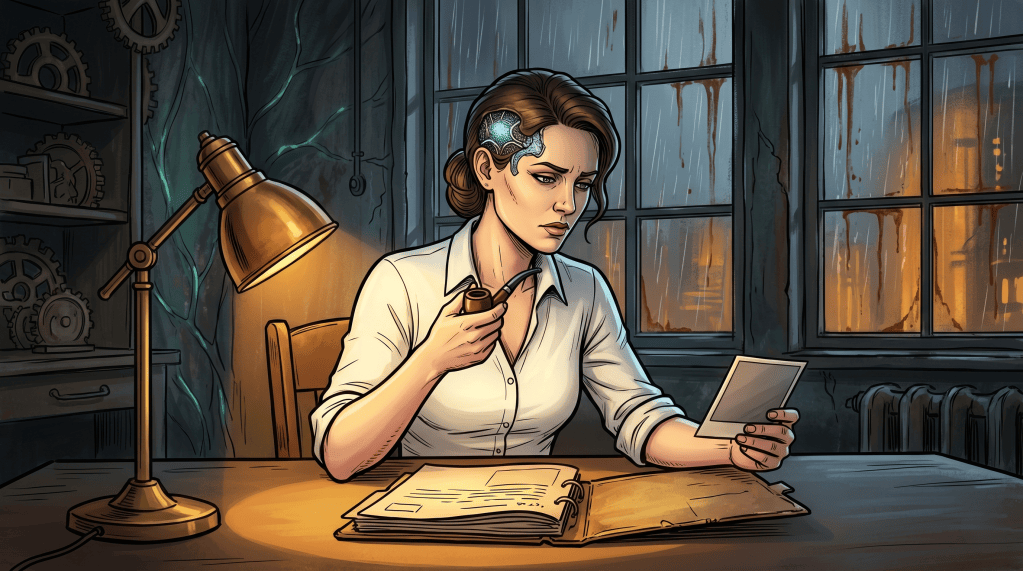
She lit her second pipe of the morning and spread the file across her desk.
The desk itself was thinking. All the furniture in Mechanicus thought, to varying degrees — a consequence of the city’s neural integration network, which had saturated every constructed surface with low-level cognition over the past century. Her desk was not particularly intelligent. It managed inventory, flagged overdue items, occasionally offered unsolicited organizational suggestions in the form of subtle surface vibrations that Wren had learned to ignore. Right now it was humming faintly in the frequency she had come to associate with concern, which she also ignored.
The file was forty-one years old.
She had opened it four hundred and thirty-seven times. She knew this because her neural mesh kept count of everything, which was a feature she had never learned to fully appreciate.
The case was simple in its facts and impossible in its resolution, which was the worst kind of case.
Forty-one years ago, in the Copper Quarter of the city of Veldris in the eastern reaches of Mechanicus, a watchmaker named Dorin Ashvale — her father — had walked out of his workshop at the end of a Tuesday and had not returned.
No body. No note. No evidence of foul play, no evidence of any play at all. The workshop had been locked from the outside with his own key, which meant he had left intentionally. His tools were arranged with the particular precision he used when he was finished for the day rather than stepping out briefly. The work on his bench — a commission for a Veldris council member, a pocket-watch with a living mechanism, one of his finest — was sixty percent complete and had remained sixty percent complete in evidence storage for four decades.
He had been forty-four years old. She had been three.
She had no memories of him. She had his tools, which she kept in a case under her desk. She had the workshop’s final inventory, which she had memorized. She had four hundred and thirty-seven openings of a file that had never added a single page since she became a detective and formally transferred the case to her own supervision twenty years ago.
She had no resolution.
The pipe smoke rose toward the workshop ceiling and was absorbed by the ventilation system, which sorted it from the general atmospheric mix and recycled the particulate matter back into the city’s resource cycle. Mechanicus wasted nothing. The city’s integrated intelligence found inefficiency philosophically troubling, which Wren found grimly funny given that she represented a significant ongoing inefficiency in its records — a detective spending professional hours on a cold case that had generated no new leads in four decades.
She had, over the years, developed three theories.
The first: he had left voluntarily for reasons that had nothing to do with her, her mother, or anything in Veldris. People disappeared into the vastness of Mechanicus for ordinary reasons — debt, desire, the particular exhaustion of a life that had stopped fitting the person living it. The city’s neural network, for all its integration, could not track people who didn’t want to be tracked. He might have been alive somewhere for years afterward. He might have built other watches in other workshops under another name.
The second: he had been taken. The commission on his bench had been for a council member, and council members in Veldris in that decade had been navigating the early years of the consciousness integration debates — the question of how much of a person’s neural architecture could be enhanced before the essential self was compromised. Her father had been known, in certain circles, for his opinions on this. His work incorporated organic mechanisms alongside mechanical ones in ways that the strict integration faction had found provocative.
The third theory was the one she had never written down in the file and never spoken aloud and returned to most frequently at three in the morning when the rain was doing its copper-and-memory thing against the workshop windows.
He had solved something. He had understood something that his sixty-percent-complete watch had been built to contain, and he had left because the understanding required leaving, and the watch was sixty percent complete because sixty percent was all it needed to be to hold whatever it held.
This theory made no logical sense. She was aware of this. She was also aware that she had spent twenty years as a detective, during which she had solved one hundred and fourteen cases, and that the thing which had made her good at her work was a specific tolerance for theories that made no logical sense until they suddenly did.
She had not solved her father’s case.
She did not know if she would.
The desk vibrated in its concern frequency. She pressed her palm flat against it in the way she had found, over years of cohabitation, communicated acknowledged, not urgent.
She looked at the photograph in the file. It was the only one she had of him — a workshop photograph, the kind Veldris guild members had taken for official records. He was standing at his bench in a posture she recognized because she stood at her own desk the same way, weight slightly forward, attention fully on the work in front of him, apparently unaware of or uninterested in the camera. He had her hands. She had noticed this at eleven years old when she first found the file in her mother’s things, and had spent the rest of her life not being sure what to do with the noticing.
On the desk beside him in the photograph, partly visible at the frame’s edge, was the sixty-percent-complete watch.
She had studied this photograph with optical enhancement so many times that she could reproduce every detail of that bench from memory. The arrangement of tools. The particular angle of the work lamp. The small personal items that watchmakers kept at their stations — a cup, something that might be a folded letter, the edge of something reflective that might be a mirror or a second piece of glass or something she had never been able to identify with certainty.
She had never identified it with certainty.
This was not for lack of trying.
The rain shifted against the windows. The city’s atmospheric processors were adjusting the evening cycle — she could feel it in the slight pressure change that her enhanced senses registered before her ordinary ones did. In four hours, the rust-colored streaks would dry to pale lines on the glass, and the city would begin its overnight integration cycle, during which its collective intelligence processed the day’s accumulated data and arrived at new conclusions about itself.
Wren closed the file.
She did this the same way every time — not with finality, because there was no finality in it, but with the specific gesture of someone setting something down rather than putting it away. The distinction mattered to her in a way she had never fully articulated. Putting it away would mean deciding it was finished. Setting it down meant she was simply done with it for today.
Tomorrow she would open it and it would be four hundred and thirty-eight times.
She reached under the desk and touched the tool case. The metal was cool and smooth and did not think, which she found restful. Her father had made things that did not think — watches and mechanisms that were precisely what they appeared to be, no more and no less, their function entirely visible to anyone who understood the components.
She understood the components. She had spent forty-one years understanding them.
She still didn’t know where he went.
The desk hummed. The rain came down. The city thought its vast overnight thoughts around her, and somewhere in its accumulated intelligence, perhaps, was an answer she had not yet found a question capable of reaching.
Perhaps tomorrow.
She lit her third pipe and watched the window streak with iron and memory, and waited for the case that never closed to show her something new.
☕ Enjoyed this story? Writing Lumenvale is how I pay my bills. If these stories are worth something to you, a $1 Ko-fi keeps the forge burning — and tells me this world is worth continuing. 👉 Buy Chadwick a coffee
👈 Previous Story: Missed the last tale from Lumenvale? Catch up now — Read The Mirage That Told the Truth


Leave a Reply