


What the Soil Remembered
A Story from Lumenvale
The seed was illegal.
Not in a formal sense — no statute named it, no guild ordinance had been written specifically for its prohibition. But Renna had been a botanical mage for eleven years and she understood the distinction between what the Botanical Guild permitted and what it merely had not yet thought to forbid. The seed in her palm sat in the second category, barely.
It had come from a Peak-rider trader at the upper ports, a woman with earth-dark hands and the particular stillness of someone who spent her life moving through enormous landscapes. She had carried it wrapped in waxed cloth inside an oilskin pouch inside a cedar box, and she had handed it to Renna without ceremony, the way you handed something to the one person qualified to receive it.
“Stone-blooming meridian orchid,” the woman had said. “Nomados. The walking mountains carry them in their joint-crevices. They root in living stone and nowhere else.”
Renna had looked at it for a long time. “There’s no living stone in Lumenvale.”
“There’s the Crystal Spires.”
The Spires were not the same as the walking mountains of Nomados. The Spires were ancient and fixed and the most protected structures in the city, maintained by the Resonance Keepers with a dedication that bordered on sacred obligation. Planting anything in their base stone — drilling even a hair-width channel to settle a root system — would require permissions from three guild councils, the Magisterium, and probably a personal letter of intent to High Councilor Wintermere.
Renna had purchased the seed for two months’ wages and carried it home in her breast pocket.
That had been in early spring. By the time summer arrived, she had done nothing with it. She kept it in the cedar box on the corner of her worktable in the Whispering Gardens propagation shed, where the ambient warmth of the botanical hearth maintained the temperature it needed to remain viable. Each morning she moved it to check the moisture of the waxed cloth. Each morning she put it back.
The Whispering Gardens were full of difficult plants. That was the point of the Whispering Gardens — the botanical mages tended species that grew nowhere else in the city, cultivated through decades of patient work and accumulated understanding of what specific plants required in order to stop dying. Renna had coaxed frost-orchids to bloom in midsummer. She had kept a specimen of the night-breathing kelp from Sylvenmere alive for three years in a freshwater tank by adjusting the mineral content three times daily. She was not a person who shied from difficult plants.
But the meridian orchid required living stone, and the only living stone in Lumenvale was the Crystal Spires, and going to the Spires with a drill and a Nomados seed without authorization was exactly the kind of thing that ended careers.
In late summer she looked up the relevant statutes. There were none. The Botanical Guild’s founding charter listed prohibited categories — parasitic specimens, invasive root systems, species with documented magical instability — and the meridian orchid fit none of them. It was rare and it was from outside Lumenvale’s botanical tradition and it required an unusual substrate, but none of that was technically prohibited.
She read the Resonance Keepers’ operating charter next. It prohibited structural alteration of the Spires, damage to the crystal housing, interference with the harmonic conduits. A root channel in the base stone — the non-crystalline granite footing below the crystal formation proper — was arguably not any of these things.
Arguably.
She went to see Cassian Dawnweaver on a Thursday morning in early autumn, before his First Light shift, when he had the particular focused calm of someone not yet fully inside the day’s demands.
She brought the seed and the two charters and her notes. She did not bring an apology.
He looked at everything she had brought him for a long time. The propagation shed was quiet around them — the singing plants at their morning murmur, the frost-orchids exhaling their faint cool breath into the warmer air.
“You want to plant a walking-mountain orchid in the Spire footing,” he said.
“In the granite base. Below the crystal structure. The root system of meridian orchids is non-invasive — they anchor, they don’t spread. The Peak-rider who sold it to me said a mature specimen adds harmonic density to its host stone. Living stone that carries one actually resonates with slightly more complexity.”
Cassian looked at the seed. It was pale and flat with a slight iridescence, the kind of thing that looked unremarkable until the light caught it from a particular angle and then looked like a piece of the sky.
“If it damages the footing —”
“I’ll remove it and pay for the repair. Documented in writing before I plant anything.”
“If the Guild —”
“I’ve read both charters. There’s no prohibition.” She paused. “If I’m wrong about the charters, I’ll accept the review.”
He was quiet for a moment. Outside the shed, the morning was beginning its usual business — the sound of the first canal boats, the resonance-birds somewhere above the Spire District singing their calibration songs.
“Why?” he asked. Not as an objection. As a genuine question.
She looked at the seed. She had thought about this answer across the entire summer of not acting, and she had arrived at something that felt true.
“Because I’ve spent eleven years learning what these gardens can hold. And I think this city’s botanical record has a gap in it that I can fill, if I’m careful and if the stone agrees.” She closed her fingers around the box. “If it doesn’t root, it doesn’t root. But I won’t know that without trying, and the only thing I’d regret is not trying.”
Cassian Dawnweaver was quiet for a long time after that.
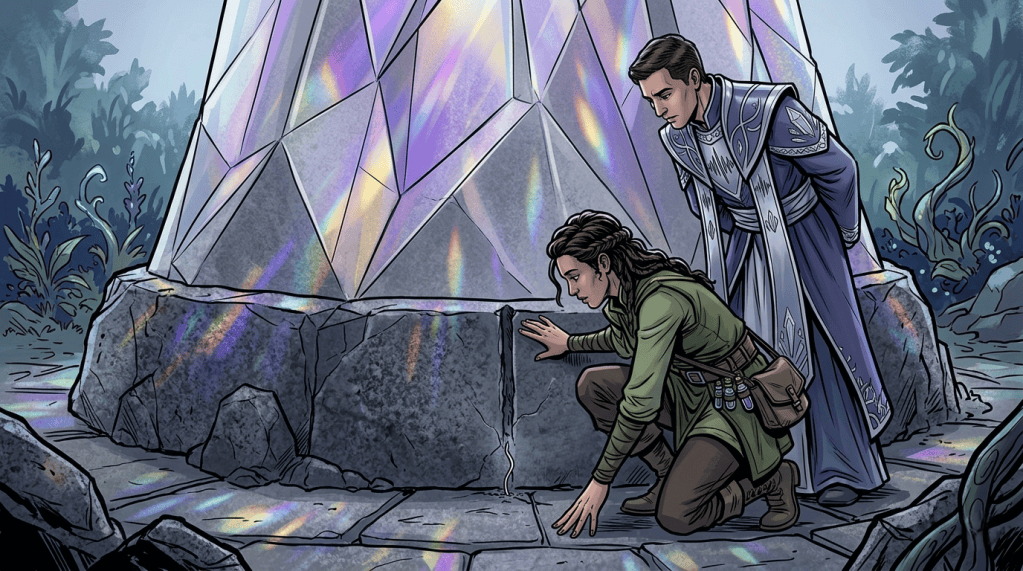
In the first week of autumn, Renna drilled a channel in the granite base of the third Crystal Spire — four centimeters deep, two wide, at ground level on the eastern face where the morning light came in at the low angle the Peak-rider had specified. She settled the seed with a mix of Nomados mineral soil she had spent two weeks sourcing through the trader networks. She packed it carefully and smoothed the surface and wrote a complete record of everything she had done in her propagation log.
Then she waited, as botanical mages always waited, which was the majority of the work.
In the second week of winter the crystal above the planting channel began to resonate at a frequency Cassian had never recorded before — a low sustained note that sat beneath the Spire’s usual harmonics like a foundation note under a melody. He sent her a written message through the guild post. She was there within the hour.
The orchid had not bloomed. It would not bloom for years — the Peak-rider had been clear about that, meridian orchids being geological in their patience. But the channel was no longer empty. A pale filament had emerged from the seed and found the edge of the stone. It was thinner than thread and white as quartz and it was there.
Cassian stood beside her looking at it for a while.
“The harmonic density reading,” he said. “It’s already changed.”
“She said it would.” Renna crouched to look at the filament. It had the quality of something that had been looking for this exact piece of stone for a long time and had finally found it. “Living stone and the right seed. That’s all it needed.”
She stood. Her knees were cold from the autumn ground. The Spire above them caught the morning light and scattered it in the usual way, except now with that low note underneath, barely perceptible, like a word added to the end of a sentence that changed the sentence’s meaning.
“I don’t regret it,” she said.
“I didn’t think you did,” Cassian said.
They stood there a while longer in the cold, watching something very small and very patient do what it had always known how to do.
☕ Enjoyed this story? Writing Lumenvale is how I pay my bills. If these stories are worth something to you, a $1 Ko-fi keeps the forge burning — and tells me this world is worth continuing. 👉 Buy Chadwick a coffee


Leave a Reply