


The Flaw in the Fourth Panel
A Story from Lumenvale
The bracket had been wrong from the beginning.
Vesna had known it when she first laid eyes on Guildmaster Harrow’s revised specifications — a hairline reduction in the load-bearing cross-member that he had approved with the casual confidence of a man who had not stood at a forge in fifteen years. She had done the calculations three times on the back of her apron, the numbers coming out the same each time. The reduction would hold. It would hold for years, probably decades. But under sustained lateral stress — the kind that came during the high-wind festivals when the upper market crowds surged against the Archive’s eastern colonnade — the fourth panel bracket would eventually fail.
Not catastrophically. Nothing so dramatic. A stress fracture. A visible separation at the joint. The kind of failure that got noticed before anyone was hurt, that resulted in an embarrassing emergency repair and a quiet review of specifications, and that would require someone to explain why the design had been approved with a known marginal tolerance.
She had not said any of this to Guildmaster Harrow.
She was twenty-three and had been a journeyman for eight months and the commission was for the Grand Archive’s eastern colonnade and the Guildmaster had spent thirty years earning the authority he carried into every room. She had thought about saying it. She had formed the words in her mind during the three days between the specification meeting and the fabrication sign-off. She had rehearsed the approach — deferential but clear, framed as a question rather than a correction, offering the calculations as her own uncertainty rather than his error.
She had not said any of this.
She had stamped the sign-off sheet with the journeyman’s mark and gone back to her section and made the brackets to spec.
That had been four years ago.
The Archive’s eastern colonnade had stood without incident through two festival seasons, which was either vindication or accumulating probability depending on how you chose to read it. Vesna had made Master three months prior — the examination had gone well, her portfolio clean, her technique beyond reproach. She had her own section now, four journeymen of her own, the brass master’s badge on its cord around her neck that she had wanted since she was nine years old watching her father work the forge.
She walked the colonnade every Seventhday. This was not compulsive behavior, she had decided. It was professional diligence. She was noting the condition of her fabrication, confirming that the joints she had made to specification were holding as modeled.
The fourth panel bracket showed no visible stress. It had shown no visible stress for four years. By her calculations it would show no visible stress for several more years, after which the festival wind-loads would begin accumulating in ways that the metal’s memory would eventually record.
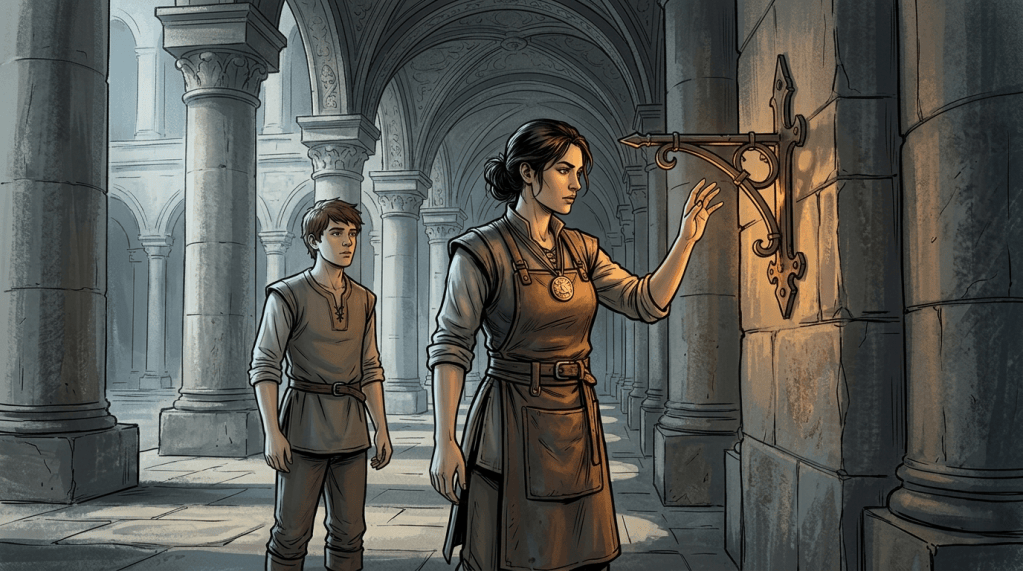
She stood in front of it on a Seventhday morning in early autumn, the colonnade empty at this hour, the Archive not yet open. The bracket was beautiful work — she could say that honestly, separate from the specification question. Clean lines, proper grain orientation in the steel, welds that had gone in smooth and cooled without distortion. Harrow’s specification, her execution.
A journeyman named Tomas appeared at her elbow. He was new to her section — six weeks in, quick hands, too eager to impress, which she was gradually correcting.
“Master Vesna.” He looked at the bracket with the focused attention of a young person trying to see what the master was seeing. “Something wrong with the joint?”
She looked at him. He was the age she had been when she had not spoken. He had her father’s same quality of direct attention — the kind that absorbed instruction and turned it immediately practical.
“What do you see?” she said.
He looked more carefully. He was good enough now to look properly — studying the weld line, checking the contact points, running his eye along the cross-member to where it met the load-bearing column.
“Clean,” he said. “Welds look good. I’d check the column anchor if I was doing an inspection, but from here it looks solid.”
“It is solid,” she said. “The execution is sound.”
He waited. He had learned that when she said one thing she sometimes meant to follow it with another.
“The specification has a tolerance issue,” she said. “The cross-member is undersized for sustained lateral stress. Not dangerously — not in a way that will hurt anyone. But in four or five years, during festival season, you’ll see a stress fracture at the third weld.”
Tomas looked at the bracket, then back at her. “Did you catch it during fabrication?”
“Before fabrication. During sign-off.”
He was careful with his next words, which was good instinct in a young person. “Why didn’t you — “
“I was a journeyman. Harrow was the Guildmaster.” She kept her voice level. “I had the calculations. I had the concern. I had three days to raise it and I said nothing.”
The colonnade was quiet. Somewhere above them, the Archive’s upper floors were starting their day — she could hear the distant movement of the first scholars arriving, the sound traveling down through stone.
“What would you do differently?” Tomas asked.
It was a genuine question, not a judgment. He was writing notes he would use for his own career, she understood. She was standing in front of a bracket she had made wrong on someone else’s specification, teaching a young person what she knew now that she had not known then.
“I would say it once,” she said. “Clearly. With the numbers. Without apology, but without accusation either — just the concern, stated plainly, so that whatever happened next, the concern was on record.” She looked at the bracket. “If he’d heard it and overruled me, that would have been his decision to make. That’s how rank works. But I never gave him the chance to make it. I made the decision for him by staying quiet, and then I made the bracket, and now I walk here on Seventhdays.”
Tomas absorbed this.
“When the stress fracture appears,” she said, “I’ll report it as a specification issue from the original commission. I’ll pull the sign-off records. My mark is on them, so I’ll explain what I knew and what I didn’t say and why. It will not be a comfortable conversation.” She paused. “But it will be the conversation I should have had four years ago, and I will have it without flinching because I have been practicing it since the week I stamped that sheet.”
She turned from the bracket.
“Come on,” she said. “We have the morning’s work.”
Tomas fell into step beside her. He said nothing further, which was the correct response. Some things required time to settle into the places where they’d be useful.
Behind them the bracket held, patient and flawed, in the early autumn light.
☕ Enjoyed this story? Writing Lumenvale is how I pay my bills. If these stories are worth something to you, a $1 Ko-fi keeps the forge burning — and tells me this world is worth continuing. 👉 Buy Chadwick a coffee


Leave a Reply