


The First Step
A Story from Lumenvale
The mountain had been still for three days.
This was normal. Grandfather Ironheart rested when the season turned, when the snowmelt on his upper flanks needed time to drain into the lower cisterns before the walking resumed. Bren had known this since he was four years old and had pressed his ear to the granite floor of their dwelling to feel the deep slow breathing that meant rest, not death. Every Peak-rider child learned the difference early. It was the first thing you learned.
The second thing you learned was not to stand at the edge of the crown platform when the walking resumed.
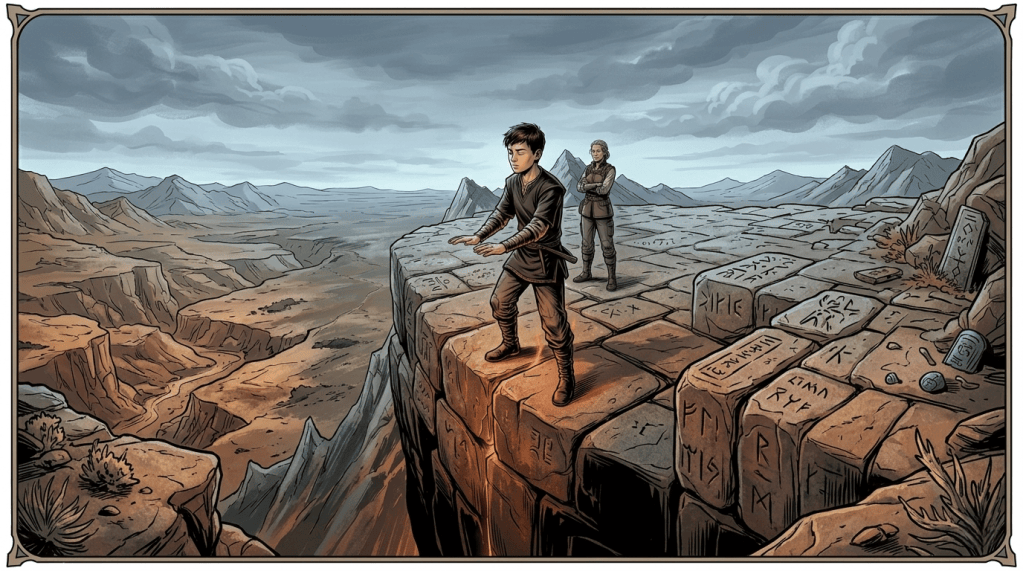
Bren was standing at the edge of the crown platform.
He had his reasons. He was sixteen, which in itself was not a reason but felt like one. He had also been assigned, three weeks ago, to his first solo reading — the task of pressing his hands to the mountain’s outer skin and interpreting the stone-song without a senior rider to confirm his interpretation. This was how it went. You trained for years under your parents or your assigned elder, learning to feel the difference between a joint ache and a structural warning, between the deep vibration of contentment and the subtler frequency of distress. And then one day someone handed you the responsibility and walked away.
His elder, Davena, had not actually walked away. She stood twenty paces behind him at the inner rail, arms folded, watching with the expression of a woman who had seen sixteen-year-olds attempt this before and intended to let it unfold without interference.
The stone under his palms was warm. That was not useful information — the crown stone was always warm, heated from below by the mountain’s internal furnaces. What he needed was beneath the warmth. The song under the warmth. The particular frequency that would tell him whether Grandfather Ironheart intended to rise today, or tomorrow, or in another three days.
He breathed the way Davena had taught him. Slow into the belly. Hold for a count of four. Release through the nose. Feel for the resonance where his heartbeat met the stone’s deeper pulse.
Nothing.
He tried again. The wind off the upper peaks pushed at his back, cold and indifferent. Below the crown platform, the residential levels of the mountain’s city went about their morning — he could hear the stone-goats in the lower paddocks, the resonance-birds singing their calibration songs from the mountain’s ear-ridge, the ordinary sounds of a community that had built its entire existence around something that moved. They were not nervous. They had been doing this for generations.
Bren had been doing it for sixteen years, and his hands were sweating.
“You’re gripping,” Davena said from behind him.
He was. His fingers had curled slightly without his noticing, pressing harder than contact required. You had to rest against the stone, not demand from it. The mountain shared its song willingly with those who asked. It gave nothing to those who reached in and tried to take.
He uncurled his fingers. Rested his palms flat again, the way you rested a hand on a sleeping person’s back to feel them breathe.
There.
It was fainter than he expected — quieter than any rising-frequency he had practiced on during training, when Davena had shown him recordings of previous awakenings, when he had felt the rehearsal-vibrations she created by tapping the resonance-plates deep in the mountain’s communication chambers. But it was there. A low, sustained hum at the base of his awareness, rising in intervals of seven, the pattern that every Peak-rider knew the way they knew their own heartbeat.
Ironheart was waking.
Not now. Not in an hour. But by midday the joints would begin to flex, the deep internal mechanisms that moved six hundred meters of living stone would begin their preparations, and by early afternoon the crown platform would tilt at the familiar three-degree angle that marked the first step. If you were standing at the edge when that happened — and Bren had been told this story approximately forty times — you went over. The angle was not large. It was exactly large enough.
He stepped back from the edge.
“Well?” Davena said.
“Rising frequency. Pattern of seven. Midday preparation, early afternoon first step.”
She was quiet for a moment. The wind moved between them.
“Confidence?”
This was the question that mattered. Not just the reading, but whether you trusted it. Whether you would stake the safety of your community’s preparations on what your hands had told you. Bren had given readings before — dozens of them, with Davena’s hands alongside his, her confirmations arriving quietly after his interpretations. He had never given one alone. He had never had to decide, by himself, whether he believed what he felt.
His palms were still warm from the stone. The pattern of seven still moved in his chest, syncopated with his own heartbeat.
“High,” he said. “I’m confident.”
Davena unfolded her arms. She walked to the platform’s edge — where he had been standing thirty seconds ago — and pressed both palms flat against the crown stone. She stayed that way for half a minute, eyes closed, the focused stillness of someone reading something important.
When she turned back, her expression had not changed. This told him nothing. Davena’s expressions were not a reliable instrument for gauging correctness; she had the same composed look when a student was completely right and when they were about to be gently corrected.
“Go tell the Stable-master,” she said. “Early afternoon first step. Ask him to secure the lower paddocks by noon.”
He was already moving. Then he stopped.
“Was I right?”
She had already turned back to the view — the wide plain below, the distant grey-green of the migration grasslands, the sky that was the same color as the inside of the reading-stones when the song moved through them. She did not look back at him.
“You were the one reading,” she said. “I didn’t have my hands on it.”
He understood what she was not saying. He had known what she was not saying before he asked, which was perhaps why he had asked. There was a particular nervousness that did not go away when you were right. It only went away when you accepted that the nervousness was not a warning — it was the cost of being the person responsible for something that mattered.
He went down to tell the Stable-master.
At midday, the mountain began to warm from below.
At early afternoon, exactly when Bren’s hands had told him it would, Grandfather Ironheart took his first step. The crown platform tilted its familiar three degrees. The resonance-birds sang their position-songs. The stone-goats, safely in their secured paddocks, did not go over the edge.
Bren was not on the crown platform. He was in the lower residential levels helping his mother secure the loose shelving that always needed attention on first-step days. His hands still remembered the frequency. He thought they probably always would.
The mountain walked east, as it had always walked, following paths laid down in geological memory older than any record Lumenvale’s Grand Archive held. The plain moved below them. The horizon shifted. The nervousness did not entirely go away.
He was starting to understand that it wasn’t supposed to.
☕ Enjoyed this story? Writing Lumenvale is how I pay my bills. If these stories are worth something to you, a $1 Ko-fi keeps the forge burning — and tells me this world is worth continuing. 👉 Buy Chadwick a coffee
Every cup counts more than you know.


Leave a Reply