


The Last Hour of the Forge
A Story from Lumenvale
The mystery began, as most mysteries do, with a simple observation.
For eleven months, Petra had watched Master Corryn close the forge at dusk. The same sequence every evening — tools hung in their proper order on the iron rack, the bellows covered, the forge coals banked with the particular economy of someone who had done it ten thousand times and stopped thinking about it. Then his apron came off, folded once, set on the corner bench. Then his boots went back on — the soft ones he kept by the door, not the forge boots. Then he left.
Not home. She knew where he lived. She’d delivered a commission to his house once, a set of enchanted hinges for a Magisterium door, and it sat three streets north of the Artificer’s Quarter. He didn’t walk north.
He walked south. Toward the canals.
For eleven months she had assumed there was somewhere he went — a tavern, a friend’s house, an errand that took him along the water before looping him back north for supper. It was none of her business. She was a second-year apprentice, and the boundaries between apprentice and master were ancient and respected, and she understood this.
On the twelfth month, on an evening when she had stayed late to finish buffing the seams on a commission that was due at dawn, she followed him.
He walked south along the Artificer’s main lane, past the enchanters’ row where light still bled through shuttered windows, past the copper-workers’ guild whose chimney never fully went cold, past the narrow alley where the scrap collectors sorted their day’s work with the particular clanging musicality that drove the neighboring tenants half-mad. He walked without hurrying, without purpose in his pace, which was itself strange — Corryn moved through the forge the way water moved through the Spires’ harmonic conduits, always exactly where it needed to be.
Out here he moved differently. Slower. Like something unwinding.
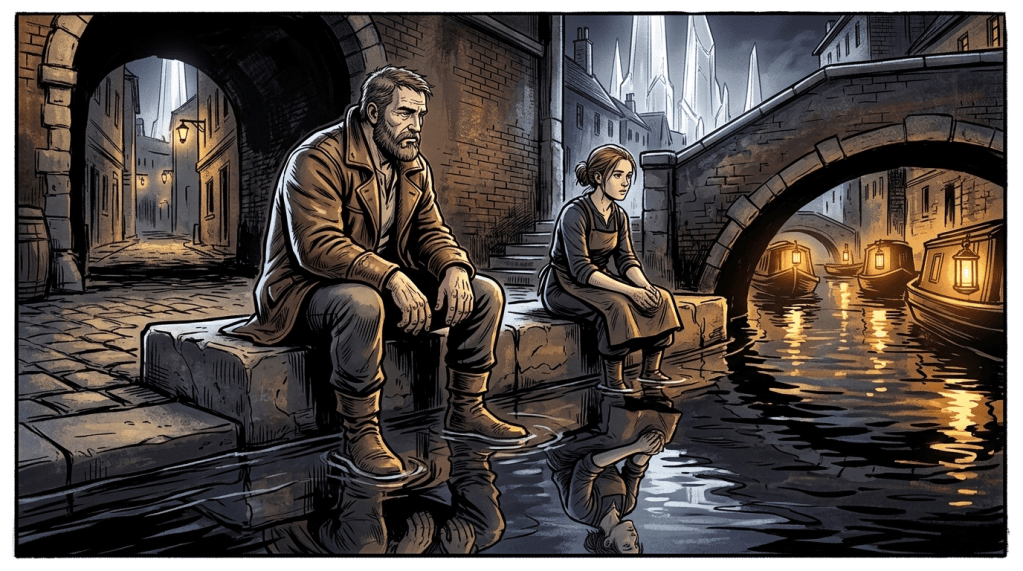
He reached the canal at the old stone junction where the northern and western waterways met in a wide elbow of dark water. There was a worn flat stone there, part of an old bridge footing that had outlasted the bridge by at least two centuries, low enough to the water that on high-flow days it disappeared entirely. He stepped down onto it, settled himself, and went still.
Petra stopped at the canal’s edge, ten paces back, in the shadow of a warehouse overhang.
He wasn’t doing anything.
She waited for him to produce something — a fishing line, a book, a flask, a pipe. She waited for someone to join him, for a conversation to begin, for the purpose of it to reveal itself.
Nothing. He sat with his hands loose on his knees, looking at the water, and the water moved past him in its silver indifferent way, and the Crystal Spires began their evening shift from gold to luminous white somewhere above the roofline, and Master Corryn, finest smith in the Artificer’s Quarter, sat on an old stone and did absolutely nothing.
She was back the next evening before he arrived. She told herself this was reasonable.
On the third evening, he spoke without turning around.
“Apprentice Petra.” His voice had the same quality it carried in the forge — not unkind, but without any particular invitation in it either. “If you’re going to keep coming, you may as well sit.”
She felt her face go hot in the cooling evening air. She stepped down from the bank and sat on the edge of the stone footing, keeping proper distance, her hands folded in her lap with the rigid posture of someone trying to look like she hadn’t just been caught doing something she couldn’t explain.
“I wasn’t — ” she started.
“You were.” He didn’t say it with any reproach. Just as a fact. “What did you think I was doing?”
“I didn’t know. That’s why I — ” She stopped. Started again. “There must be something. You come here every night. Masters don’t do things without reasons.”
Something shifted at the corner of his mouth. Not quite a smile.
“Sit properly,” he said. “You look like you’re waiting for a judgment.”
She eased her posture, reluctantly. The stone was cool and rough under her, and the canal smelled of iron and water-weed and the faint sweetness that came off the canal boats in the evenings when their cook-fires were lit. Somewhere nearby, a night bird she couldn’t name was making a sound like water dripping into a deep well.
They sat in silence for a while. She counted her own breaths and tried not to fidget.
“What did you make today?” he asked.
The question surprised her — he’d been there all day, he knew exactly what she’d made. “The bracket assembly for the Archive commission. Third and fourth panel supports.”
“How did they come out?”
“The third was clean. The fourth — ” She paused. “The fourth had a stress line in the weld on the east joint. I caught it before tempering. Ground it back and redid it.”
He nodded. “How long did the redo take?”
“An hour and a half.”
“And how did you feel when you caught the stress line?”
She considered. “Annoyed. Then — ” She paused again. “Then it was all right. The fixing of it was all right.”
“The fourth panel will be stronger than the third,” he said. “You know that.”
“Yes.”
“And in two years you’ll catch that stress line thirty seconds in instead of thirty minutes in, and it won’t cost you an hour and a half, it’ll cost you five minutes, and you’ll feel nothing about it because it will simply be part of the work.” He looked at the water. “That’s how it goes.”
Petra waited, certain there was more. He said nothing further.
“Is that what you think about?” she asked. “Out here?”
“No.” He picked up a small piece of broken canal-stone from beside him, turned it in his fingers, set it back down. “Out here I don’t think about the forge at all.”
She looked at him. “But you just — “
“I asked because you’re in your second year and those are the questions that matter in your second year.” He glanced at her briefly. “Here I’m not your master. Out here I’m just a man sitting by water.”
Petra was quiet, trying to understand the distinction and finding it stranger than she expected.
“You’re the best smith in the Quarter,” she said finally, because it was true and she had always said true things even when the timing was poor. “People say you work better than men half your age. Master Drenwick says your technique is — “
“Drenwick talks a great deal.” There was no edge in it.
“Don’t you want to — ” She stopped.
“What?”
“I don’t know. Practice. Plan. Think about tomorrow’s commissions. Whenever I leave the forge I feel like I should be doing more, thinking more, finding the things I missed during the day.” She looked at her hands, the small burns and calluses of eleven months at the anvil. “I always feel like I’m not working hard enough.”
Corryn was quiet for a long moment.
A canal boat passed at the far end of the junction, its lantern swinging gentle arcs of gold across the water’s surface. Two figures on the deck were talking, their voices carrying across the distance as a warm unintelligible murmur. Then they were gone, and the water settled back to its own business.
“How much does a blade weigh?” he asked.
She blinked at the shift. “Depends on the blade.”
“Ceremonial short blade. Commission work. The kind you’ll make in your fourth year.”
“Seven hundred grams, roughly. Maybe eight for a heavier commission.”
“And when you’re working the steel, you’re holding it, turning it, judging it by its weight and heat and the sound it makes under the hammer.” He paused. “Can you do that forever?”
“No. Your arms give out.”
“They do.” He spread one hand, looking at it without particular emotion — the thick knuckles, the burns layered over older burns, the calluses so established they had their own topography. “Your eye gives out. Your judgment gives out. You start making small errors you don’t catch because the part of you that catches errors is the same part that’s been working since dawn.” He closed his hand. “The forge is a thing you carry all day. Heavy things need to be set down.”
Petra looked at the canal. Looked at the stone beneath them, worn smooth by weather and perhaps by him, by years of sitting exactly here.
“This is where you set it down,” she said.
“Every night. For as long as it takes.” He picked up the piece of canal-stone again. “When I was your age I never set it down. I took the forge home with me and I laid down with it at night and I got up with it in the morning. I was very productive.” A pause. “I was also a miserable man.”
The night bird made its deep dripping sound again somewhere in the shadows.
“How long do you stay?” she asked.
“Until I’ve forgotten what I made today.”
She turned to look at him. “Forgotten?”
“Not permanently. It comes back fresh in the morning.” He almost smiled. “But here I sit until the day’s work stops living in my hands. Until my hands are just hands again. Until I’m just a person who happens to work a forge rather than a forge that happens to be attached to a person.” He set the stone down one final time. “Then I go home and eat my supper and sleep like a man who isn’t carrying anything.”
Petra was quiet for a long time.
The Crystal Spires had completed their shift to full evening white. Their song was barely audible from this distance — less a sound than a pressure change in the air, something her chest recognized before her ears did. The canal moved. The lamplighter passed behind them on the high bank without stopping, knowing this section by memory and habit, touching each post to amber light in a rhythm as old and reliable as any forge work she’d ever seen.
“I thought you were going to teach me a technique,” she said at last. “Some method. Some way of improving in the evenings.”
“I know.” He stood, unhurried, straightening with the careful economy of a man who respected the demands of his own body. “That’s why you followed me.” He looked at her for a moment with the direct appraising look he used when examining finished metalwork — not unkind, but seeing clearly. “You’re very good, Petra. You’ll be better than me in eight years if you stay.”
She didn’t know what to do with this, so she said nothing.
“But not if you try to work all twenty-four hours.” He stepped back up to the bank. “The forge will always be there in the morning. Put it down.”
He walked north, toward home and supper, the soft boots quiet on the old cobbles.
Petra sat on the stone for a while longer, watching the water. She tried, deliberately and with some effort, to stop thinking about the stress line in the fourth panel’s east joint. Tried to let her hands simply be hands. Tried to be, for a few minutes, just a young woman sitting by a canal in a city that was settling into dark around her.
It was harder than she expected.
But she stayed until it got a little easier, and then a little more, and when she finally walked home through the lamplit streets of the Artificer’s Quarter, she thought she understood something she hadn’t when she left.
She was back the next evening. This time she brought a piece of canal-stone of her own.
☕ Enjoyed this story? Writing Lumenvale is how I pay my bills. If these stories are worth something to you, a $1 Ko-fi keeps the forge burning — and tells me this world is worth continuing. 👉 Buy Chadwick a coffee
Every cup counts more than you know.


Leave a Reply