


Seventeen Minutes
A Story from Lumenvale
Nobody stayed at the Spire Complex after the dusk sequence completed.
That was simply how it worked. The day-singers finished their transition, the night-keeper took the evening watch, and the rest of the staff filtered out through the lower gates and dispersed into the city — toward supper, toward family, toward the particular relief of people whose bodies had been instruments all day and were grateful to be nothing more than bodies again.
Davan stayed because the east maintenance corridor needed its harmonic conduits checked after a feedback tremor three days prior, and because nobody else had volunteered, and because he was still new enough to the Grounds Guild that he said yes to things senior staff quietly declined. He didn’t particularly mind. He was twenty-two and had not yet learned to protect his evenings.
He was halfway through the third conduit panel when he heard it.
Not singing. He’d been hearing singing all day — the deep ceremonial harmonics of the transition sequence, the overlapping tones of the day-keeper handing off to the night-keeper, the constant low resonance the Spires themselves exhaled like breathing. He had stopped truly hearing any of it weeks ago, the way canal workers stopped hearing water.
This was different.
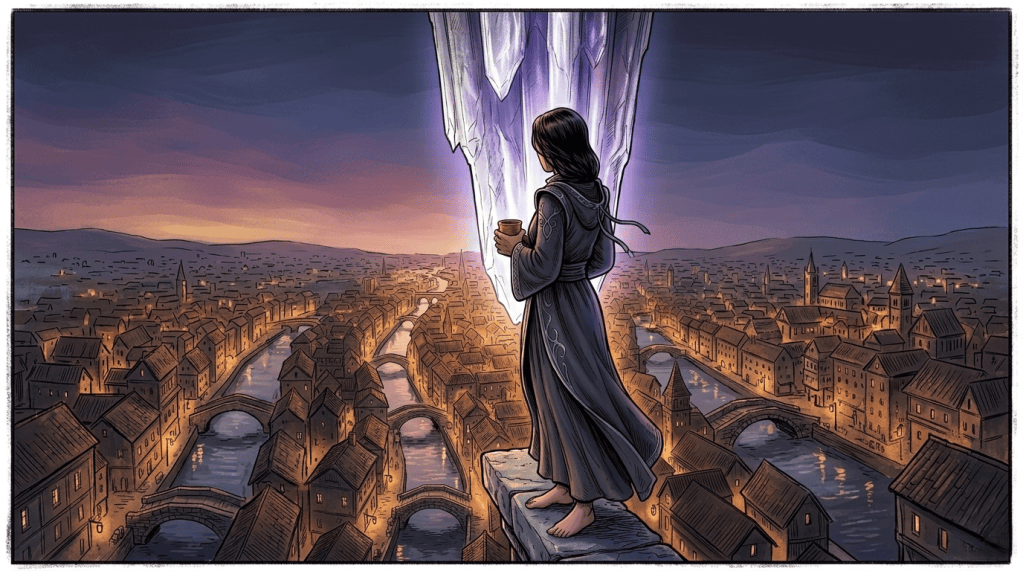
He set down his calibration tool and moved toward the sound without deciding to, the way you move toward warmth in winter. It led him down the east corridor and out onto the observation ledge — a narrow stone shelf that wrapped the base of the third Spire, wide enough for two people standing close, overlooking the city’s northern districts where the canal network spread out like spilled silver in the last bruise of daylight.
A woman stood at the ledge’s far end.
He recognized her from the schedule boards — Auren Solis, dusk-transition Keeper, one of three who managed the evening sequence. She was still in her resonance robes, though she’d loosened the formal collar ties. Her boots were off. Her feet were bare on the cold stone, which struck him as such a specific and private detail that he almost retreated back into the corridor.
She was not singing.
She was — he searched for the word and could only find the simplest one — still. Her hands rested loose at her sides. Her face was turned toward the city, not with the focused attention of a Keeper reading harmonic patterns, but with the open unfocused gaze of someone who had stopped reading anything at all. A small clay cup sat on the ledge beside her, steaming with something that smelled of cardamom and char.
He must have made some sound, because she turned.
She did not seem alarmed. She looked at him the way a person looks at a cat that has wandered into a room — curious, mildly assessing, deciding without urgency what to do about it.
“Conduit work?” she said. Her voice had the particular texture of someone whose vocal cords had been working since midmorning. Not hoarse exactly. Worn smooth, like river stone.
“Third panel,” he said. “Sorry. I didn’t know anyone was — the schedule said the observation ledge clears after transition.”
“It does.” She turned back to the city. “I’m not on the schedule.”
He should have gone back to his panel. Instead he stood at the ledge entrance with his calibration tool in his hand, watching the city do what cities did at this hour — soften, slow, begin its long exhale toward dark.
“What are you doing?” he asked. Then, immediately: “Sorry. That’s — you don’t have to answer that.”
“I’m not doing anything,” she said. “That’s the point.”
He was quiet for a moment, considering this.
“How long do you stay?”
She reached for the clay cup, held it between both palms without drinking from it. “Seventeen minutes. Give or take.”
Seventeen minutes. He knew the number, of course — every member of the Grounds Guild did. The interval between the dusk sequence completing and the night harmonics initializing, the brief window when the Spires settled into their rest-state and the city’s crystal-song dropped to its lowest register. Staff called it the quiet, a word that technically referred to the reduced harmonic output but which anyone who’d worked the complex long enough understood meant something harder to explain.
“You come here every night?”
“Most nights.” She finally drank from the cup. “Since my third year. When I figured out that the transition sequence takes everything I have — not the training, not the technique, all of that becomes reflex eventually. But the actual cost of it. The part that doesn’t have a name in any of the guild manuals.” She paused. “I tried going straight home. Tried supper with colleagues. Tried the bathhouses on the Luminescent River. Nothing worked until I tried this.”
“Nothing?”
“I’d carry the transition home with me. Wake up at two in the morning hearing frequencies that weren’t there. Answer questions at dinner with the wrong part of my mind.” She shook her head. “I was living my evenings like a bell that hadn’t stopped ringing.”
The city below was reaching the particular threshold where lanterns overtook daylight, the balance tipping street by street. From this height, Davan could watch it happen — a lamp here, three more there, the Merchant Quarter warming from gray to amber in slow patches, the canals going from silver to black to silver again in a different way.
“What does it do?” he asked. “The seventeen minutes.”
Auren considered the question seriously, the way guild seniors considered calibration questions — not dismissing them, but not rushing either.
“You know what the Spires are like during transition,” she said. “Every harmonic they produce for those seventeen minutes, you’re shaping. Channeling. There’s nothing that passes through without going through you first.” She turned the cup in her hands. “After that — I need seventeen minutes of nothing passing through me at all. I need to be a person who isn’t receiving anything. Isn’t transmitting anything. Just standing here, being made of skin and bone, watching people light their lamps.” She paused. “It sounds simple.”
“It doesn’t sound simple,” he said.
She looked at him then — really looked, with the focused attention she had clearly been resting from.
“How long have you been with the Grounds Guild?”
“Eight weeks.”
“Do you like it?”
He thought about the conduit panels, the calibration tables, the particular satisfaction of a harmonic reading that came back clean. “I think I will,” he said. “I’m still learning what I’m doing, mostly.”
“That’s the right answer.” She finished the last of her cup. “The ones who say they like it before they understand it usually burn out by spring.”
They stood together in the easy silence of people who have nothing to prove to each other, watching the city fill with light. Below, a night-ferry was making its way along the northern canal, its bow-lantern drawing a long reflection that stretched and bent with the current. Somewhere in the Merchant Quarter, someone was closing up a stall with more noise than strictly necessary. The Spires above them exhaled their quiet breath, seventeen minutes of true rest before the night harmonics began.
“I should finish the third panel,” Davan said eventually.
Auren nodded, already turning back to the city.
He was halfway into the corridor when she spoke again.
“Grounds Guild staff are allowed on the observation ledge during off-hours. It’s in the secondary charter, section four.” A pause. “In case you were wondering whether you’re supposed to be here.”
He looked back. She wasn’t looking at him. She was watching a lamp come on three streets over, the small warm rectangle of someone’s window finding its light.
“Thank you,” he said.
She lifted one hand — not quite a wave, not quite a dismissal. Just an acknowledgment that he had been here, and that it had been all right.
He went back to his panel. He worked through the third conduit and then the fourth, and when he finally packed his tools and walked back through the lower gate into the city, the Spires had resumed their full evening harmonics — complex and beautiful and present in the chest the way the sound of a river is present, so familiar you only notice it when it stops.
On the walk home, he found himself thinking about what it might mean to carry your work home inside you, ringing and ringing, long after the work was done. He was twenty-two and had not thought about this much yet.
He thought about it all the way home.
☕ Enjoyed this story? Writing Lumenvale is how I pay my bills. If these stories are worth something to you, a $1 Ko-fi keeps the forge burning — and tells me this world is worth continuing. 👉 Buy Chadwick a coffee
Every cup counts more than you know.


Leave a Reply