


What the Lanterns Remember
A Story from Lumenvale
The old man came every evening at the hour when the Crystal Spires began their slow bloom into gold.
Senna had watched him for three nights from her bench at the canal’s edge — the same bench where she ate her supper wrap after her shift at the weavers’ guild, the same bench where she let her feet stop hurting before the long walk home through the Merchant Quarter. She had not meant to notice him. She had simply been sitting, chewing, watching the silver water catch the last of the daylight.
But you noticed a man like this. The way he moved through a crowd like the crowd wasn’t there. The way he carried himself — not with the forward lean of purpose, not with the shuffle of age, but with something in between, like a man who had already arrived somewhere else entirely and was only bringing his body along out of habit.
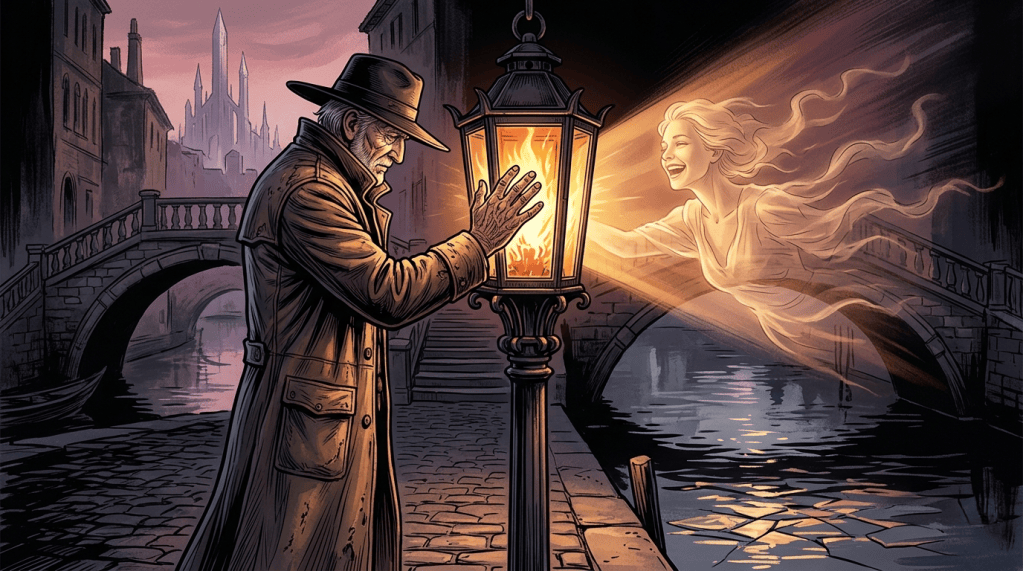
He stopped at the echo-lantern post at the fourth canal junction, the tall iron one with the green patina at its base and the carved herons along the crossbar. Every citizen of Lumenvale knew the echo-lanterns. They’d stood at the major junctions for three generations — enchanted posts where you could press a memory-stone to the glass and cast a moment outward into the air, a projection for any passerby who cared to stop and see. Most people used them for news, for trade announcements, for festival notices. Children used them to share first snowfalls. Young couples used them, briefly and embarrassingly, to share the view from a particular rooftop.
The old man pressed his memory-stone to the glass.
Light bloomed outward from the lantern in a soft wash of amber and pale rose — and there she was. A woman. She was standing in a kitchen that Senna did not recognize, in a morning that might have been any morning in the last thirty years, and she was laughing at something off to the left that the memory did not capture. Her hair was silver-streaked and loose, and she had flour on her left cheek, and she was laughing with her whole body, the kind of laugh that starts somewhere below the ribs.
The projection lasted perhaps twenty seconds. Then the light folded back into the lantern like water returning to a cup.
The old man stood with his hand still resting on the warm glass. Not weeping. Not smiling, exactly. Just present, the way people are present when they are holding something that cannot be held for much longer.
Senna forgot about her supper wrap.
On the fourth night she arrived early, positioning herself at the far end of the bench with a book she did not read. She told herself this was not strange. People watched echo-lanterns all the time. That was the point of them.
He came as the spires turned gold, as he always did. Tonight he wore a woodworker’s apron that he hadn’t bothered to remove, and there were curls of cedar shaving caught in the fold of his collar. His hands, when he reached into his coat, were the hands of someone who had worked with them every day of his life — wide and deliberate, the knuckles thickened with old labor.
He withdrew the memory-stone. Small and pale, not much larger than a sparrow’s egg.
Tonight’s memory: the same woman, older now, sitting at the edge of the Luminescent River with her shoes off and her feet in the water. Evening light on the river’s soft glow made everything amber. She was eating something — a peach, maybe — and watching the water the way people watch water when they’ve run out of things to need. She looked utterly and completely content.
A young couple passing behind Senna paused to watch, then moved on with a murmur Senna couldn’t catch.
When the light folded away, the old man stood quietly for a moment. Then he tucked the stone back into his coat and turned to walk home.
“Excuse me,” Mira said.
She hadn’t decided to speak. She was as surprised as he was.
He turned, unhurried, with the mild expression of a man who no longer startled easily.
“I’m sorry,” Senna said. “I’ve been watching. I don’t mean — I only wanted to ask.” She stopped. “How long ago?”
The old man looked at her for a moment, taking her measure the way craftspeople did, assessing without judgment.
“Two years this winter,” he said. His voice was low and even, the voice of someone who had said the number aloud enough times that it no longer broke him, though she could hear where it had broken once.
“I’m sorry,” Senna said again, meaning it differently this time.
He nodded, accepting it.
She looked at the lantern post, at the faint warmth still lingering in the glass. “Do you come every night?”
“Most nights.” He paused. “She used the echo-lanterns. Always had. She’d share the view from our upstairs window on clear mornings. The frost on the canal in the first week of winter. The cats that sleep in the Cobalt Bazaar.” A brief quiet. “Small things. She always said the lanterns were for small things — that the big things people already knew about.”
Senna thought of all the things she had ever shared on the lanterns. Trade announcements. A sale at the guild. The time a wind-ship from Aethermoor had docked at the upper port and she’d thought people might like to see.
“She sounds like she understood something,” Senna said.
“She understood most things,” the old man said, without bitterness, without performance. Simply as a fact.
He turned to go, and then paused with the particular hesitation of someone who has decided to offer something they don’t often offer.
“The one from last night,” he said. “The one in the kitchen. That was her birthday morning. I’d tried to make the almond cake she liked. I’d burned the first two. I was trying to hide the evidence and she found the pan in the garden where I’d thrown it to cool.” He exhaled through his nose — not quite a laugh, but the ghost of one. “She laughed for a full minute. I was embarrassed. She told me it was the best birthday she’d ever had.”
He said this not for her, Senna understood. He said it because the echo-lanterns only held twenty seconds, and twenty seconds was not long enough, and he had thirty-two years of small moments stored in that pale stone, and some of them needed air.
“My name is Senna,” she said.
“Calder,” he said. “Calder Ashvane.”
He touched the brim of his hat — an old gesture, the gesture of another era — and walked back into the city.
Senna sat for a long time after he had gone. The canal moved in its silver way, indifferent and endless. The Spires shifted from gold toward the soft luminous white of full evening, their song just barely at the threshold of hearing, less a sound than a feeling in the chest.
She thought about the woman in the kitchen, laughing at a ruined cake.
She thought about all the mornings she had not preserved. The light on her own windowsill at dawn, the smell of her neighbor’s bread, the particular way the canal sounded on rainy evenings when the water ran high and fast. The thousand ordinary moments she had moved through without pressing them to glass.
The lantern post stood patient at the junction, its carved herons watching the water.
On the way home, Senna stopped at a stone-cutter’s stall in the Merchant Quarter, still open in the early dark, and bought a memory-stone. It was small and plain and cost less than her supper wrap.
She held it in her palm all the way home, thinking about which moment to put in it first.
☕ Enjoyed this story? Writing Lumenvale is how I pay my bills. If these stories are worth something to you, a $1 Ko-fi keeps the forge burning — and tells me this world is worth continuing. 👉 Buy Chadwick a coffee
Every cup counts more than you know.
New chapters every Monday — get them free by email
📅 Chronicles of the Giantess returns Monday, November 23, with a new chapter every Monday. Subscribe free and new chapters and stories come straight to your inbox.
New here? Start Here → · More Lumenvale stories · All series


Leave a Reply