
When was the first time you really felt like a grown up (if ever)?
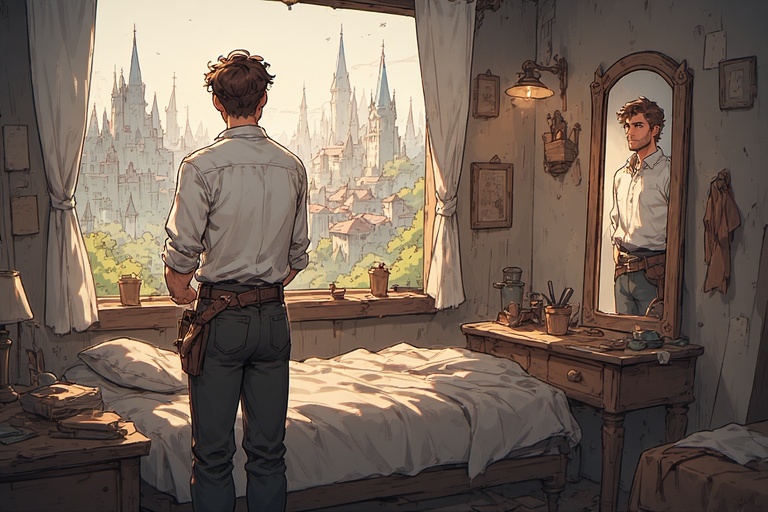
The morning of his thirtieth birthday arrived without fanfare, marked only by the familiar weight of consciousness returning as dawn light filtered through the threadbare curtains of his rented room. Rowan Ashfield lay still, watching dust motes dance in the amber glow, aware of something fundamental shifting in the architecture of his understanding—a tectonic movement too subtle for immediate comprehension but powerful enough to reshape the landscape of everything that would follow.
Around him, the room catalogued a decade of transience. Clothing draped over a chair borrowed from the landlady downstairs. Books stacked in precarious towers against walls that belonged to someone else. A sword leaning in the corner, its leather scabbard worn from years of use but the blade itself rarely drawn except for practice. The accumulated possessions of a man who had spent his twenties moving through life like water finding the path of least resistance, always temporary, always ready to flow elsewhere when circumstances shifted.
Thirty years. Three decades on this earth, walking beneath the Crystal Spires of Lumen Vale, breathing the mountain air, eating bread baked by hands that were not his own, sleeping in beds that would never carry the weight of his history because he had never stayed anywhere long enough to create history worth remembering.
The realization arrived not as dramatic revelation but as quiet recognition, the way one might notice that seasons had changed while attention was directed elsewhere. He was no longer young. The elasticity of youth—that miraculous capacity to make mistakes and start over, to try and fail and try again with time stretching endlessly forward like an infinite road—had calcified into something more finite. The future, once a vast territory of unlimited possibility, had contracted into a landscape with visible boundaries.
Rowan rose from the narrow bed, his body moving through morning routines with practiced efficiency. Washing from the basin of cold water. Dressing in clothes that were clean but worn, respectable but unremarkable. Running fingers through hair that showed its first threads of gray at the temples—markers of time’s passage that he’d been ignoring until this particular morning made them impossible to dismiss.
The mirror above the washstand reflected a face he barely recognized. Not because it had changed dramatically, but because he was seeing it clearly for perhaps the first time. The smooth confidence of twenty had weathered into the more complex terrain of thirty. Lines bracketed his mouth, carved by laughter and worry in equal measure. His eyes carried knowledge that his younger self had lacked, but also a particular exhaustion that came from years of never quite committing to anything permanent.
He had been everywhere and nowhere. Worked for the merchant guilds, the city guard, a noble house, a traveling theater troupe. Lived in six different quarters of the city, tried his hand at a dozen professions, cultivated the appearance of capability without ever developing deep expertise in any single domain. He was competent at many things and master of nothing—a generalist in a world that rewarded specialists, a transient in a society built on accumulated investment.
The revelation that had been building through the night crystallized as he descended the narrow stairs to the street: he had been waiting for his life to begin, treating everything as rehearsal for some grand performance that never quite materialized. But there was no grand performance coming. This was it—the only life he would receive, unfolding moment by moment whether he actively shaped it or simply allowed it to happen to him.
Lumen Vale spread before him in the morning light, the city he’d called home without ever quite belonging to it. The Crystal Spires sang their eternal harmonies, their music filtering through districts where people owned shops and houses, where families gathered for meals in kitchens that smelled of accumulated generations, where neighbors knew each other’s names and histories because they had stayed long enough to become woven into the community’s fabric.
Rowan walked without destination, his feet carrying him through familiar streets while his mind processed implications that kept branching into uncomfortable territory. Thirty years old with nothing to show for it except experience that hadn’t accumulated into expertise and connections that hadn’t deepened into community. No property. No established reputation. No roots reaching deep enough into any soil to provide genuine stability.
The Artisan Quarter revealed itself in the golden morning—workshops where craftspeople bent over their trades, merchants opening shutters to display wares that bore their names and reputations. Old Henrik was already at his forge, the ring of hammer on metal providing rhythm to the morning’s awakening. The baker’s daughter—he’d known her name once, before he’d moved to a different quarter—arranged fresh bread in the window display with the casual competence of someone who knew exactly what her day would hold.
These people had foundations. They had built something that would outlast them, had invested in futures that extended beyond their individual lifespans. When they died, they would leave gaps that communities would feel and remember.
When he died—the thought arrived with uncomfortable clarity—what would mark his passage? A few people might remember him vaguely as someone who had passed through, who had been pleasant enough company but never quite present enough to matter deeply to anyone.
The realization hurt with the particular ache of recognizing self-inflicted wounds. He had cultivated transience, had treated permanence as confinement rather than foundation. But freedom without direction was just another form of being lost.
Near the city’s eastern wall, where Lumen Vale’s terraced districts began their descent toward the working quarters, Rowan found himself drawn to the land office—a modest building where property transactions were recorded and territorial claims officially recognized. He’d passed it countless times without really seeing it, another administrative structure that served purposes irrelevant to his rootless existence.
Today, he entered.
The clerk behind the desk looked up with the practiced neutrality of someone accustomed to citizens seeking information they didn’t quite know how to request. “Help you?”
“I’m looking for information about available properties,” Rowan heard himself say, the words emerging before conscious decision had fully formed. “Land for building, or perhaps existing structures that might be available for purchase.”
The clerk’s expression shifted minutely—not quite surprise, but recognition of someone crossing a threshold. “Looking to put down roots?” he asked, not unkindly.
“Something like that.”
Maps emerged from carefully organized drawers, their surfaces covered with notations in the precise hand of bureaucratic record-keeping. Properties available in various districts, each with its own characteristics and price considerations. Land in the upper terraces commanded premium rates but offered prestige. Lower quarters provided more affordable options but less immediate status. The merchant districts fell somewhere between—respectable addresses for people who earned their standing through commercial success rather than inherited privilege.
Rowan studied the maps with growing understanding of how unprepared he was for such decisions. He’d spent a decade moving through life without building the capital—financial or social—that made property ownership feasible. The prices listed beside available parcels might as well have been astronomical distances, equally impossible to traverse with his current resources.
“Most folks start smaller,” the clerk observed, reading his expression with the expertise of someone who’d seen many versions of this same realization. “Pooled investments with partners, or apprenticeships that include lodging rights. Build up capital over years, establish reputation, prove creditworthiness.” He paused, his tone softening slightly. “Takes time. Foundation work always does.”
Foundation work. The phrase resonated through Rowan’s consciousness like a stone dropped into still water, ripples spreading outward to touch everything he thought he understood about how lives were built.
He had been treating existence as something that happened to him rather than something he actively constructed. Had accepted temporary positions rather than committing to career development. Had moved from room to room, quarter to quarter, always ready to leave, never investing enough to create genuine belonging.
But thirty years had passed while he wasn’t paying attention, and the infinite horizon of youth had contracted into the visible boundaries of middle age. Time remained, certainly—decades potentially, if fortune and health cooperated—but not unlimited time. Not time that could be spent indefinitely waiting for conditions to become perfect before beginning the actual work of building a life.
“What would you recommend,” Rowan asked slowly, “for someone starting from minimal resources who wants to eventually own property?”
The clerk leaned back, considering the question with the thoughtfulness of someone who took his work seriously. “Depends on your skills and temperament. Guilds offer structured paths—apprenticeships that include lodging, journeyman positions that build capital, eventual master status that provides stability. Or there’s independent trade, which offers more autonomy but requires more personal investment and carries higher risk.”
“I have varied experience,” Rowan admitted. “Guard work, merchant operations, some theatrical work. Competent at many things, master of nothing in particular.”
“Then you’ll need to choose,” the clerk said plainly. “Pick one path and commit to developing real expertise. That’s how foundation gets built—by staying in place long enough for roots to establish.”
The afternoon found Rowan at the Broken Shield tavern where he’d spent countless evenings over the past year, drinking with acquaintances whose names he knew but whose lives he’d never really entered. Today, the familiar space appeared different—not changed in any physical sense, but transformed by his altered perception of his own relationship to everything around him.
Merchants gathered at corner tables, discussing business ventures with the comfortable authority of people whose reputations preceded them. Craftsmen shared drinks after work, their hands bearing the marks of sustained practice in particular trades. Families occupied larger tables, their conversations weaving the complex patterns of people whose lives intersected daily in ways that created genuine interdependence.
He was surrounded by people who had made choices—to specialize, to commit, to invest in specific places and relationships and trades. And those choices, accumulated over years, had generated the stability and community he’d been envying without understanding how it had been earned.
As evening deepened and the tavern filled with its familiar patrons, Rowan found himself in conversation with Garrett Stone-hand, a mason whose work could be seen throughout the Artisan Quarter—careful repair work on ancient structures, new construction that honored traditional techniques, the kind of craftsmanship that earned respect from both clients and peers.
“Heard you were at the land office today,” Garrett observed, his weathered face showing neither judgment nor particular surprise. News traveled quickly in communities where people stayed long enough to build information networks.
“Thirty today,” Rowan replied, acknowledging what the visit had signified. “Seemed like time to start thinking about foundations.”
Garrett nodded slowly, his expression carrying the understanding of someone who had walked similar paths. “Hard realization, recognizing how much time you’ve spent waiting for life to happen instead of making it happen.” He paused, taking a measured drink. “I was thirty-two when I figured it out. Spent my twenties working for established masters, always planning to start my own practice ‘when conditions were right.’ Took hitting thirty to realize conditions would never be perfect, that waiting for certainty was just fear dressed up as prudence.”
“How did you start?”
“Small projects. Took work others considered beneath them—repair jobs, restoration of structures that wouldn’t win architectural accolades but needed skilled hands. Built reputation brick by brick, literally. Saved every spare coin, lived simply, reinvested in better tools and more knowledge. Took seven years before I could afford to purchase the workshop. Another three before I had reliable contract streams. But I kept showing up, kept doing work I could be proud of, kept investing in becoming the kind of craftsman people would trust with important projects.”
Seven years. Three more after that. The timeline stretched ahead with both promise and weight—long enough to require genuine commitment, but possible if approached with consistent dedication.
“Any advice?” Rowan asked, aware that he was seeking something between permission and guidance.
Garrett considered the question while studying Rowan with the assessing gaze he probably brought to evaluating stone—looking for hidden flaws, testing for load-bearing capacity. “Pick something you can sustain,” he said finally. “Not necessarily what you’re most passionate about, but what you can commit to doing competently for years without burning out. Find people who are building things similar to what you want to build—not competitors exactly, but parallel practitioners who understand the long game. And accept that progress will be slower than you want but faster than you expect, if you just keep consistently showing up.”
That night, in his rented room above the tavern that had been home for the past year, Rowan made lists. Not the idle daydreaming that had characterized much of his twenties, but actual inventory of resources and capabilities. Skills developed through his varied work experiences. Connections that might be cultivated into professional relationships. Savings accumulated despite years of treating money as something that flowed through his hands rather than something to be actively managed.
The numbers were sobering but not hopeless. He had less capital than he wanted but more than nothing. His varied experience, while preventing deep specialization, had provided broad competence that might serve foundation work. And he was thirty—young enough that commitment didn’t mean resignation, old enough that continued drifting would become increasingly difficult to justify.
Over the following weeks, Rowan began the unglamorous work of building foundation. He chose guard work—not because it ignited particular passion, but because it offered stable employment, opportunities for advancement based on demonstrated competence, and a clear path from entry positions to roles that carried real responsibility and compensation.
The decision required accepting limitations. Guard work meant structured schedules, hierarchical authority, duties that were often tedious and occasionally dangerous. It meant committing to the City Watch for a minimum of five years—a span that had once seemed impossibly confining but now appeared as necessary infrastructure for the life he wanted to build.
He found lodging in the Guard Quarter—modest but respectable rooms that cost slightly less than what he’d been paying for transient accommodations. The difference in rent went into a savings account that he checked weekly, watching with growing satisfaction as the balance accumulated with arithmetic predictability.
The work was hard. Guard duty required physical conditioning he’d let slip during years of varied employment. Learning the Watch’s protocols and procedures demanded sustained attention to detail that his previous career approach had rarely required. Building genuine competence took months of showing up consistently, performing unglamorous tasks with care, earning the trust of veterans who had seen too many recruits treat guard work as temporary stop rather than serious profession.
But slowly—incrementally, with the patient accumulation that characterized all genuine foundation work—Rowan felt something shifting in his relationship to his own existence. He was no longer waiting for his life to begin. He was building it, one shift at a time, one saved coin at a time, one professional relationship at a time.
Six months after his thirtieth birthday, Rowan received his first promotion—a modest advancement that came with marginally better pay and slightly more responsibility. The promotion itself was unremarkable, the kind of ordinary career progress that happened to thousands of people throughout Lumen Vale every year. But for Rowan, it represented something more significant: evidence that investment generated returns, that consistent effort accumulated into tangible results, that foundation could be built through sustained dedication rather than waiting for perfect circumstances.
A year after that, he made his first serious property inquiry—not for anything he could afford immediately, but to establish relationships with the clerks and agents who facilitated such transactions. They remembered him from his previous visit, noted that he was now employed with the Watch, observed that his savings account showed consistent deposits. Still insufficient for property purchase, but trending in directions that suggested serious intent rather than idle curiosity.
“Keep it up,” one clerk advised, reviewing his financial records with professional assessment. “Another three years at this pace, you’ll have enough for a down payment on modest property. Five years, you could purchase outright if you’re willing to start in the lower districts.”
Three years. Five years. Timescales that his twenty-year-old self would have dismissed as impossibly distant. But at thirty-one, having finally begun the actual work of foundation building, they seemed merely like waypoints on a journey that would unfold whether he actively shaped it or simply let it happen around him.
Two years after his thirtieth birthday, Rowan found himself walking through the Artisan Quarter during off-duty hours, looking at properties with the assessing eye of someone who had moved from hypothetical interest to practical planning. Small workshops that might be converted to residences. Modest homes that needed repair work but offered solid bones. Land parcels where something new might be built according to his own vision rather than inherited from previous owners.
None were within immediate reach, but all were possible—achievable through continued dedication to the foundation work he’d finally begun. And that possibility, earned through two years of showing up consistently rather than waiting for perfect conditions, felt more valuable than any of the unrealized dreams that had characterized his twenties.
On his thirty-second birthday, Rowan woke in the same room he’d occupied for two years—the longest he’d lived anywhere since leaving his family home at seventeen. The room had accumulated history during his tenure: books he’d purchased and read rather than borrowed, furniture he’d chosen for its quality rather than accepting whatever came with temporary lodgings, small improvements he’d made because he planned to stay long enough to benefit from them.
This was what foundation felt like, he realized. Not dramatic or romantic, but solid. Not the infinite possibility of youth, but the grounded reality of choices made and maintained, of commitment honored through consistent action rather than abandoned when enthusiasm waned.
The Crystal Spires sang their morning harmonies as Rowan dressed for his shift, their music filtering through windows that framed a city he was finally beginning to belong to rather than simply inhabit. In three years, if his planning held, he would own property. In five, he might achieve the kind of stability that seemed impossible just two years ago.
But more importantly, he had learned what his thirtieth birthday had tried to teach him: that adulthood wasn’t achieved through any single dramatic decision, but through the accumulated weight of small choices to invest in foundations rather than preserve infinite options. That building a life required accepting limitations in service of creating substance. That roots didn’t restrict freedom but provided the stability necessary for anything meaningful to grow.
As he walked familiar streets toward the Guard House, nodding to neighbors who knew his name and face, Rowan felt something settle in his chest—not contentment exactly, but recognition. This was his life, actively constructed rather than passively experienced. These were his choices, honored through continued commitment rather than abandoned when they required sustained effort.
He was thirty-two years old, finally grown up, finally building the foundation that would support everything that followed.
And for the first time in his adult life, that felt like enough.

 Chadwick Rye
Leave a comment