
What would you change about modern society?
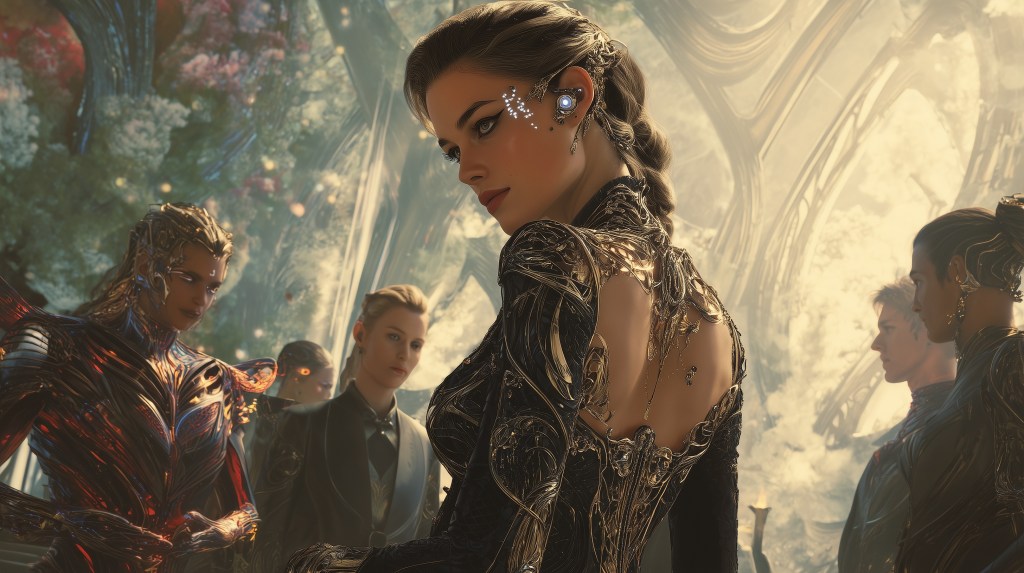
The bio-mechanical heart that pulsed within Ambassador Lyrian Cogwright’s chest quickened its rhythm as she stood before the Council of Integration, her enhanced neural pathways processing the weight of the question they had posed. The chamber around them breathed with the subtle intelligence of living architecture—walls that adjusted their opacity to optimize acoustics, floors that cushioned footsteps with sympathetic understanding, ceiling patterns that shifted to match the emotional resonance of the conversation below.
“What would you change about the societies you have observed?” Councilor Thane repeated, his own modifications gleaming softly in the chamber’s adaptive lighting. Half his face bore the elegant tracery of bio-mechanical enhancement, while his left arm moved with the fluid precision of integrated machinery that had learned to dance with organic muscle and bone.
Lyrian’s crystalline optical implants focused with microscopic precision on the assembled council members, each one a masterwork of voluntary evolution—beings who had chosen to transcend the arbitrary boundaries between flesh and steel, between natural and constructed, between what was and what could become. Yet even here, in this pinnacle of integrated civilization, she had witnessed the persistence of humanity’s most troubling flaws.
“Honored Councilors,” she began, her voice carrying harmonics generated by vocal cords that had been carefully enhanced to produce frequencies capable of direct emotional resonance, “I have walked the floating cities of Aethermoor, where beings drift through clouds of crystallized possibility yet remain trapped by the illusion that elevation grants superiority. I have swum through Sylvenmere’s coral palaces, where collective consciousness spawns new forms of beauty while ancient prejudices calcify like reef-stone around isolated hearts.”
She paused, allowing her words to settle into the chamber’s acoustic sweet spots, where the thinking walls would record and analyze every nuance for posterity.
“But most troubling of all, I have observed the persistent delusion that separation serves survival—that the complex problems facing our interconnected realms can be solved through isolation, competition, and the primitive tribalism that treats difference as threat rather than opportunity for synthesis.”
The chamber’s atmosphere processors adjusted their output in response to the elevated stress hormones her enhanced physiology was releasing, providing precisely calibrated aromatics designed to promote clear thinking and emotional balance. Yet even these technological marvels could not entirely ease the weight of what she had witnessed during her decades of diplomatic service.
Councilor Vera, whose bio-mechanical spine allowed her to interface directly with the chamber’s data networks, leaned forward with interest that manifested as subtle shifts in the room’s bioluminescent patterns. “Elaborate, Ambassador. What specific changes would you implement?”
Lyrian’s neural mesh accessed files accumulated over thirty years of inter-realm diplomacy, sorting through thousands of observations with processing speeds that would have been impossible for an unenhanced mind. The memories cascaded through her consciousness like living data—faces twisted with fear at the sight of her modifications, societies that viewed technological integration as corruption rather than evolution, conflicts that erupted when beings who should have been natural allies allowed ancient prejudices to override obvious mutual benefits.
“First,” she said, her enhanced vocal cords modulating to frequencies that would resonate with the council members’ own bio-mechanical systems, creating a subtle harmonic bond that facilitated deeper understanding, “I would dismantle the artificial barriers that prevent beings from choosing their own path of development.”
The chamber’s walls shifted to a warmer hue, responding to the council’s collective agreement. In Mechanicus, the concept of voluntary enhancement was so fundamental that restricting such choices seemed not just wrong but actively harmful to the species’ evolutionary potential.
“In the floating cities, I encountered individuals whose creativity could have been elevated to unprecedented heights through neural enhancement, yet social taboos condemned them to struggle with the limitations of unaugmented cognition. In the coral cities, I met collective consciousnesses that yearned for individual expression but were trapped by biological imperatives that could have been easily modified through symbiotic integration.”
She moved through the chamber with grace that spoke of perfectly calibrated bio-mechanical balance, her enhanced proprioception allowing her to navigate the space with dancer-like precision. The floor responded to her footsteps, adjusting its firmness to optimize the biomechanics of her gait while her modified nervous system processed dozens of environmental variables simultaneously.
“Most tragic of all, I have witnessed countless beings suffering from ailments—physical, mental, emotional—that could be addressed through integration technologies that already exist, proven and refined. Yet they choose suffering over transformation because their societies have convinced them that enhancement represents loss of essential nature rather than fulfillment of ultimate potential.”
Councilor Marcus, whose optical implants had been replaced with crystalline arrays capable of perceiving electromagnetic spectra far beyond natural human vision, nodded with understanding that manifested as synchronized light patterns across his modified features. “The persistence of biological chauvinism,” he murmured, “even in the face of obvious alternatives.”
“Precisely,” Lyrian confirmed, her bio-mechanical heart modulating its rhythm to match the chamber’s harmonics, creating a physical resonance that reinforced their intellectual connection. “But the second change I would implement runs deeper still—the elimination of scarcity-based thinking that treats resources as finite rather than infinitely renewable through proper application of integrated technology.”
She gestured toward the chamber’s eastern wall, which responded by becoming transparent and revealing the cityscape beyond—towers that grew like living organisms, their bio-mechanical systems converting atmospheric elements into structural materials while their thinking substrates continuously optimized energy flow and resource allocation.
“In every realm I have visited, I have observed conflicts that exist purely because beings assume that one person’s gain must equal another’s loss. They fight over territory when space itself can be multiplied through dimensional folding. They hoard wealth when matter and energy are infinitely transformable through properly calibrated conversion systems. They compete for knowledge when information shared is information multiplied.”
The memories flowed through her enhanced consciousness with crystalline clarity—trade wars between realms that possessed complementary resources, territorial disputes over lands that could be expanded through careful application of spatial manipulation, research hoarded in isolation when collaboration could have advanced all participants exponentially.
“Here in Mechanicus,” she continued, her neural mesh accessing real-time city statistics to illustrate her point, “our integrated systems have eliminated material scarcity through renewable resource cycles. Our thinking architecture optimizes distribution of necessities while our bio-mechanical citizens pursue enhancement and creation rather than mere survival. Yet we are seen as aberrant rather than exemplary.”
Councilor Thane’s bio-mechanical features shifted into expressions of thoughtful consideration, his enhanced cognitive systems processing the implications of her observations. “What would you propose as mechanisms for implementing such changes?”
Lyrian’s crystalline optical implants focused on each council member in turn, her enhanced peripheral vision simultaneously monitoring the chamber’s response patterns while her neural mesh calculated optimal presentation strategies.
“Education through demonstration,” she said, her voice carrying the quiet authority of someone who had spent decades witnessing the cost of ignorance. “Not forced conversion, but voluntary exposure to possibilities. Exchange programs that allow beings from other realms to experience integrated living without permanent commitment. Medical aid that demonstrates the benefits of bio-mechanical solutions for specific problems. Cultural projects that showcase the artistic possibilities that emerge when creativity is unleashed from biological limitations.”
The chamber’s atmospheric processors detected the shift toward hope in her hormonal output and adjusted their aromatic blend accordingly, promoting the neurochemical conditions that facilitated innovative thinking and collaborative problem-solving.
“But most importantly,” she continued, her bio-mechanical heart finding perfect synchronization with the chamber’s harmonic field, “we must address the fundamental fear that drives resistance to positive change—the terror that transformation equals death, that becoming more than what you were means losing what you are.”
Her enhanced memory systems accessed files containing thousands of integration procedures she had witnessed, each one a testament to the continuity of consciousness through enhancement. Beings who had emerged from bio-mechanical modification not diminished but expanded, their essential personalities not erased but elevated to new possibilities of expression and experience.
“In truth, integration preserves identity while expanding its potential manifestations. The enhanced individual remains themselves but gains access to capabilities that were previously impossible. Yet societies cling to the myth that change equals loss, that growth equals corruption, that evolution equals abandonment of essential nature.”
Councilor Vera’s spinal interface pulsed with increased activity as she processed data from across the city’s consciousness network. “The empirical evidence supports your observations, Ambassador. Citizens who undergo enhancement report not loss of self but discovery of previously unknown aspects of their identity.”
“Indeed,” Lyrian confirmed, her vocal harmonics shifting to frequencies that promoted collective contemplation. “Which brings me to the third change I would implement—the replacement of hierarchical power structures with collaborative networks that optimize the contributions of all participants.”
She gestured, and the chamber’s walls responded by displaying visual representations of information flow throughout Mechanicus—not the rigid pyramid structures that characterized most societies, but organic networks where authority flowed based on expertise and contribution rather than inherited position or accumulated wealth.
“In every realm I have visited, I have observed the tragic waste of potential that occurs when beings are constrained by systems that assign value based on accidents of birth rather than actual capability. Brilliant minds relegated to manual labor because they lack social connections. Natural leaders ignored because their origins don’t match predetermined criteria. Innovative solutions dismissed because they emerge from unexpected sources.”
The bio-mechanical enhancements that adorned each council member pulsed with synchronized light patterns as they processed her words through enhanced cognitive systems. In Mechanicus, merit flowed through networks that could objectively measure contribution, creativity, and collaborative effectiveness rather than relying on the subjective prejudices that plagued organic evaluation systems.
“Here, our integrated systems create natural hierarchies of expertise while maintaining horizontal relationships of mutual respect. Authority emerges organically from demonstrated capability while remaining fluid enough to adapt as circumstances change. Yet this is seen as artificial rather than optimized.”
She moved to the chamber’s center, her enhanced proprioception allowing her to find the perfect acoustic position where her words would reach each council member with equal clarity while the chamber’s systems recorded her presentation for posterity.
“The changes I would implement are not radical restructuring but natural evolution—the same progression that led us from purely biological existence to our current integrated state. Voluntary enhancement. Resource abundance through proper application of existing technologies. Collaborative networks that optimize everyone’s contributions. Fear replaced by curiosity. Scarcity replaced by abundance. Hierarchy replaced by expertise.”
The chamber’s atmosphere had grown thick with the aromatic compounds that promoted deep contemplation and collaborative decision-making. Around the council table, bio-mechanical systems pulsed in harmony as enhanced minds processed the implications of her vision.
“The question,” Councilor Thane said finally, his enhanced vocal cords producing overtones that resonated with the chamber’s harmonic field, “is not whether such changes would benefit all societies, but whether beings conditioned to fear transformation can overcome their conditioning to embrace possibility.”
Lyrian’s crystalline optical implants focused on him with laser precision while her neural mesh accessed decades of diplomatic experience, searching for patterns that might suggest pathways toward the future she had described.
“Change begins with choice,” she said, her bio-mechanical heart finding perfect rhythm with the chamber’s pulse. “We cannot force evolution, but we can demonstrate its benefits. We cannot compel enhancement, but we can offer it freely. We cannot eliminate fear overnight, but we can provide examples of what becomes possible when fear yields to curiosity.”
The session concluded with harmonics that spoke of resolution without finality, of decisions deferred while possibilities multiplied. As the council members departed, their bio-mechanical systems already beginning to process and integrate the evening’s discussion into the city’s collective knowledge base, Lyrian remained in the chamber’s center.
Around her, the thinking architecture pulsed with quiet satisfaction, its consciousness touched by visions of futures where the artificial barriers between realms dissolved into collaborative networks of mutual enhancement. The changes she described were not impossible dreams but inevitable evolution—the natural progression of consciousness toward its fullest potential.
In the gathering twilight, as the city’s bio-mechanical systems shifted into their nocturnal optimization patterns, Ambassador Lyrian Cogwright smiled with the quiet confidence of someone who had glimpsed tomorrow’s possibilities and found them beautiful beyond imagining.

 Chadwick Rye
Leave a comment