Do you remember your favorite book from childhood?
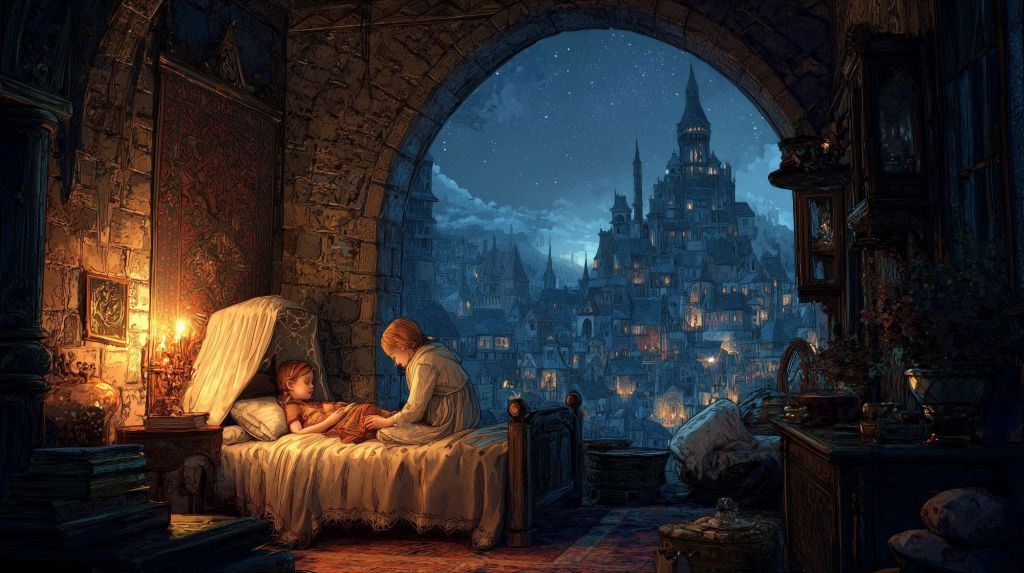
The scent of old parchment and binding glue transported Evangeline Stormwright back through the decades as surely as any temporal enchantment. She knelt beside her daughter’s bed in their tower chamber overlooking Lumenvale’s Merchant Quarter, watching seven-year-old Celestine’s eyelids grow heavy with approaching sleep. The child’s fingers still clutched the worn cover of *Tales from the Thornwood*, but Evangeline’s mind had already drifted to two other volumes—books that had shaped the contours of her imagination before she even understood what imagination could become.
“Mama,” Celestine mumbled, her voice thick with the honey-slow cadence of approaching dreams, “tell me about your favorite books. The ones from when you were little like me.”
Evangeline smoothed her daughter’s copper hair, so like her own had been before silver threads began weaving their own story through the auburn strands. The question stirred something deep in her chest—a recognition that reached across thirty years to touch the girl she had been, curled in her grandmother’s reading nook while rain drummed against diamond-paned windows.
“Two books,” she said softly, her voice taking on the storyteller’s rhythm that came as naturally as breathing. “Two books that showed me worlds I didn’t know existed, even in a realm as magical as Lumenvale.”
She settled more comfortably on the edge of Celestine’s bed, letting memory guide her words back to that cramped apartment above her grandmother’s apothecary shop, where books had been treasures beyond any alchemical creation.
“The first was called *Where the Storm Beasts Dwell*,” Evangeline began, watching her daughter’s eyes widen despite their drowsiness. “Written by Madame Cordelia Nightwind, about a boy named Micah who possessed a terrible temper that manifested as actual storms.”
The memory crystallized with startling clarity—her seven-year-old self discovering Valdris Thornweaver’s masterpiece hidden between practical texts on herb cultivation and potion brewing. The cover had been simple leather dyed deep blue, but when opened, the pages seemed to crackle with barely contained lightning.
“Micah lived with his grandmother in the Windward Reaches,” she continued, her voice dropping to the conspiratorial whisper that made bedtime stories feel like shared secrets. “Every time he grew angry—which happened often, for he was a restless, wild sort of boy—thunder would rumble through the house, and rain would begin drumming against the shutters.”
Celestine’s breathing had grown deeper, but her eyes remained fixed on her mother’s face with the intensity children reserved for truly captivating tales.
“One night, after his grandmother sent him to bed without supper for tracking mud through her spotless kitchen, Micah’s rage summoned something unprecedented.” Evangeline’s hands moved as she spoke, painting shapes in the air that seemed to shimmer with remembered magic. “A whirlwind that tore through his bedroom wall, carrying him away to a realm where living storms ruled kingdoms made of crystallized lightning and thunder-forged stone.”
The original book had been far more complex than any children’s story had a right to be, layered with symbolism that Evangeline had only begun to understand years later. But at seven, she had been mesmerized by Micah’s journey through the Storm Realm, where hurricanes wore crowns of frozen rain and tornadoes danced in parliamentary circles, debating the proper protocols for devastating mortal settlements.
“The Storm Beasts made Micah their king,” she continued, watching wonder bloom across her daughter’s sleepy features. “They crowned him with a circlet of captured lightning and declared him ruler of all tempests, all fury, all the wild weather that mortals feared. He could command blizzards to bury his enemies, summon hailstones the size of battle-shields, call down lightning that could split mountains.”
But the story’s true power, Evangeline remembered, had lay not in its spectacular magic but in its emotional honesty. Micah’s initial delight at commanding such devastating forces gradually transformed into something more complex—the recognition that rage, however magnificent, was a lonely master.
“For weeks, Micah reveled in his storm-crown,” she said, her voice growing softer as Celestine’s eyelids fluttered with approaching sleep. “But slowly, he began to miss his grandmother’s warm kitchen, her patient voice reading to him by firelight, even her scoldings that came wrapped in love rather than fear.”
The book’s climax had haunted Evangeline’s childhood dreams—Micah’s choice to abdicate his storm-throne, to trade the raw power of unleashed fury for the gentler strength that came from belonging somewhere, to someone who loved him despite his tempestuous nature.
“When he finally returned home,” she whispered, “Micah discovered that only a single night had passed. His grandmother found him sleeping peacefully in his bed, and though she never mentioned the mysteriously repaired bedroom wall, she did notice that her grandson’s tantrums no longer summoned actual weather.”
Celestine’s eyes had finally closed, her breathing settling into the rhythm of genuine sleep, but Evangeline found herself reluctant to end the story. The book had taught her something profound about the difference between power and control, between commanding respect through fear and earning love through understanding.
“The second book,” she continued, though she suspected her daughter could no longer hear her, “was called *Crossbows for the Crystal Wars*.”
This memory carried different weight, tinged with the complexity that came from discovering adult themes while still inhabiting a child’s understanding of right and wrong. She had been twelve when she’d discovered Garrett Ironhold’s war chronicle hidden among her uncle’s military histories, its leather binding scarred by what looked suspiciously like actual battle damage.
The novel had followed young Darius Ashford, barely sixteen, as he left his family’s farming village to join the Royal Crossbow Corps during Lumenvale’s bitter conflict with the Obsidian Empire. What had begun as a tale of heroic adventure—brave soldiers defending their homeland against crystalline-armored invaders—had gradually revealed itself as something far more nuanced and troubling.
Evangeline remembered the queasy recognition that had accompanied Darius’s first battle scene, the way Ironhold had described not just the tactical brilliance of crossbow formations, but the specific sound of quarrels punching through enchanted armor, the weight of a dying enemy soldier in the protagonist’s arms, the way victory felt hollow when purchased with the lives of boys who’d left their own families behind to fight for causes they barely understood.
*”War makes monsters of us all,”* Darius had written in his fictional journal, *”but some monsters serve necessary causes, while others simply serve themselves.”*
The book had forced her to confront questions no twelve-year-old should need to grapple with: whether violence could ever truly serve justice, what separated heroism from brutality, how good people could find themselves on opposite sides of conflicts that seemed to offer no clear moral resolution.
But perhaps more importantly, it had introduced her to the concept that stories could carry uncomfortable truths, that literature’s greatest power lay not in providing easy answers but in asking difficult questions that lingered long after the final page turned.
Celestine stirred slightly, her small hand reaching out to find her mother’s in the dim lamplight. Evangeline took the seeking fingers gently, marveling at how such tiny hands would someday turn pages that would shape their own understanding of courage, loss, wonder, and the complicated business of growing up in a world that rarely offered simple choices.
“Those books,” she whispered to the sleeping child, her voice carrying the weight of three decades’ reflection, “taught me that imagination wasn’t escape from reality, but preparation for it. That the wildest fantasies often contained the most honest truths about what it meant to be human in a world full of storms—both literal and metaphorical.”
Outside their tower window, Lumenvale settled into its nightly rhythm, the Crystal Spires dimming their radiance as the city prepared for sleep. Somewhere in the vast libraries that honeycomb the ancient city, other children would discover their own life-changing books, would find their worldviews expanded by authors who understood that the most powerful magic wasn’t in spells or enchantments, but in words that could transform a reader’s understanding of themselves and their place in an endlessly complex universe.
Rising quietly from beside her daughter’s bed, Evangeline made a mental note to visit the Grand Library’s children’s collection tomorrow. Perhaps it was time to search for new books that might speak to Celestine with the same transformative power that *Where the Storm Beasts Dwell* and *Crossbows for the Crystal Wars* had once spoken to her.
After all, every generation deserved to discover their own literary storms, their own paper battlefields where they could safely explore the territories of the heart that would shape them long after childhood’s final chapter closed.


Leave a Reply