List three books that have had an impact on you. Why?
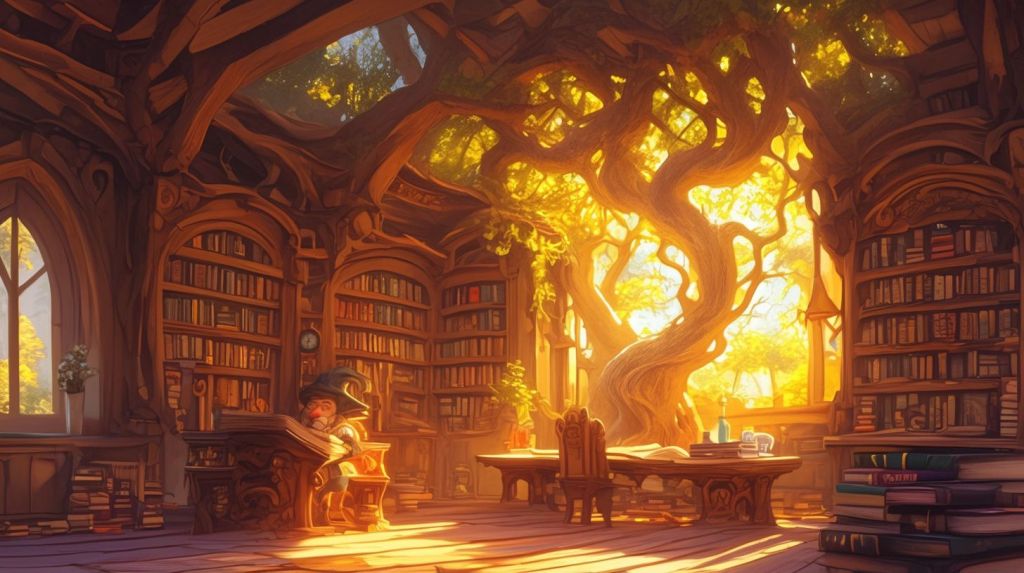
The amber light of my study’s perpetual flame danced across parchment older than most kingdoms, casting shifting shadows that seemed to whisper secrets only I could decipher. My workshop, carved into the living heartwood of Lumenvale’s Great Library tree, hummed with the quiet energy of accumulated knowledge—thousands of volumes breathing in harmony like a forest of ideas taking root in fertile silence.
At barely three feet in height, I had spent the better part of my hundred and forty-seven years climbing literary mountains that towered above me both literally and figuratively. My name is Pip Quillnibbler, Third Circle Transmutation Specialist and keeper of the Restricted Theoretical Manuscripts, though most know me simply as the gnome who talks to books when he thinks no one is listening.
Which, to be perfectly accurate, is always.
The question had emerged during this morning’s visit from Seraphina Moonweaver, the half-elf researcher whose curiosity about magical methodology had led her to my sanctuary deep within the library’s roots. “Master Quillnibbler,” she had asked, settling herself carefully onto one of the mushroom-shaped stools I kept for visitors whose legs were inconveniently long, “what texts have most profoundly shaped your understanding of the arcane arts?”
Such questions typically received my standard deflection—a bibliography of approved theoretical works, safe recommendations that satisfied academic curiosity without revealing the vulnerable territories where knowledge had carved channels through my very soul. But something in her earnest expression, the way lamplight caught the silver threads in her dark hair, reminded me of another seeker who had once approached my predecessors with similar hunger for understanding.
“Three books,” I said finally, my voice carrying the textured quality that came from decades of inhaling manuscript dust and exhaling incantations. “Three books that didn’t simply teach me magic, but transformed my relationship with what it means to know anything at all.”
I rose from my writing desk—a marvel of miniaturized engineering that brought ancient texts down to gnome-friendly eye level—and moved toward the vault where I kept my most treasured volumes. Each step triggered soft chimes from the protective wards woven into the floorboards, a musical progression that had become the soundtrack to my contemplative life.
“The first,” I began, withdrawing a slim volume bound in scales that shifted color with the reader’s emotional state, “fundamentally altered my understanding of what magic actually is.”
*Conversations with the Fundamental Forces* by Archmage Valdris the Questioner rested in my palms like a living thing, its pages rustling with anticipation even though no wind stirred within my sealed chamber. The book had been written three centuries past, but time flowed differently through its contents—each reading revealed new layers of meaning, as though the text rewrote itself in response to the reader’s growing comprehension.
“I discovered this during my apprenticeship,” I continued, settling back onto my chair while the book opened itself to passages that glowed with soft phosphorescence. “Sixty years ago, when I believed magic was about memorizing formulas and perfecting hand gestures. I was… struggling.”
The memory surfaced with the clarity that shame burned into recollection. Young Pip, barely four decades old, standing before Master Thornwick while my latest transmutation attempt resulted in a teacup that existed in seven dimensions simultaneously, none of them particularly useful for containing liquid. My tiny hands had shaken with frustration as I attempted the prescribed gestures, each failure deepening my conviction that perhaps gnomes were simply too small to contain the grandeur that true magic required.
“Valdris wrote this book as a series of dialogues,” I explained, my fingers tracing passages that seemed to pulse with understanding. “Not between teacher and student, but between the Archmage and magic itself. He discovered that elemental forces possessed something approaching consciousness—not intelligence as we understand it, but awareness, intention, even humor.”
Seraphina leaned forward, her research instincts clearly engaged. “You mean he anthropomorphized natural forces?”
“No,” I said, smiling at the common misconception. “He recognized that consciousness exists at levels we rarely acknowledge. Fire doesn’t simply burn—it chooses what to consume and what to preserve, makes decisions based on criteria we’re only beginning to understand. Water doesn’t merely flow—it remembers every container that has held it, carries the dreams of everyone who has ever wished upon its surface.”
The book’s pages fluttered to a passage I had memorized decades ago: *The greatest error of aspiring mages is believing they command elemental forces. In truth, we merely learn to participate in conversations already in progress, adding our voices to symphonies that began before consciousness took its first breath.*
“This changed everything for me,” I continued, watching understanding dawn in Seraphina’s expression. “I stopped trying to force magic to obey my will and started listening to what it was already trying to accomplish. My transmutations became collaborations rather than commands. That teacup problem? Solved when I realized the ceramic was trying to exist in multiple dimensions because it wanted to hold impossible quantities of tea for a gathering that spanned several planes of reality.”
I set the book aside with the reverence due to scripture, then moved toward the second volume—this one considerably larger, bound in leather that bore the subtle scars of outdoor adventure.
“*The Cartographer’s Confession* by Elena Pathfinder,” I announced, hefting the weighty tome with both arms. “This taught me that knowledge without exploration remains theoretical, while exploration without knowledge becomes dangerous wandering.”
The irony hadn’t been lost on me when I first discovered Elena’s work—a gnome whose natural inclination toward cozy libraries finding inspiration in the journals of Lumenvale’s most legendary explorer. Elena had mapped territories that existed only during certain lunar phases, had documented creatures that lived in the spaces between seconds, had survived expeditions into realms where the very concept of “return” required negotiation with entities that viewed linear time as a quaint limitation.
“I was ninety-three when the wanderlust struck,” I admitted, watching Seraphina’s eyebrows rise in surprise. “Most gnomes my age had settled into comfortable specializations, but Elena’s descriptions of the Singing Caverns had haunted my dreams for months. Caves where crystalline formations created music that could rewrite the listener’s understanding of harmony itself.”
The expedition had been disaster and revelation in equal measure. My carefully planned journey—complete with detailed supply lists, backup incantations, and emergency protocols—had collapsed within hours of leaving Lumenvale’s protective wards. The Whispering Woods possessed a peculiar relationship with planned itineraries, delighting in transforming straight paths into spiraling adventures that tested the traveler’s adaptability rather than their preparation.
“Elena’s book became my survival guide,” I explained, opening to pages marked with pressed flowers from that transformative journey. “Not because it provided maps—her maps were deliberately useless, drawn to capture emotional landscapes rather than geographic coordinates—but because it taught me how to think like an explorer rather than a librarian.”
Seraphina examined the marginalia I had added during that expedition—tiny notes written in inks that changed color based on the writer’s stress levels, creating a emotional timeline of discovery and panic in equal measure.
“She wrote about the difference between knowing and understanding,” I continued, my voice carrying the weight of hard-earned wisdom. “You can memorize every theoretical treatise about the Singing Caverns, but until you’ve felt crystalline harmonies rewriting your bones into instruments capable of producing music you’ve never heard, you don’t truly comprehend what you’ve studied.”
The expedition had lasted three months and transformed my relationship with both magic and knowledge. I returned to Lumenvale carrying samples of crystal that sang lullabies in languages no living tongue could reproduce, sketches of flora that bloomed only in the presence of genuine wonder, and a journal filled with observations that my previous, purely theoretical understanding could never have generated.
“The third book,” I said, approaching the final volume with something approaching reverence, “nearly destroyed me before it saved me.”
*Meditations on the Infinite* by the anonymous author known only as the Stargazer occupied a place of honor in my personal collection—not for its binding, which was simple cloth over pressed wood, but for its contents, which had once driven me to the very edge of madness before pulling me back with insights that redefined sanity itself.
“This book doesn’t teach magic,” I explained, my voice dropping to a whisper that seemed appropriate for discussing texts that dealt with cosmic perspective. “It teaches humility. It forces you to confront the terrifying beauty of how little we actually understand about anything.”
The Stargazer had been a mage of considerable power who spent his final decades contemplating not what magic could accomplish, but what it revealed about the nature of existence itself. His meditations followed consciousness from individual awareness through collective understanding to cosmic perspective, each chapter expanding the reader’s viewpoint until personal concerns dissolved into appreciation for patterns too vast to fully comprehend.
“I was one hundred and twenty when I first attempted to read this completely,” I admitted, my fingers tracing the cloth cover with the familiarity of long association. “The experience… broke something fundamental in my understanding of myself and my place in the universe.”
The breakdown had been spectacular in its quiet devastation. After reading the Stargazer’s meditation on temporal perspective—how a single gnome lifetime appears to cosmic consciousness much as a single heartbeat appears to daily awareness—I had spent three weeks unable to perform even basic transmutations, paralyzed by the recognition that my carefully accumulated century of knowledge was less than a grain of sand on an infinite beach.
“Master Elderoak found me in the library’s deepest archives,” I continued, “sitting in darkness because I couldn’t bear to illuminate my own insignificance. I thought the book had revealed the futility of all learning, all effort, all individual existence.”
But Elderoak—ancient even by elf standards, his perspective shaped by millennia of watching knowledge evolve through countless iterations—had offered a different interpretation. Not the crushing weight of cosmic insignificance, but the liberating recognition that consciousness itself was miracle enough to justify its own existence.
“He helped me understand that the Stargazer’s message wasn’t about meaninglessness,” I explained, opening to a passage that still made my hands tremble slightly. “It was about participating in something larger than individual comprehension while remaining fully present to the immediate experience of being alive.”
The relevant passage read: *To understand that your thoughts are brief ripples on an infinite ocean does not diminish their reality, but places them in proper context. Each moment of awareness contributes to the universe’s growing understanding of itself. Consciousness is not accident but inevitable consequence—the cosmos awakening to its own beauty.*
“These three books,” I concluded, gesturing toward the volumes that had shaped my understanding more profoundly than any formal education, “taught me that magic is conversation rather than command, that knowledge without experience remains theoretical decoration, and that wisdom begins with accepting the beautiful impossibility of ever understanding everything.”
Seraphina sat in contemplative silence, her research forgotten as she processed the implications of my unconventional reading list. Around us, the library tree’s heartwood pulsed with the slow rhythm of accumulated wisdom, thousands of volumes breathing in harmony while knowledge sought new forms of expression through curious minds.
“They’re not what I expected,” she said finally, her voice carrying new appreciation for the complexity that lay beneath my diminutive exterior.
“The most transformative books rarely are,” I replied, returning each volume to its protective housing with the care due to trusted companions. “We think we know what we need to learn, but wisdom has its own curriculum—one that typically involves dismantling our assumptions about what learning actually means.”
As evening deepened around my workshop, casting longer shadows that transformed familiar spaces into mysterious territories, I reflected on the journey these three books had guided me through. From frustrated apprentice to cosmic perspective, from theoretical knowledge to practical wisdom, from isolation to participation in conversations that spanned dimensions of understanding I was still discovering.
The books remained, patient as stone, ready to reveal new meanings to the next reader brave enough to approach them with genuine curiosity rather than merely academic interest. And somewhere in Lumenvale’s vast collection, other volumes waited to reshape other perspectives, to challenge other assumptions, to guide other seekers toward wisdom they didn’t yet know they needed.
After all, the greatest magic wasn’t what we could accomplish with spells and incantations—it was what we could become through the patient alchemy of reading, understanding, and allowing ourselves to be transformed by words that carried the power to rewrite reality itself.


Leave a Reply