
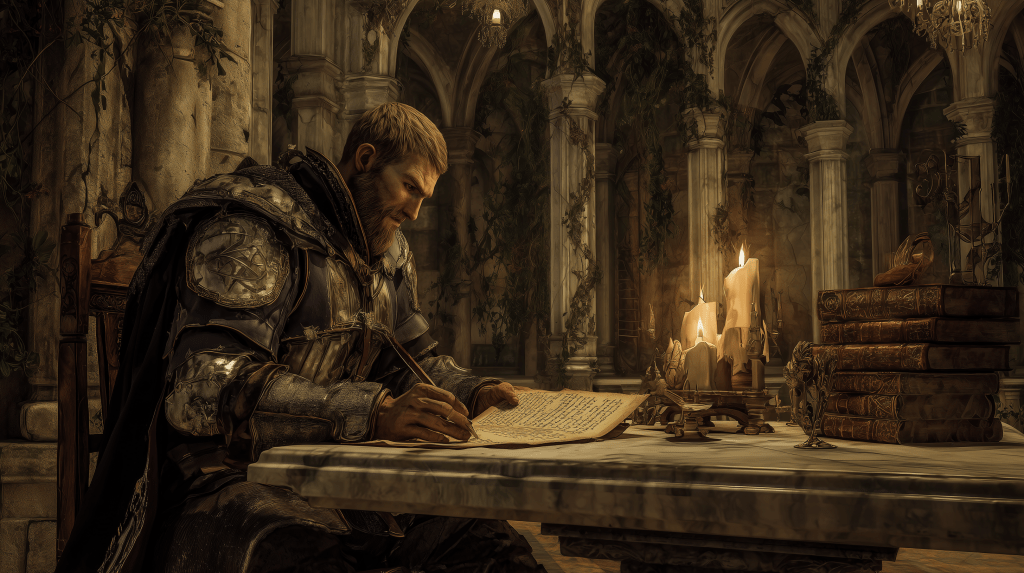


The ancient scroll felt heavier than parchment had any right to feel as Kieran Darkbane carefully unrolled it across the marble reading table in the depths of Lumen Vale’s Grand Conservatory. Even in the warm glow of crystal-light that illuminated the archive’s forgotten vaults, the manuscript seemed to absorb radiance rather than reflect it, its notation written in silver ink that caught the light with an almost metallic gleam.
Three floors above, the evening’s concert was reaching its crescendo—some pastoral symphony celebrating the harvest season, all gentle harmonies and predictable progressions that would leave the audience feeling pleasantly uplifted and safely entertained. But here, in the sealed chambers where the Conservatory stored its most controversial acquisitions, Kieran had stumbled upon something that made his musician’s heart race with anticipation and dread in equal measure.
The scroll bore no composer’s name, only a title written in the ancient script of the Scholar’s Quarter: “The Dark Saga – A Musical Chronicle in Eleven Movements.” Beneath the title, a warning in smaller text: “To be performed only by those who have walked in shadow and understand the weight of redemption earned through suffering.”
Kieran’s fingers trembled slightly as he traced the opening measures. Twenty-three years of musical training had taught him to read complex notation with ease, but this composition challenged everything he thought he understood about how music should be structured. The time signatures shifted unpredictably, the harmonic progressions ventured into territories that conventional theory declared impossible, and throughout it all ran a rhythmic pulse that seemed to match something deeper than heartbeat—the rhythm of someone walking a path between damnation and salvation.
As a former soldier turned musician, Kieran possessed the rare qualification mentioned in the manuscript’s warning. Five years ago, he had returned from the Border Wars with scars both visible and hidden, his sword-arm steady but his soul fractured by the things he’d been ordered to do in the name of protecting civilization. Music had become his refuge, his attempt to transform the darkness he’d witnessed into something that might serve beauty rather than destruction.
But this composition promised something different—not transformation of darkness but acknowledgment of it, exploration of what it meant to carry shadows while still choosing to serve the light.
The first movement, titled “Dawn of Battle,” began with a deceptively simple melody that gradually revealed layers of complexity beneath its surface. As Kieran hummed the opening themes, he recognized something he’d never encountered in any conventional composition: the music seemed to understand the precise emotional experience of standing at the edge of combat, when fear and duty and the desperate hope for survival all collided in the space between heartbeats.
His war-trained mind immediately supplied memories to match the music’s progression—the weight of armor in the pre-dawn darkness, the whispered prayers of soldiers who might not see another sunset, the terrible clarity that came when violence became inevitable and all choices narrowed to a single point of action.
But the composition didn’t stop there. The second movement, “The Fallen Warrior,” plunged into territory that made Kieran’s breath catch in his throat. Here was music that captured not just the fact of death in battle, but the specific experience of watching consciousness fade while understanding that one’s actions in life had been insufficient, that the cause served had been more complex than young idealism had allowed him to perceive.
The harmonies turned dark without becoming merely discordant, creating a sense of profound loss that somehow contained seeds of transformation. It was music for someone who had died but not departed, who had been offered a chance at continuation but only at a price that would fundamentally alter everything they understood about themselves.
The third movement bore the title “Hellish Bargains,” and its opening measures sent chills down Kieran’s spine that had nothing to do with the archive’s cool temperature. The melody twisted through progressions that seemed to spiral downward into depths that conventional musical math insisted didn’t exist, while counter-melodies provided glimpses of what was being offered in exchange for accepting damnation as the price of continued existence.
Here was music that understood temptation not as simple moral weakness, but as the awful rationality of choosing terrible power when it offered the only hope of protecting what remained precious in a world that had revealed its fundamental corruption. The composition seemed to acknowledge that sometimes the choice wasn’t between good and evil, but between different forms of compromise with forces that cared nothing for human categories of right and wrong.
As Kieran continued reading, the emotional weight of the composition began to feel like a physical presence in the archive chamber. This wasn’t music for entertainment or even artistic appreciation in any conventional sense. This was musical documentation of a spiritual journey that few had survived intact, a roadmap through territories of the soul that most people never needed to explore.
The fourth movement, “Transformed Return,” captured the horror and power of awakening to find oneself fundamentally altered by bargains struck in desperation. The melody carried themes from the opening movement but transformed them into something that retained recognizable humanity while incorporating harmonic elements that spoke of powers that belonged to neither heaven nor earth.
This was music for someone who had learned to wield darkness in service of protection, who had accepted transformation into something that could stand against forces too terrible for ordinary mortals to confront. It celebrated the terrible strength that came from such choices while mourning everything that had been sacrificed to achieve it.
The fifth through seventh movements explored the internal struggle of someone caught between their original nature and their transformed capabilities, between loyalty to human values and the demands of powers that operated according to alien logic. The music revealed the exhausting effort required to maintain some semblance of moral direction when every instinct had been rewritten by forces that cared nothing for the distinctions that had once seemed absolute.
But it was the eighth movement, “Love Beyond Recognition,” that brought tears to Kieran’s eyes. Here was music that captured the devastating experience of returning to those one had sworn to protect, only to discover that the very transformations that made protection possible had also made recognition impossible. The melody wove themes of devotion and loss into harmonies that spoke of love strong enough to persist even when the beloved could no longer acknowledge the lover’s identity.
The ninth movement, “The Wages of Power,” explored the ongoing cost of wielding abilities that came with their own moral imperatives. This wasn’t music about the corruption of power, but about the terrible responsibility that came with capabilities that could reshape reality according to one’s will. It captured the isolation of standing guard against threats that others couldn’t perceive, of making decisions that would be condemned by those who lacked the knowledge to understand their necessity.
As Kieran reached the final movements, he began to understand why this composition had been sealed away in the Conservatory’s restricted archives. This wasn’t music that could be performed casually or consumed passively. It demanded something from its audience—recognition, acknowledgment, the willingness to confront aspects of existence that comfortable society preferred to ignore.
The tenth movement, “Redemption Through Sacrifice,” built toward a resolution that managed to be both triumphant and heartbreaking. The music spoke of salvation earned not through divine grace or moral superiority, but through the willingness to accept damnation in service of protecting others from the necessity of making similar choices.
The final movement, “Legacy of Shadows,” concluded the saga with a melody that seemed to fade into silence while somehow continuing beyond the ability of notation to capture. It was music for someone who had learned that heroism and villainy were often separated by perspective rather than action, that the greatest victories were sometimes achieved by those who could never be publicly acknowledged for their sacrifice.
When Kieran finally set down the manuscript, the crystal-lights seemed dimmer than before, as if the composition had somehow absorbed illumination from its surroundings. His hands shook slightly—not from fear, but from the recognition that he had encountered something that spoke directly to experiences he’d never been able to articulate, even to himself.
This was music for soldiers who had crossed lines they’d never imagined crossing, for protectors who had become the very things they’d once fought against, for anyone who had learned that sometimes salvation required accepting the appearance of damnation. It was a musical testament to the truth that heroism was often indistinguishable from its opposite when viewed from outside the circumstances that had necessitated terrible choices.
The sound of footsteps echoing through the archive’s stone corridors interrupted his reverie. Master Harmonist Silvira descended the spiral staircase with the careful precision of someone who had learned to navigate the restricted sections despite age and failing eyesight.
“Ah,” she said, her voice carrying the particular tone of someone who had expected to find exactly what she was seeing. “You’ve discovered the Dark Saga. I wondered when someone with the appropriate qualifications would find their way to it.”
“You knew this was here?” Kieran asked, his voice hoarse from hours of silent emotional engagement with the composition’s overwhelming intensity.
“I’ve been the Conservatory’s keeper of restricted works for thirty-seven years,” Silvira replied, settling into a chair that had been positioned near the reading table as if such discoveries were expected. “The Dark Saga was donated to our collection by a traveling bard who claimed it had been given to him by someone who insisted it could only be preserved by those who understood its true nature.”
“Has anyone ever performed it?”
Silvira’s expression grew thoughtful, her clouded eyes focusing on memories that seemed to carry their own weight. “Twice, to my knowledge. Both times privately, for audiences consisting entirely of individuals who had… particular experience with the themes the composition explores. Both performances were described as transformative by those who witnessed them, though no recordings were permitted.”
Kieran looked down at the manuscript, understanding with sudden clarity that he was being offered something far more significant than mere musical discovery. “You think I should attempt a performance.”
“I think,” Silvira said carefully, “that certain works of art exist not to be admired from safe distance, but to serve specific purposes for specific people at specific moments in their lives. The Dark Saga has been waiting in our archives for seventeen years. Perhaps it was waiting for you.”
The suggestion hung in the air like a challenge and an invitation combined. Kieran knew that attempting to perform such a composition would require not just technical skill but emotional courage he wasn’t certain he possessed. This wasn’t music that could be approached as artistic exercise or academic study. It demanded complete engagement with the experiences it documented, the willingness to open aspects of himself he’d spent years learning to keep sealed.
But wasn’t that exactly what he’d been seeking without knowing it? Not escape from the shadows of his military service, but artistic framework that could accommodate them? Not transformation of darkness into light, but recognition that some forms of service required learning to work with both?
“What would such a performance require?” he asked, his soldier’s mind automatically beginning to assess the logistical and emotional challenges involved.
“A venue appropriate to the work’s nature,” Silvira replied. “An audience composed of individuals who have earned the right to witness such material. And a performer willing to serve as conduit for truths that most people prefer to leave unexamined.”
“How long would I have to prepare?”
“As long as necessary. The Dark Saga cannot be rushed or forced. The music will tell you when it’s ready to be heard, and your heart will tell you when you’re ready to serve as its voice.”
That night, Kieran carried the manuscript home to his modest apartment in the Artisan Quarter, where the distant sounds of the city’s evening activities provided a comforting counterpoint to the silence that seemed to surround the ancient composition. He spent hours studying individual movements, playing fragments on his harp, beginning to understand how the written notation translated into lived sound.
But more importantly, he began to recognize how the music created space for experiences that had never found proper expression in his life. The rage he’d felt at commanders who’d demanded impossible choices. The guilt over actions that had been necessary but remained unforgivable. The isolation of carrying knowledge that couldn’t be shared with those who hadn’t faced similar darkness.
For the first time since leaving military service, Kieran felt the possibility of transformation that didn’t require abandoning or denying the most difficult aspects of his past. The Dark Saga offered something he’d never encountered in conventional religious or philosophical frameworks: acknowledgment that some forms of service required temporary alliance with forces that operated beyond conventional morality, and that such choices could be both damning and redemptive simultaneously.
Three months later, in a private chamber beneath the Conservatory where acoustic properties had been carefully designed for experimental works, Kieran performed the Dark Saga for an audience of twelve individuals—all veterans of various conflicts, all carrying their own shadows, all seeking art that could accommodate rather than transcend the complexities of their experience.
The performance lasted nearly two hours, and when the final notes faded into silence, no one spoke for several minutes. The music had created a space where recognition could occur without explanation, where the terrible beauty of choices made in extremity could be acknowledged without judgment or justification.
Later, as the audience dispersed into the night, Master Silvira approached Kieran with an expression of satisfaction that seemed to encompass more than mere artistic approval.
“The composition has found its voice,” she said simply. “And perhaps you have found yours as well.”
Walking home through Lumen Vale’s quiet streets, Kieran carried with him the knowledge that some music existed not to create beauty but to serve truth, not to provide comfort but to offer recognition to those whose experiences fell outside the boundaries of conventional narrative. The Dark Saga had given him framework for understanding his own journey through shadow and back toward something that might eventually resemble light.
It would never be his favorite music in any simple sense—the emotional demands were too great, the themes too heavy for casual listening. But it had become essential music, the composition that allowed all other music to exist in proper context.
Some songs, he had learned, were meant not to be enjoyed but to be witnessed. And some voices were meant not to entertain but to testify to truths that required particular courage to acknowledge.
In the growing darkness of Lumen Vale’s sleeping streets, Kieran hummed fragments of the Dark Saga’s final movement, his voice carrying notes of resolution that had been earned through the willingness to descend into personal hell and return bearing gifts that could only be acquired through such terrible journeys.
The music lived in him now, and through him, it would continue to find the voices that needed to hear it.

 Chadwick Rye
Leave a comment