
What’s the story behind your nickname?
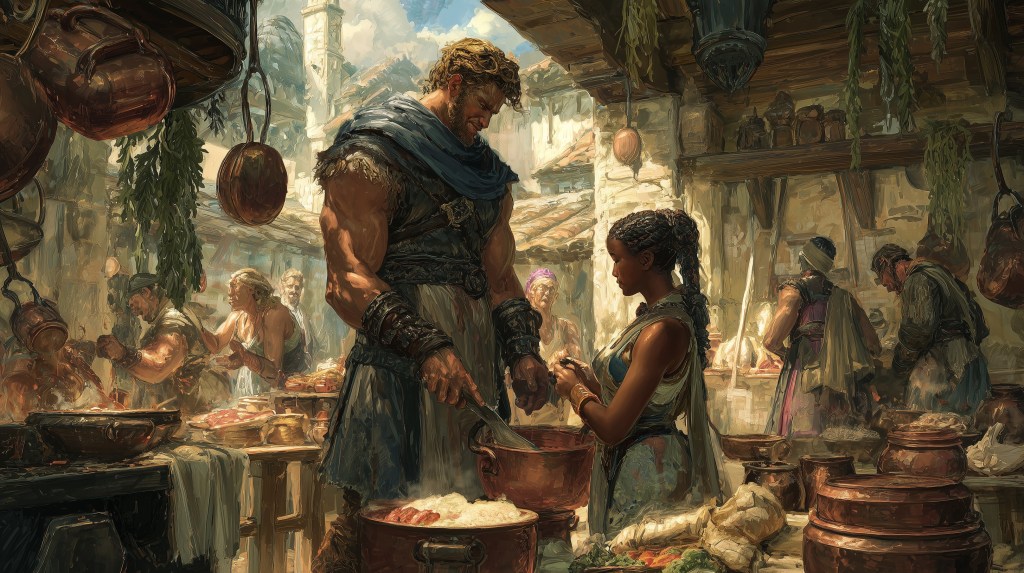
The crash of copper pots hitting the stone floor echoed through the Gilded Griffin’s kitchen like thunder announcing an approaching storm. Gareth Ironwood—all six and a half feet of him—stood frozen among the wreckage, his massive frame somehow appearing even larger in the sudden silence that followed. Flour dusted his broad shoulders like premature snow, while his boulder-sized hands still gripped the wooden tray that had held a dozen perfectly arranged meat pies mere moments before.
“Sweet merciful stars,” came a voice rich with exasperation and barely contained laughter. “Boy, you move through this kitchen like a bull moose crashin’ through morning bracken.”
Zara Goldenheart emerged from behind the massive stone hearth, her dark skin glistening with sweat from the breakfast fires, her knowing eyes taking in the devastation with the weary patience of someone who had witnessed this particular dance too many times. She moved with the fluid grace of a woman who had spent thirty years navigating kitchens, her small frame a stark contrast to Gareth’s towering presence as she began collecting scattered copper vessels with practiced efficiency.
Gareth’s face flushed crimson beneath his sandy beard, the heat radiating from his cheeks rivaling the warmth from the cooking fires. Three months he’d been working at the Griffin, three months of careful movements and conscious awareness of every gesture, yet somehow his body continued to betray him in moments of distraction. This morning, it had been the sight of Lady Brightwater’s carriage pulling up to the inn’s entrance—the golden crests catching sunlight like captured flame—that had stolen his attention for the crucial second it took to misjudge the clearance between his shoulders and the hanging pot rack.
“I’m sorry, Zara,” he rumbled, his voice carrying the deep bass notes that seemed to resonate from somewhere near his boots. “I was watching the road, thinking about the breakfast rush, and I just—”
“—moved like you always do,” she finished, her tone holding more affection than reproach. “Like a creature built for wide-open spaces trying to work in a world made for smaller folk.”
She handed him a dented copper pot, their fingers brushing briefly—her weathered brown hands dwarfed by his massive palms that could palm a melon like most men held apples. The contrast never failed to amuse her, this gentle giant who could heft a full ale cask like it weighed nothing yet struggled to navigate the intricate choreography required for professional cooking.
The Gilded Griffin’s kitchen bustled around them with the controlled chaos of morning preparation. Other staff members—Tomás at the bread ovens, young Petra chopping vegetables with machine-like precision, old Henrik stirring enormous pots of porridge—worked with the synchronized movements of a well-rehearsed ensemble. They had learned to work around Gareth’s occasional collisions with the physical world, adjusting their patterns to accommodate his presence while pretending not to notice when he had to duck under hanging herbs or turn sideways to navigate between preparation tables.
“You know,” Zara said, straightening to her full height which still left her eye-level with his chest, “back home in the Southward Villages, we had actual moose in the forests. Great magnificent creatures, all antlers and noble bearing when they had space to move proper. But get one of them confused in the village market…” She shook her head with knowing sympathy. “Chaos. Beautiful, well-meaning chaos.”
Gareth had heard fragments of Zara’s stories before—glimpses of a childhood spent in territories beyond Lumenvale’s immediate influence, where different customs and different creatures shaped daily life. She rarely spoke of why she’d come to the city, but her knowledge of herbs and spices that didn’t grow in local soil, her understanding of preservation techniques that worked in climates Lumenvale never experienced, and her occasional use of expressions that carried the rhythms of distant places all suggested a life lived in motion before finding anchor in the Griffin’s kitchen.
“Moose,” she repeated, testing the word like a new seasoning. “Yes, that fits. Strong as mountain stone, gentle as morning mist, but built for spaces bigger than what most folks can provide.”
The nickname should have stung. In his youth, Gareth had endured the casual cruelties that came with being larger than his peers—”giant,” “ogre,” “mountain,” each label carrying its own weight of otherness. But something in Zara’s voice transformed the comparison into something approaching benediction. When she said “moose,” it carried notes of respect, of recognition for both his strength and the challenges that came with inhabiting a frame built for different purposes than the delicate work of professional cooking.
“Don’t mind the name,” said Tomás from the bread station, his arms elbow-deep in dough that would feed the day’s customers. “Better than what they called Big Henrik when he first started—’Tornado’ wasn’t meant kindly, if you catch my meaning.”
Henrik himself chuckled from his position by the soup cauldrons, his own substantial frame moving with the economy of motion that came from decades of practice. “Took me two years to stop knocking things over,” he called out. “The trick isn’t getting smaller—can’t change what the gods built, after all. The trick is learning to think differently about space.”
As if summoned by the conversation, trouble arrived in the form of Lord Aldric’s breakfast order—a complex arrangement requiring seven different courses, each one timed to arrive at precise intervals that would showcase the Griffin’s reputation for excellence. Zara began orchestrating the preparation with the focused intensity of a military commander, her voice cutting through kitchen noise with instructions that needed to be followed to the minute.
Gareth found himself assigned to the heavy work—lifting, carrying, moving the substantial ingredients that would form the foundation of the elaborate meal. But even these seemingly simple tasks became exercises in spatial awareness. The kitchen’s layout, designed for efficiency rather than accommodation of his dimensions, transformed routine movements into careful negotiations with physical reality.
It was while maneuvering a heavy pot of reduction sauce around the central preparation island that disaster struck again. The combination of his broad shoulders, the pot’s awkward weight distribution, and a moment of hesitation as he calculated the clearance between hanging utensils created a perfect storm of miscalculation. His elbow caught the edge of a spice rack, sending jars of expensive seasonings cascading across the stone floor in a symphony of breaking glass and scattered aromatics.
The silence that followed felt heavier than the pot in his hands. Precious saffron mixed with common salt, while exotic cardamom pods rolled between fragments of shattered containers. The air filled with the complex perfume of spices that represented significant portions of the kitchen’s monthly budget, now reduced to expensive floor sweepings.
“Moose,” Zara said quietly, and the name carried no humor now—only understanding. “Set down that pot before you drop it too.”
She moved through the wreckage like a dancer, her bare feet somehow avoiding every shard of glass as she began the process of salvage and assessment. Other kitchen staff joined her, their movements automatically adapting to include cleanup in their morning routines. No one spoke of the cost, the waste, the frustration of starting over. They simply worked, accepting catastrophe as part of the price of employing someone whose gifts didn’t always align with the demands of confined spaces.
“Why do you keep me?” Gareth asked later, during the brief lull between breakfast service and preparation for midday meals. He sat on a stool that creaked ominously under his weight, his large hands wrapped around a cup of tea that seemed delicate as spun glass in his grasp.
Zara paused in her inventory of remaining spices, considering the question with the seriousness it deserved. Around them, the kitchen hummed with reduced activity—other staff members catching brief rest or attending to maintenance tasks that kept their workspace functional.
“You know what I see when I watch you work?” she asked, settling onto a nearby stool that allowed her to meet his eyes without craning her neck. “I see someone who understands that food matters. Not just as fuel, not just as commerce, but as something that connects people to each other, to comfort, to home.”
She gestured toward the dining room beyond the kitchen’s swinging doors, where the morning’s customers were finishing their meals in satisfied conversation. “When you carry those heavy pots, when you help prepare the dishes we send out—there’s care in your movements. Clumsy, yes, but careful too. Like you understand that what we do here matters to the people we serve.”
The observation struck deeper than criticism might have. Gareth had indeed found something approaching purpose in the kitchen work, despite his ongoing battles with the physical demands of the space. There was satisfaction in being part of the process that transformed simple ingredients into experiences that brought joy to strangers, that provided comfort to travelers far from home, that created moments of connection around shared tables.
“Besides,” Zara continued, her voice taking on the practical edge that characterized her approach to most problems, “strength like yours doesn’t come along often. When we need those ale barrels moved, when the stone hearth needs rebuilding, when suppliers deliver ingredients too heavy for the rest of us to handle—that’s when having a moose around becomes essential.”
The afternoon brought its own challenges and small victories. Gareth successfully navigated the preparation of evening stews without major incident, his movements growing more deliberate as he internalized Henrik’s advice about thinking differently about space. When a delivery arrived requiring someone to carry sacks of grain up narrow stairs to the storage loft, his value became immediately apparent—what would have required multiple trips for others, he accomplished in a single journey that left him barely winded.
“Moose!” Zara called as closing time approached and the last customers settled their accounts. “Need those tables cleared and reset for tomorrow.”
The name had already begun to feel natural, no longer a description of his clumsiness but an acknowledgment of what he was—a creature of strength and gentle intention, learning to navigate a world that hadn’t been built with his dimensions in mind. When other staff members began using it, the word carried none of the mockery he had feared but rather the casual affection reserved for accepted members of the kitchen family.
Years later, when Gareth had grown into the spatial demands of professional cooking and earned his place as the Griffin’s head chef, new employees would ask about the nickname that had followed him through promotion and recognition. The story would be told with warmth, how a wise woman had seen past surface clumsiness to recognize something worth nurturing, how a name meant to describe could become a name meant to honor.
But in those early days, as he learned to move through the world with consciousness instead of assumption, “Moose” served as daily reminder that belonging didn’t require changing fundamental nature—only learning to express that nature in harmony with the spaces and people around him.
The kitchen cleaned and ready for tomorrow’s service, Gareth made his careful way home through Lumenvale’s evening streets. Behind him, the Gilded Griffin settled into night-time quiet, its kitchen holding the lingering aromas of the day’s cooking and the promise of tomorrow’s fresh start. In the morning, there would be new challenges, new opportunities for both grace and catastrophe, new moments when strength would matter more than precision.
But tonight, walking beneath crystal spires that sang with harmonic light, Gareth Ironwood—known to friends and family as Moose—smiled with the satisfaction of someone who had found his place in the world, even if that place required ducking under doorways and thinking twice before turning around.


 Chadwick Rye
Leave a reply to Chad Rye Cancel reply