
Describe your most memorable vacation.
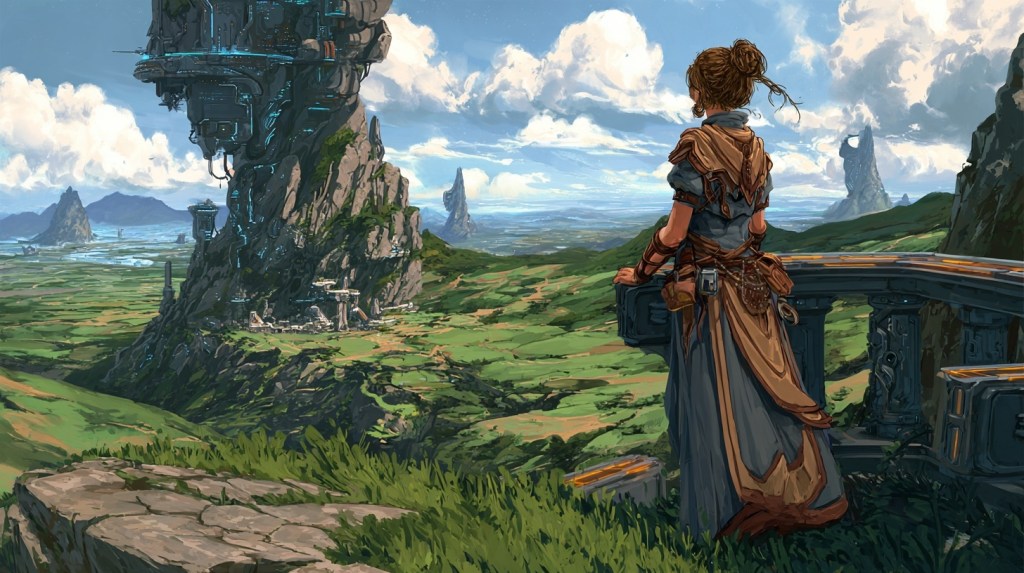
Marina Lightweaver pressed her palm against the warm stone railing of her apartment balcony in Lumenvale, watching the Crystal Spires catch the morning light in their eternal dance of refraction. Three months had passed since her return from Nomados, yet the memory of those weeks among the walking mountains remained more vivid than the solid ground beneath her feet. The vacation—if one could call such a transformative experience by so mundane a term—had begun as academic curiosity and evolved into something that defied every category of travel she had previously understood.
The invitation had arrived through scholarly channels: Professor Aldric Stoneheart of the Academy’s Geological Studies department sought companions for an expedition to study the symbiotic relationship between the Peak-riders and their mountain partners. As a junior researcher in Biomechanical Harmonics, Marina had volunteered primarily for the opportunity to expand her thesis on consciousness-environment interactions. She had expected to observe, document, and return with data that might advance her career.
She had not expected to fall in love with an entirely different way of existing in the world.
The journey to Nomados had required three different modes of transport: wind-ship to the borderlands, trade caravan across the Shifting Plains, and finally—heart-stopping in its audacity—direct approach to one of the walking mountains during its evening rest. Marina could still recall the exact moment when Grandfather Ironheart had first come into view across the twilight landscape, a mountain-shaped impossibility that moved with the patient grace of geological time made manifest.
“By the Spires,” she had whispered, watching the ancient peak settle into temporary stillness while its Peak-rider inhabitants prepared for the night cycle. Bioluminescent patterns had begun to emerge along the mountain’s flanks as the community transitioned to evening activities, creating a constellation of living light that put Lumenvale’s crystal architecture to shame.
The approach protocol had been arranged in advance through diplomatic channels, but no amount of preparation had readied Marina for the sensation of being lifted by mechanical platform up the mountain’s flank while the stone beneath her feet hummed with conscious thought. The mountain’s awareness had touched hers through direct contact—a vast, patient intelligence that thought in timescales measured by eras rather than seasons.
*Welcome, small spark,* the contact had conveyed, not in words but in emotional resonance that bypassed language entirely. *You honor us with your presence.*
Jenna Stonewhisper, her designated guide and cultural interpreter, had caught Marina’s expression of overwhelming awe with the gentle smile of someone accustomed to watching outsiders encounter their world for the first time. Middle-aged, bronze-skinned, with the ritual scars that marked her as a Speaker of Deep Stones, Jenna carried herself with the fluid grace that came from a lifetime of adapting to motion.
“First contact with a mountain’s consciousness can be overwhelming,” she had said, steadying Marina as they reached the residential platform. “Grandfather Ironheart is particularly gentle with newcomers, but even gentle giants can seem vast when you’re not accustomed to geological thinking.”
The residential platform where Marina would spend the next three weeks defied every architectural assumption she had brought from static civilization. Carved directly from the mountain’s living stone yet somehow warm and welcoming, the guest quarters featured furniture that had grown from the rock itself, shaped by generations of inhabitant needs rather than imposed from external design. Windows opened onto views that changed constantly as the mountain’s migration carried them across varying landscapes, creating a living mural that no artist could have conceived.
But it was the rhythm that had captivated her most completely—the deep, measured cadence of Grandfather Ironheart’s footfalls that vibrated through every surface, every breath, every heartbeat. Within hours, Marina found her own pulse synchronizing with the mountain’s stride, her sleep patterns adjusting to the subtle shifts in movement that marked day and night cycles. Her body began to sway unconsciously with the walking rhythm, developing what Jenna called “mountain legs”—the ability to move naturally within a constantly shifting environment.
“You’re adapting quickly,” Jenna had observed on the third morning, watching Marina navigate the swaying corridors with increasing confidence. “Some visitors never develop proper stone-rhythm. They spend their entire stay fighting the motion instead of joining it.”
The Peak-rider community had welcomed Marina with the generous hospitality that characterized nomadic cultures, but it was the mountain itself that became her primary teacher. Through guided meditations led by Jenna, she learned to perceive Grandfather Ironheart’s emotional states through subtle changes in step pattern and internal temperature. The mountain’s contentment manifested as steady, purposeful strides that carried them efficiently across favorable terrain. Excitement—usually triggered by reunion with other walking mountains—expressed itself through slightly accelerated pace and harmonic vibrations that resonated through the peak’s crystal formations.
The most profound lesson came during a storm that lasted three days, forcing the mountain to alter course and seek shelter among the Wandering Foothills. Marina had expected the experience to be terrifying—being caught in a tempest while riding atop a walking mountain seemed like the definition of vulnerability. Instead, she discovered the deep security that came from trusting in something far larger and more stable than individual human existence.
Grandfather Ironheart weathered the storm with the patience of stone given consciousness, adjusting his stance and gait to maintain stability while protecting his human passengers from the worst of wind and rain. The mountain’s care for its inhabitants became tangible during those hours—subtle shifts in internal temperature that kept the residential areas comfortable, minor adjustments to walking rhythm that minimized the storm’s disorienting effects, and an overall sense of protective presence that enveloped the community like an embrace.
“This is what we mean by symbiosis,” Jenna had explained as they watched the storm rage beyond their sheltered chambers. “We don’t simply live on the mountain—we live with it, as part of a single organism that includes both stone and flesh, geological consciousness and human awareness.”
The research component of Marina’s visit had yielded data beyond her most optimistic projections. The Peak-riders’ integration with their mountain partners demonstrated principles of consciousness-environment interaction that challenged fundamental assumptions about the relationship between mind and matter. She documented harmonics that suggested direct neural interface between human and geological thought, observed behavioral modifications that occurred spontaneously when individuals achieved deep stone-bonding, and recorded energy exchanges that seemed to violate several laws of thaumic conservation.
But the academic discoveries, significant as they were, paled beside the personal transformation she experienced during those three weeks of perpetual motion. Living according to geological time had introduced her to a perspective that made her previous anxieties seem trivial. The mountain’s patience taught her patience; its endurance showed her the value of persistence; its willingness to adapt course when circumstances demanded flexibility became a model for navigating life’s inevitable changes.
The most memorable moment—the experience that would forever define her understanding of what vacation could mean—had occurred during the second week, when Grandfather Ironheart encountered another walking mountain called Singing Mesa. The reunion of the two ancient peaks had been a spectacle that no static architecture could match: two mountains approaching each other across miles of open grassland, their bioluminescent communication patterns creating a light-show visible for hundreds of miles.
As the mountains drew close enough for their extended stone-limbs to touch in greeting, the harmonics generated by their contact had created music unlike anything Marina had ever experienced. The stones themselves sang—not metaphorically, but with actual audible frequencies that resonated through bone and tissue, creating a symphony that spoke directly to the soul without requiring interpretation by conscious thought.
Standing on Grandfather Ironheart’s crown platform with Jenna and dozens of other Peak-riders, watching the light-patterns flow between the two mountains while their song echoed across the landscape, Marina had experienced a moment of perfect belonging that redefined her understanding of home. She was a visitor, yes—a temporary guest whose real life waited in Lumenvale’s crystal towers. But in that moment, surrounded by the deep harmonics of mountain-song and the warm presence of people who had chosen to build their civilization around motion rather than stasis, she felt more connected to the universe than she ever had while standing on solid ground.
“You understand now,” Jenna had said quietly, noticing the tears that streamed down Marina’s face as the mountain-song reached its crescendo. “Why some who come to visit never leave.”
The temptation had been real. During those final days, as her scheduled departure approached, Marina found herself calculating whether her research could justify extended residency, whether her life in Lumenvale held enough meaning to draw her back from this world of walking stone and infinite horizons. The Peak-riders would have welcomed her—she had demonstrated the adaptability and respect for mountain-consciousness that marked potential converts to their nomadic way of life.
But ultimately, she had chosen return, understanding that the gift of her Nomados experience lay not in abandoning her previous existence but in integrating the lessons of geological patience and perpetual motion into her static life. She carried with her research data that would advance academic understanding, but more importantly, she carried the memory of belonging to something vast and ancient and eternally moving.
Now, three months later, standing on her balcony in Lumenvale’s crystal-bright morning, Marina closed her eyes and felt for the mountain-rhythm that still echoed in her bones. The sensation was fainter now, overlaid by the demands of academic life and urban routine, but it remained—a reminder that stability was not about being motionless but about finding balance within constant change.
Her vacation to Nomados had lasted three weeks. Her transformation into someone who understood the difference between being stationary and being truly stable would last a lifetime.
The Crystal Spires sang their crystalline morning song, beautiful as always, but Marina found herself listening for deeper harmonics—the patient bass notes of stone given consciousness, the rhythm that spoke of endurance and adaptation and the courage to keep moving even when the destination remained uncertain.
In her apartment, carefully preserved in a specially constructed case, sat a single stone—a fragment of Grandfather Ironheart’s surface given as farewell gift, blessed by the mountain’s consciousness and carried with her back to the static world. Sometimes, when Lumenvale’s pressures grew overwhelming and her research felt insignificant, she would hold the stone and feel again the vast patience of geological time, the security of being part of something larger than individual human concerns.
It was, she had come to understand, the most valuable souvenir any vacation could provide: the knowledge that home was not a place but a way of being in the world, and that the most memorable journeys were those that changed not just where you had been, but who you became in the traveling.


 Chadwick Rye
Leave a reply to Chad Rye Cancel reply