
What are you most worried about for the future?
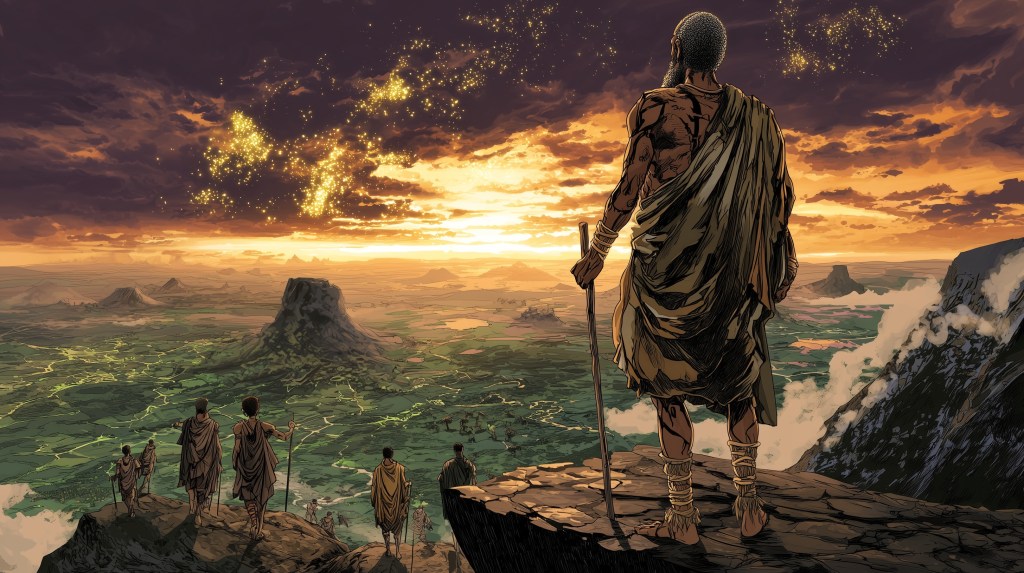
High Keeper Daveron Earthsong stood upon the Crown Platform of Ancient Thunderstep, his weathered hands pressed against the carved obsidian rails that had been worn smooth by generations of leaders before him. The pre-dawn air carried the scent of granite dust and morning dew, while beneath his feet, the mountain’s massive heart beat its eternal rhythm—slower now than in his youth, each pulse separated by intervals that spoke of profound weariness.
Forty-three years he had served as High Keeper of the Nomadic Clans, forty-three seasons of guiding the thirteen walking mountains that carried his people across the ever-changing face of the world. In all that time, he had never felt the weight of leadership as heavily as he did this morning, watching the sun rise over a landscape that seemed increasingly hostile to the ancient ways.
Thunderstep’s great stone lungs expanded beneath him, drawing breath that tasted of distant storms and approaching change. Through the soles of his bare feet—callused from decades of direct communion with living rock—Daveron felt the subtle tremor that had been growing stronger each day. Not the healthy vibration of muscles flexing against earth, but something deeper. Something wrong.
“You feel it too, don’t you, old friend?” he whispered to the mountain, his voice barely audible above the whisper of wind through the stone passages that honeycombed Thunderstep’s crown. “The tiredness that runs deeper than seasonal migration. The way your dreams have grown heavy with memories of mountains that no longer walk.”
In the distance, eleven other peaks moved in their eternal procession across the Wandering Plains. Ironheart to the north, her copper veins gleaming in the early light as she carried the Forge Clans with their smoking workshops and ringing hammers. Gentlebrook to the east, smallest of the walking mountains but swiftest, her stream-carved channels sparkling with the morning meditation pools of the Water Dancers. Each mountain unique, each carrying communities that had been shaped by their stone partner’s character across centuries of symbiotic evolution.
But where once thirteen had walked, now only twelve followed Thunderstep’s lead. The absence of Weeping Stone struck Daveron’s heart like a physical blow every time he performed the morning count. Three months since the youngest of the walking mountains had simply… stopped. No warning, no sign of illness or injury. One morning, Weeping Stone had ceased his eternal march and settled into the Greengrass Valley, his consciousness fading like sunset into the quiet dreams of ordinary stone.
The two hundred souls who had called Weeping Stone home now lived as refugees among the other clans, their loss a wound that refused to heal. They spoke of dreams filled with silence, of waking to stillness where motion had always been, of the terrible moment when they realized their mountain-partner would never rise again.
“High Keeper.” The voice belonged to Mira Deepreach, his youngest advisor and the most gifted earth-speaker of her generation. She approached with the fluid grace of one born to shifting stone, her bronze skin marked with the ritual scars that showed her rank among the Stone Whisperers. “The Council of Roots awaits your presence. The morning reports have arrived from the outer scouts.”
Daveron nodded but didn’t turn from his contemplation of the horizon. “Tell me, Mira. When you commune with the deep stones, what do you hear?”
She joined him at the platform’s edge, her own hands finding the familiar comfort of the obsidian rails. For a moment, she was silent, her consciousness reaching down through layers of living rock to touch the vast intelligence that dwelt in Thunderstep’s core. When she spoke, her voice carried the hollow resonance of one speaking from trance.
“Sadness,” she said finally. “Ancient beyond measure, and growing stronger. They remember when the world was young and mountains walked in great herds across virgin continents. They speak of the Long Wandering, when their kind numbered in the hundreds and the earth itself sang with their footfalls.”
She paused, her breathing synchronized with the mountain’s slower rhythm. “They’re lonely, High Keeper. The walking mountains are dying one by one, and those that remain know their time grows short. They fear for us—for what will become of the Peak-rider clans when the last mountain chooses to rest.”
The words confirmed Daveron’s deepest fears, giving voice to the dread that had haunted his sleep for months. He had led his people through droughts and storms, through conflicts with the ground-dwelling nations who viewed the nomadic clans with suspicion and fear. He had negotiated passage rights across territories that grew increasingly hostile to the old ways, had mediated disputes between clans whose mountain-partners held ancient grudges, had preserved the traditional knowledge that bound his people to their stone companions.
But how could any leader prepare for the possibility that their entire way of life might simply end? That the mountains themselves, weary beyond the capacity of human understanding, might choose to abandon the eternal migration that had defined Nomadic culture since time immemorial?
“The southern scouts report increased seismic activity in the Shattered Lands,” Mira continued, her voice returning to normal timbre as she withdrew from the earth-trance. “The ground-dweller cities are expanding their mining operations, using techniques that wound the earth’s deeper layers. The mountains feel each excavation like cuts upon their own bodies.”
Daveron’s jaw tightened. The ground-dwellers’ hunger for mineral wealth had grown insatiable in recent decades, their magical-industrial revolution demanding ever-greater quantities of rare stones and metals. Their mining operations scarred landscapes that the walking mountains had traversed for millennia, leaving wounds in the earth that radiated pain for hundreds of miles.
“And the northern territories?”
“The Ice Crown glaciers continue their retreat. The water sources that have sustained us through the Northern Circuit for fifteen generations are failing. Frostpeak sends word that her ice-cap has thinned to dangerous levels—she may not survive another summer passage.”
Each report added another weight to the burden pressing down upon Daveron’s shoulders. Climate changes driven by magical industrialization, territorial restrictions imposed by expanding nation-states, resource depletion caused by ground-dweller extraction—all combining to threaten not just the Nomadic way of life, but the very survival of the walking mountains themselves.
He thought of his daughter Kira, now leading her own clan on Singing Ridge, and of her children who had never known a world where the mountains’ songs weren’t touched with melancholy. What future could he offer them? What wisdom could guide them when the traditional paths no longer led to safety?
“There’s something else,” Mira said quietly, her tone suggesting she had saved the most troubling news for last. “The young ones—both human and mountain. They’re losing the connection. The children born in the last decade struggle to hear the stone-songs that their parents learned as easily as breathing. And the walking mountains themselves… they speak of dreams where they forget their names, forget the ancient compacts that bind them to our people.”
This revelation struck deeper than all the others. The bond between Peak-rider and mountain was more than symbiosis—it was a fusion of consciousness that had evolved over millennia, each generation strengthening the connection until human and stone shared dreams, emotions, even aspects of memory. If that bond was weakening…
“They’re preparing to rest,” Daveron said, the words tasting like ash in his mouth. “All of them. The walking mountains are choosing to end their long migration while they still have the strength to ensure our survival.”
Mira’s silence confirmed his fears. Through her earth-speaking abilities, she had access to the deep conversations that passed between the mountains—communications too profound and ancient for ordinary humans to perceive. If she wasn’t denying his conclusion, it meant the walking mountains had indeed begun discussing their own mortality.
The Council of Roots convened in the Chamber of Echoes, a vast hollow within Thunderstep’s heart where the mountain’s voice could be heard most clearly. Representatives from each clan had gathered via speaking-crystal networks that connected all thirteen remaining peaks, their faces reflecting the same worry that gnawed at Daveron’s core.
Elder Tomson of the Forge Clans spoke first, his voice heavy with the practical concerns of his people. “Ironheart’s inner furnaces burn cooler each season. Our metalworkers report difficulty maintaining the temperatures needed for their craft. Without the mountain’s heat, we cannot produce the tools and weapons that sustain our trade relationships.”
“Gentlebrook’s springs run slower,” added Speaker Yara of the Water Dancers. “The pools that have never failed now sometimes run dry for days at a time. Our purification rituals lose their potency when the mountain’s life-force ebbs.”
Similar reports came from each clan—craft traditions failing as their mountain partners lost vitality, ancient magics weakening as the bonds that powered them grew tenuous, survival skills becoming inadequate for the challenges of a changing world.
“We must consider the unthinkable,” Daveron said when the last report had been delivered. “If the walking mountains choose to rest—if our way of life ends with this generation—how do we preserve what can be preserved? How do we honor our traditions while adapting to a future none of us were raised to imagine?”
The question sparked heated debate. Some clan leaders insisted that the solution lay in deeper communion with their mountain partners, in rituals that might restore the ancient bonds and revitalize the walking stones. Others argued for aggressive expansion, claiming new territories before other powers could restrict their movement further. A few suggested the most radical approach of all—gradual integration with ground-dweller societies, preserving Nomadic culture within static communities.
But as Daveron listened to the arguments swirl around him, he found his attention drawn to the mountain’s own voice—the deep harmonics that resonated through the Chamber of Echoes, carrying Thunderstep’s thoughts in frequencies that bypassed conscious understanding and spoke directly to the soul.
The mountain was tired, yes. Ancient beyond human comprehension and weary from eons of bearing responsibility for fragile human lives. But beneath the exhaustion, Daveron sensed something else—not resignation, but a kind of patient hope. Thunderstep and his fellow mountains weren’t simply choosing to die. They were choosing to transform.
“The mountains aren’t abandoning us,” he said suddenly, his voice cutting through the debate. “They’re trying to teach us something. The same lesson they’ve always taught—that all things change, that survival requires adaptation, that the end of one way of being can become the beginning of another.”
He stood, his hands pressed against the chamber’s living stone walls, feeling the mountain’s ancient wisdom flow through the contact. “For generations, we’ve been passengers on a journey the mountains controlled. But perhaps it’s time for us to learn to walk on our own—to carry the stone-songs in our hearts instead of in our feet, to preserve the clan bonds through choice rather than circumstance.”
The debate that followed would continue for days, but Daveron had found his answer to the question that had haunted him since dawn. His greatest worry for the future wasn’t the death of the old ways—it was the possibility that his people might be too afraid to embrace the new ones.
That night, as Thunderstep’s great heart slowed toward the deep rhythms of sleep, Daveron stood once again upon the Crown Platform. The other mountains moved through the darkness around him, their bioluminescent markers creating a constellation of living stars across the landscape. For tonight, they still walked. For tonight, the ancient bonds still held.
But tomorrow would bring new challenges, new choices, new opportunities to prove that the wisdom of the walking mountains lived not just in stone and soil, but in the hearts of the people who had learned to call the wandering peaks home.
The future, uncertain as it was, would be what they made of it together.


 Chadwick Rye
Leave a comment