Do you have a quote you live your life by or think of often?
The Words That Guide Us
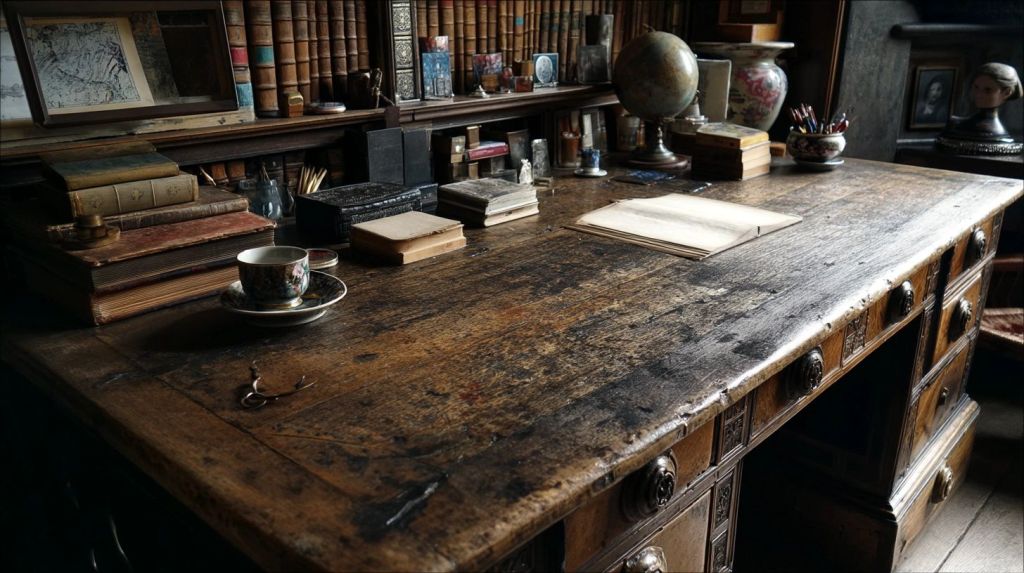
The ancient oak desk bore the battle scars of forty years of scholarly dedication, ink stains like tiny archipelagos, circular ghosts of countless tea mugs, and the subtle groove worn where Allister Thornfield had rested his left forearm while writing day after day, year after year. The morning light filtered through leaded glass windows, casting honeycomb patterns across the manuscript pages scattered before him, illuminating dust motes that danced in the air like ephemeral constellations.
Allister paused, quill hovering above parchment, and glanced toward the bookshelf where a simple wooden frame stood among leather-bound tomes and artifacts collected from his travels. Unlike the ornate academic honors displayed in the university’s grand hall, this modest frame contained just seven words, written in his father’s steady hand decades ago.
*What is true remains true, regardless of belief.*
The phrase had followed Allister from his childhood home in Mistwood Village to the ivory towers of the Royal Academy, through expeditions across treacherous mountain ranges and into the hidden libraries of fallen civilizations. It had survived the Great Fire that claimed half his collection fifteen years ago, the frame’s edges blackened but the message intact, perhaps the universe’s way of emphasizing its importance.
A knock at his study door pulled him from his contemplation.
“Enter,” he called, setting down his quill and straightening his spectacles.
Eliza Whitmore, his most promising graduate student, appeared with arms laden with fragile scrolls bound in protective silk. Her eyes, sharp with intelligence and perpetual curiosity, widened at the chaos of his normally orderly workspace.
“Professor Thornfield, I’ve brought the Meridian texts you requested,” she said, carefully navigating around stacks of books. “Are you well? This looks like one of your… episodes.”
Allister smiled at her diplomatic phrasing. His “episodes” of intense scholarly focus were legendary among students, periods when he would disappear into research for days, emerging disheveled but inevitably with some breakthrough that would send ripples through academic circles.
“Quite well, thank you,” he replied, clearing space for the scrolls. “I’ve been contemplating the Astorian paradox again. Something about Magistrate Colthurst’s transcriptions doesn’t align with what we found at the excavation site.”
Eliza set down her burden with practiced care. “Perhaps because Colthurst never visited the ruins himself? He worked from second-hand accounts.”
“Precisely,” Allister nodded approvingly. “And yet his work has been treated as authoritative for nearly a century, simply because of his position. The evidence tells a different story, but academia is reluctant to revise established thinking.”
His eyes drifted back to the framed quote. Eliza followed his gaze.
“Your father’s words,” she observed. “You’ve mentioned them before.”
“Indeed.” Allister leaned back in his chair, the ancient wood creaking in protest. “They’ve guided more of my life than perhaps anything else.”
“How so?” Eliza asked, settling into the leather armchair across from him. Their relationship had evolved beyond mere teacher and student; she had earned the right to such personal inquiries.
Allister removed his spectacles, pinching the bridge of his nose as memories cascaded through his mind. “Do you know why I became a historian, Eliza?”
“I assumed it was family tradition. The Thornfield legacy of scholarship spans generations.”
He chuckled softly. “A reasonable assumption, but incorrect. My father was a blacksmith, the finest in three counties, but a man who never had formal education. Those words were his response when the local magistrate tried to convince villagers that increased taxes were beneficial to them, despite evident suffering.”
Eliza’s expression registered surprise. The revelation countered the assumption many held about Allister’s pedigreed academic background.
“My father had no formal schooling, but he possessed wisdom that has served me better than many advanced degrees I’ve encountered,” Allister continued. “He believed that truth exists independent of our ability or willingness to accept it. That reality doesn’t bend to accommodate our preferences or prejudices.”
He stood, moving to the window that overlooked the university’s ancient courtyard. Below, students hurried between lectures, worlds of potential encased in youthful forms.
“When I was sixteen, a traveling scholar visited our village. He was cataloging local histories, seeking stories that hadn’t been recorded in official chronicles. I showed him some archaeological findings I’d discovered in the hills, pottery fragments, tools, evidence of settlements that predated our kingdom.”
The memory sharpened, details emerging with crystalline clarity despite the decades that had passed.
“This scholar, Professor Blackwood was his name, he dismissed my findings. Said they contradicted established historical records, therefore I must be mistaken. My interpretations couldn’t possibly be correct because they didn’t align with accepted historical narratives.”
Allister turned back to face Eliza, his weathered face animated by the recollection.
“My father overheard this conversation. He was not an educated man by conventional standards, but he understood something fundamental that this esteemed professor did not. The next morning, he wrote those seven words and placed them above my worktable.”
*What is true remains true, regardless of belief.*
“It wasn’t just about standing firm in one’s convictions,” Allister clarified, seeing Eliza’s thoughtful expression. “It was about humility before evidence. About recognizing that our beliefs, however cherished, however widely accepted, must yield to demonstrable reality.”
Eliza nodded slowly. “And this guided your approach to historical research.”
“It has guided everything,” Allister emphasized, returning to his desk. “When the Royal Academy initially rejected my application because I lacked proper pedigree, those words gave me courage to persist. When my early findings about the Västergård settlements contradicted centuries of accepted chronology, those words reminded me to trust the evidence rather than consensus.”
He gestured toward the sprawling manuscript before him, his life’s work nearing completion after decades of research.
“Even now, as I finalize this text, I find myself returning to father’s wisdom. The academic world won’t welcome many of these conclusions. Careers and reputations are built upon narratives I’m challenging. Yet what is true remains true, regardless of how uncomfortable that truth might be.”
Sunlight shifted, the honeycomb patterns on his desk elongating as morning deepened toward midday. Allister carefully moved several fragile parchments out of direct light, historian’s instinct protecting the vulnerable artifacts from damage.
“You know,” he continued, his voice taking on a reflective quality, “I once found myself in quite literal darkness because of those words.”
Eliza leaned forward, recognizing the prelude to one of Allister’s rare personal stories.
“The expedition to the Cavernous Archives beneath Mount Solace,” he began. “Official records claimed they had been completely destroyed during the Reckoning Wars. No surviving texts, just empty chambers filled with ash, that was the academic consensus.”
“But you didn’t believe it,” Eliza prompted, familiar with the broad strokes of this particular adventure though not its personal significance.
“I followed the evidence, not the consensus,” Allister corrected gently. “Trade records showed continued imports of preservation oils to the region decades after the supposed destruction. Local folklore contained references to ‘night scholars’ who emerged from mountain paths with ancient knowledge.”
He picked up a small stone paperweight from his desk, a polished piece of cave crystal that caught the light in mesmerizing patterns.
“The university refused to fund an expedition based on such ‘flimsy conjecture’ as they called it. Colleagues warned that pursuing this would damage my scholarly reputation. Even my wife at the time—” he paused, old pain briefly crossing his features, “—she couldn’t understand why I would risk everything on what seemed like obsessive fancy.”
“But you went anyway,” Eliza said, not as a question but as confirmation of what she already knew about her mentor’s character.
“Three months of personal savings. No institutional support. Just me, a local guide who thought I was half-mad, and my father’s words echoing in my mind.” Allister smiled at the memory, the recklessness of youth tempered by decades of wisdom. “We discovered an entire secondary archive, concealed behind collapsed tunnels. The caretakers, descendants of the original archivists, had maintained those texts in secret for centuries, protecting knowledge they believed the world wasn’t ready to receive.”
The discovery had launched Allister’s career, transforming him from academic outsider to reluctant celebrity within scholarly circles. The Cavernous Archives had yielded texts that rewrote significant portions of accepted history.
“And yet,” he continued, his voice taking on an edge of frustration, “even with irrefutable evidence, some colleagues continued to dispute the findings because they contradicted established theories they’d built careers upon.”
“Human nature,” Eliza observed. “We become invested in our beliefs, especially when they’re tied to our identity or livelihood.”
“Precisely why father’s words remain so vital,” Allister agreed. “They remind us that truth doesn’t require our acceptance to exist. Reality persists regardless of our relationship to it.”
He moved carefully around his desk, navigating the organized chaos of his current research project, and retrieved a leather-bound journal from a nearby shelf. The book showed signs of extensive use, dog-eared pages, broken spine repeatedly repaired, margins filled with annotations.
“My personal journal from the Northern Isles expedition,” he explained, opening it to a page marked with a faded ribbon. “This particular entry was written after our disastrous encounter with the coastal storm. Three boats lost, supplies damaged, half the team ready to abandon the mission.”
He read aloud from his decades-old handwriting:
*”Storm finally subsided. Morale remains abysmal. Funding nearly exhausted and primary research sites still unexcavated. Rochester and Wellington departed this morning, returning to the mainland with tales of expedition failure no doubt already formulated for university gossip.*
*”Found myself standing at the shoreline before dawn, questioning everything. The cold was bitter enough to make breathing painful. Through breaks in cloud cover, caught glimpse of stars our ancestors used for navigation, constant, indifferent to our human struggles below. Remembered father’s words then, as I have so many times before:*
“What is true remains true, regardless of belief.*
“The ruins are here. The evidence points to their location with unmistakable clarity. Whether we find them or not, whether anyone ever finds them, they exist. Our belief or disbelief changes nothing about their reality. Only our relationship to that reality.*
“We continue digging tomorrow.”
Allister closed the journal gently. “Three days later, we uncovered the first chamber of what would become known as the Frost Civilization complex. A discovery that fundamentally altered our understanding of pre-migration settlements in the region.”
Eliza remained silent for a moment, absorbing the weight of the story and its connection to the simple phrase that had guided her mentor’s remarkable career.
“It’s not just about academic pursuits, is it?” she finally asked. “Your father’s words, they’re about how to live.”
Allister nodded, pleased by her perception. “Life presents us with countless opportunities to choose between comfortable falsehoods and uncomfortable truths. Between what we wish to be real and what evidence reveals. Between consensus and reality.”
He returned to his chair, suddenly looking every one of his seventy-three years as the morning’s energy began to wane.
“When my marriage ended, when colleagues betrayed confidences, when research led to unpopular conclusions, these words provided not just academic guidance but personal compass.” His voice softened with the intimacy of genuine confession. “They remind me that personal pain doesn’t alter fundamental truths. That disappointment doesn’t change reality. That we must align ourselves with what is, not what we wish would be.”
Outside, the university bell tower chimed midday, its resonant tones floating through the open window. Students began filling the courtyard below, their youthful voices rising in a pleasant cacophony.
“Truth doesn’t require defenders, Eliza,” Allister said, watching the scene below. “It exists regardless. But people—people need reminders that aligning with truth, however difficult, offers the only authentic foundation for meaningful life and work.”
He gestured toward the manuscript before him. “This work will challenge many established narratives. It will make powerful people uncomfortable. Some will attempt to discredit it not based on evidence but on how it threatens their position or beliefs.”
“Yet you persist,” Eliza observed.
“Because what else is there?” he replied simply. “To know something is true and remain silent for comfort or convenience? To perpetuate falsehoods because truth is too disruptive? My father was a simple man by academic standards, but he understood something essential about integrity that many learned scholars never grasp.”
Allister’s gaze returned to the framed words, worn smooth by decades of contemplation.
“In my darkest moments—professional setbacks, personal losses, periods of doubt that threatened to consume me—these words have been my anchor. Not because they promise comfort or victory, but because they remind me that reality doesn’t bend to accommodate our preferences. We must instead align ourselves with what is demonstrably real, however uncomfortable that process might be.”
The afternoon light had begun its gradual shift toward evening warmth, casting longer shadows across the study. Soon the lamp-lighters would make their rounds through the university grounds, illuminating pathways for evening scholars.
“You asked if I have a quote I live by,” Allister said, returning to Eliza’s original question. “These seven words have been my compass in academia and in life. They’ve guided research decisions, personal choices, relationships, and spiritual inquiries. They’ve comforted me in grief and tempered me in triumph.”
He reached for his quill again, ready to return to his work. “My father never wrote another philosophical statement that I know of. He didn’t need to. In these words, he distilled a lifetime of wisdom into something I could carry throughout my journey.”
Eliza rose, recognizing the subtle shift in energy that indicated their conversation was concluding. “Thank you for sharing this, Professor. It illuminates much about your approach to scholarship—and to life.”
As she gathered her materials to depart, Allister offered one final reflection. “Remember this when you face your own academic crossroads, Eliza. When evidence contradicts cherished theories, when personal comfort conflicts with demonstrated reality, when the path of truth diverges from the path of acceptance or advancement.”
He gestured toward the simple frame that had accompanied him through decades of discovery and disappointment, triumph and loss.
“What is true remains true, regardless of belief. Our task is not to bend reality to our preferences, but to continually adjust our understanding to align with what evidence reveals.” His eyes, bright despite the fatigue evident in his posture, met hers with characteristic intensity. “That is the historian’s sacred duty—and perhaps, the human being’s as well.”
As Eliza departed, Allister turned back to his manuscript, the words of a blacksmith father guiding the hand of his historian son, just as they had for over fifty years—a lantern illuminating not just academic inquiry but the deeper question of how to live with integrity in a world that often prefers comfortable falsehoods to uncomfortable truths.


 Chadwick Rye
Leave a reply to Michelle Early Cancel reply