
What are you good at?
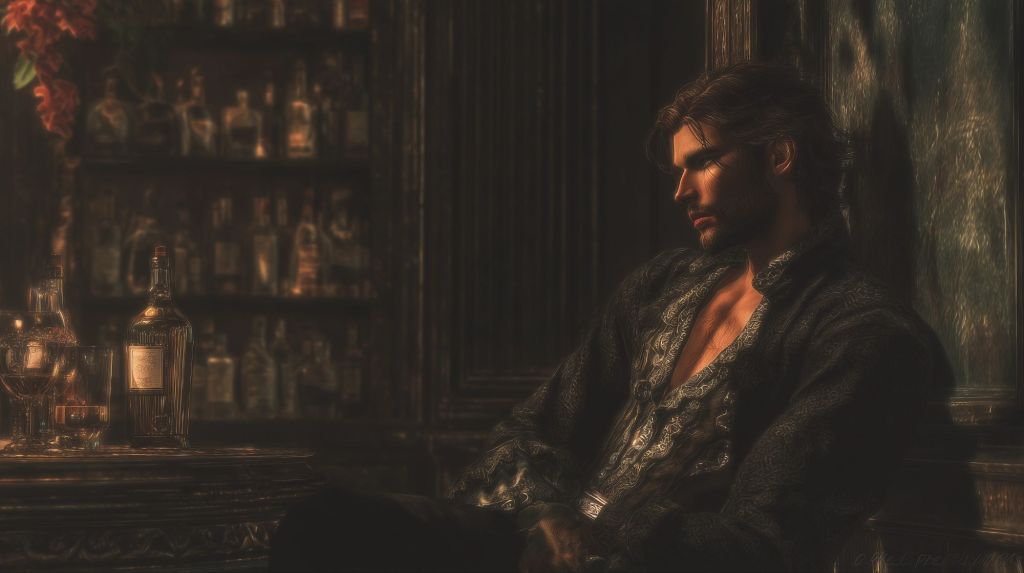
The crystalline chimes of Lumenvale’s evening bells echoed through the Merchant Quarter’s cobbled alleyways, their melodic resonance masking the softer sound of Adrian Nightwhisper’s boots against wet stone. He pressed himself against the shadow-draped wall of the Gilded Rose tavern, his breath steady despite the rapid pulse of anticipation that thrummed through his veins like liquid silver.
*Patience,* he reminded himself, the word both mantra and weapon. *The mark always reveals itself to those who know how to wait.*
Twenty paces ahead, Lord Castellan Thorne emerged from the tavern’s amber-lit doorway, his ceremonial robes rustling with the weight of woven gold thread and political ambition. The man’s fingers drummed against the leather satchel pressed close to his ribs—a tellingly protective gesture that spoke volumes to Adrian’s trained eye. Whatever resided within that modest pouch commanded more of Thorne’s attention than the jeweled dagger at his hip or the purse heavy with coin that swayed with each step.
Adrian smiled in the darkness, recognizing the subtle choreography of concealment. After fifteen years dancing through Lumenvale’s shadows, he had learned to read bodies like illuminated manuscripts, every gesture a sentence, every nervous tic a revealing paragraph. Thorne’s left shoulder dipped slightly under the satchel’s weight, his gait shortened by unconscious compensation—signs that the contents possessed both physical substance and immense value.
The game was already won; only the execution remained.
He followed at a distance that would have seemed random to casual observers, his movements synchronized to the evening’s natural rhythms. When Thorne paused to examine a merchant’s wares, Adrian became a patron studying architectural details on a neighboring building. When the lord’s pace quickened through the canal district’s narrow bridges, Adrian transformed into a late-evening stroller, hands clasped behind his back in the manner of someone lost in pleasant contemplation.
*Invisibility,* he mused, *is not about becoming unseen. It’s about becoming unremarkable.*
The art required more than mere stealth. Adrian had cultivated an entire arsenal of personas—the distracted scholar, the lovesick young man, the slightly drunk merchant’s son, the worried father searching for wayward children. Each identity came complete with appropriate body language, breathing patterns, and the subtle energy signatures that marked different social classes within Lumenvale’s complex hierarchy.
But beyond the physical mastery lay something more elusive: the ability to read the invisible currents that flowed between people like underground rivers. Adrian could sense when a mark’s attention wavered, could feel the precise moment when suspicion crystallized into awareness. These perceptions came not from magical enhancement but from years of studying human nature with the focused intensity of a master artist examining light and shadow.
Thorne turned into the narrow Silversmith’s Alley, where twilight pooled between high walls like spilled wine. The perfect hunting ground—enclosed enough to limit escape routes, shadowed enough to obscure details, yet public enough that screams would draw unwanted attention. Adrian’s pulse quickened with professional appreciation as he recognized the opportunity presenting itself like a gift from the patron saints of his trade.
He drew upon his second greatest skill: the manipulation of probability through careful preparation.
From his belt, he withdrew a handful of copper coins—not enough to constitute real wealth, but sufficient to create the right acoustic signature when dropped on cobblestone. With practiced precision, he scattered them across the alley’s mouth, each coin positioned to roll naturally toward the center when disturbed. The metal would sing against stone, creating a distraction both plausible and irresistible to curious minds.
As Thorne passed the coins, Adrian whispered a single word—”*Vexation*”—in the ancient tongue his grandmother had taught him during long winter evenings. Not a spell, precisely, but something more subtle: a vocalized intention that seemed to nudge probability toward desired outcomes. The incantation carried the weight of genuine belief, and belief, Adrian had learned, possessed its own peculiar power.
One coin rolled beneath Thorne’s boot at precisely the right angle. The lord stumbled, not dramatically but enough to shift his weight and relax his protective grip on the satchel. In that instant of distraction, Adrian moved.
His fingers found the leather pouch with the delicate precision of a surgeon, loosening ties that had been secured by someone who understood basic precautions but not the advanced principles of theft-resistant knotwork. The satchel’s contents transferred to Adrian’s possession with the fluid grace of water finding its level—inevitable, effortless, natural as breathing.
*Touch,* he reflected, *is a conversation between skin and desire.*
Master thieves developed sensitivity beyond ordinary human parameters. Adrian could differentiate between silk and linen through fabric layers, could identify metal alloys by their resonant frequencies when struck by fingernails, could sense the internal mechanisms of locks through minute vibrations transmitted through picks and tension wrenches. His hands had become instruments of inquiry, capable of asking questions that eyes could never formulate.
But the crown jewel of his abilities remained something far more subtle than manual dexterity or social camouflage. Adrian possessed an almost supernatural talent for understanding what people truly valued, for perceiving the difference between apparent worth and essential significance.
The satchel’s contents—a collection of correspondence sealed with the private sigil of House Ravencrest—would have seemed mere paper to most thieves. But Adrian recognized the documents’ true nature: evidence of a political alliance that could shift the balance of power within Lumenvale’s ruling council. Lord Thorne hadn’t been carrying coin or jewels; he had been transporting the future itself, folded into portable form.
*Knowledge,* Adrian understood, *is the only currency that appreciates through theft.*
He melted back into the evening’s embrace, leaving Thorne to discover his loss in privacy and rage. By the time the lord realized what had occurred, Adrian would be three districts away, the stolen correspondence already in the hands of parties who understood its revolutionary implications.
The narrow streets of the Artisan Quarter welcomed him like a familiar lover, their shadows deepening as Lumenvale’s Crystal Spires began their nightly illumination. Candlelit windows transformed the district into a constellation of domestic warmth, each glow representing lives lived in oblivion to the power struggles that shaped their circumstances.
Adrian paused beneath a stone arch carved with protective runes, allowing himself a moment of professional satisfaction. The evening’s work had required the integration of multiple skill sets: tactical awareness, psychological manipulation, manual precision, timing, and the intuitive understanding of human nature that separated true masters from mere practitioners.
But as he contemplated the stolen documents—their contents capable of elevating or destroying careers, of reshaping alliances that had stood for decades—Adrian felt the familiar weight of moral complexity that accompanied his greatest successes. He was, by any reasonable definition, a criminal. Yet his crimes often served justice in ways that legal channels could never achieve. The correspondence would expose corruption that had festered in darkness for years, would reveal truths that powerful men had spent fortunes to conceal.
*Perhaps,* he mused, studying the sealed letters in his palm, *what I’m truly good at is being the universe’s own instrument of correction.*
The thought carried both comfort and burden. Adrian Nightwhisper had mastered skills that existed in the shadows between light and darkness, skills that required precise calibration between right and wrong. He was good at seeing what others overlooked, at moving through spaces others couldn’t navigate, at understanding the difference between justice and law.
Most of all, he was good at being necessary—performing the delicate work that civilization required but could never officially acknowledge.
The night deepened around him as he made his way toward the meeting point where his employer waited. Above, Lumenvale’s stars emerged like scattered diamonds against black velvet, their ancient light bearing witness to another perfectly executed theft, another small adjustment to the grand balance of power and truth.

 Chadwick Rye
Leave a comment