
Do you have any collections?
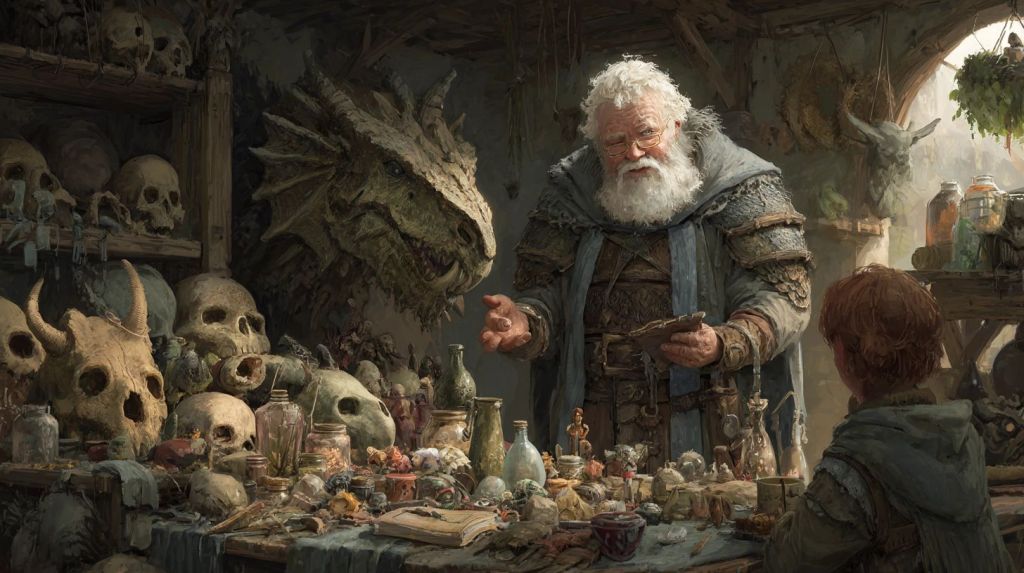
The Trophy Hall
The afternoon sun slanted through diamond-paned windows, casting prismatic rainbows across the polished oak floors of Gideon Blackthorn’s study. Dust motes danced in the colored light like tiny sprites, and the air itself seemed thick with stories waiting to be told. From every surface, shelf, and shadowed alcove, the accumulated treasures of forty years of adventuring gazed down with silent testimony to perils faced and wonders witnessed.
“Now then, young scholars,” Gideon rumbled, his voice carrying the gravelly warmth of countless campfire tales, “what brings you to this old wanderer’s den of curiosities?”
Twelve wide-eyed children from Lumenvale’s Academy of Fundamental Arts clustered near the study’s entrance, their prescribed learning robes rustling with nervous energy. Their instructor, a prim woman whose starched collar seemed to perpetually fight against smiling, cleared her throat diplomatically.
“Master Blackthorn, the children are studying the practical applications of theoretical magic. We hoped you might… illuminate some examples from your extensive travels.”
Gideon’s weathered face creased into a grin that transformed his austere features. Silver whiskers, braided with tiny bells that chimed softly when he moved, framed teeth still remarkably intact despite decades of questionable tavern fare and hastily-consumed trail rations.
“Practical applications, is it?” He gestured with a hand marked by countless small scars—souvenirs of blades, claws, and acidic substances best left unnamed. “Well then, let’s start with something properly impressive.”
He moved toward the study’s central display case with the careful gait of one whose joints remembered every tumble down rocky slopes and every night spent sleeping on unforgiving ground. Inside the case, resting on midnight-blue velvet, lay a sword whose blade seemed to capture and hold the room’s dancing light.
“Dawnbreaker,” Gideon announced, his voice dropping to the reverent tone reserved for truly sacred things. “Forged by the last of the Solarian smiths in the fires of Mount Pyrethia. See how the steel appears to glow even in ordinary light?”
A boy with unruly copper hair pressed closer to the glass, his breath fogging the surface. “Does it really hold the power of sunrise, Master Blackthorn?”
“Aye, young Thomas—it does indeed.” Gideon’s eyes grew distant, gazing not at the blade but through decades to a memory sharp as the weapon itself. “I carried Dawnbreaker into the Shadowmere Depths, where the Void Wraiths had made their nest. Creatures of pure darkness, they were—beings that fed on light itself until nothing remained but empty, hungry shadow.”
The children leaned forward as one, drawn by the magnetic pull of a story well-told. Their instructor’s disapproving expression softened despite herself.
“The battle lasted three days,” Gideon continued, moving around the display case like a storyteller pacing before his fire. “Each time I drew the blade, its stored sunlight pushed back the darkness just enough for me to advance another few steps. By the third dawn, I had reached their spawning chamber—a cavern where light had never touched stone.”
He paused, allowing the silence to build until even the dust motes seemed to hover in anticipation.
“When I finally raised Dawnbreaker overhead and spoke the Solarian invocation, the blade released every ray of sunlight it had ever absorbed. For one perfect moment, that cavern blazed brighter than midday, and the Void Wraiths simply… dissolved. Like nightmares banished by a child’s courage.”
A girl with intelligent dark eyes raised her hand tentatively. “But Master Blackthorn, if the sword released all its stored light, how is it still glowing now?”
Gideon’s grin widened with genuine delight. “Excellent question, young Sera! The answer lies in understanding the difference between magical storage and magical resonance.” He tapped the glass gently with one knuckle. “Dawnbreaker didn’t just contain light—it learned to sing with the same frequency as dawn itself. Even empty, it remembers the song.”
He moved away from the sword display, drawing the children deeper into his treasure-filled sanctuary. Shelves lined the walls from floor to ceiling, each laden with artifacts that seemed to whisper of distant lands and desperate moments.
“Now, who can tell me what practical application might be found in this?” He lifted a crystalline sphere no larger than his fist, its surface swirling with trapped mist that moved in patterns too complex to follow.
“A scrying orb?” ventured Thomas, though his voice carried more hope than confidence.
“Close, but not quite.” Gideon held the sphere up to catch the window light, and the internal mist suddenly blazed with color—deep purples and vibrant golds that pulsed like a living heartbeat. “This is a Storm Heart, crystallized from the eye of a hurricane that had raged for seven years above the Tempest Seas.”
The children gasped appropriately, and Gideon felt the familiar warmth of an appreciative audience. How long had it been since anyone had asked about his collection? Years, perhaps. The younger generation of adventurers preferred to seek their fortunes in newly-discovered realms rather than listening to tales of places already mapped and dangers already conquered.
“The Storm Heart doesn’t predict weather,” he explained, rotating the sphere slowly in his palm. “It *remembers* weather. Every storm it’s ever witnessed, every shift in atmospheric pressure, every whisper of wind across water. In the right hands, it can teach you to read the sky like a book written in clouds and lightning.”
Sera raised her hand again. “Did you use it to navigate during your travels?”
“Many times, child. But its most important service came during the Siege of Thornwick, when Duke Aldric’s forces were trapped by an unseasonable blizzard.” Gideon’s expression grew serious, the entertainer’s mask slipping to reveal the veteran beneath. “I used the Storm Heart to find the blizzard’s natural break—a gap in the storm front that would last exactly seventeen minutes. Just long enough for three hundred souls to escape before the enemy realized what had happened.”
He set the sphere carefully on a nearby table, then moved to what appeared to be an ordinary wooden box sitting innocuously among far more impressive artifacts.
“And what about this?” he asked, lifting the box’s simple lid to reveal… nothing. Empty velvet lining, unmarked by any object.
The children exchanged puzzled glances. Even their instructor frowned with polite confusion.
“It’s empty,” observed a quiet boy who had remained silent until now.
“Is it, young Marcus?” Gideon’s eyes twinkled with mischief. “Look more closely. Sometimes the most valuable collections are the ones others cannot see.”
He reached into the apparently empty box and withdrew… nothing. His hand moved as though grasping an invisible object, his fingers curved around empty air. Yet something about his posture, the careful way he held his hand, suggested he indeed held something precious.
“Memories,” he said softly, his voice carrying a weight that made the very air seem heavier. “I collect memories, children. Not just my own—though I have plenty of those—but the memories others entrusted to me. The last words of dying comrades. The secret dreams of kings and peasants alike. The final song of a dragon before it chose to fade from the world rather than diminish with age.”
The study fell silent except for the gentle chiming of his braided bells as he replaced the invisible treasure in its box.
“These memories can’t be displayed on shelves or polished to catch the light,” he continued, closing the lid with reverent care. “But they’re more valuable than any sword or stone or storm. They’re what transform mere objects into true treasures—the stories that give meaning to metal and crystal and preserved scale.”
He moved toward another display, this one featuring what appeared to be a simple leather-bound journal resting open to pages covered in cramped handwriting.
“Take this, for instance. Looks like an ordinary travel journal, doesn’t it? But these pages contain the collective knowledge of the Lost Library of Athermoor—an entire civilization’s wisdom, condensed and preserved through a desperate enchantment cast moments before the city was consumed by shifting sands.”
A girl with practical eyes and ink-stained fingers spoke up. “How did you manage to save it, Master Blackthorn?”
“I didn’t save the knowledge, young Petra. I befriended it.” Gideon’s hand hovered above the journal’s pages, not quite touching but somehow communicating with the written words. “The enchantment required willing partnership—someone to carry the memories forward, to share them with others who might benefit from their wisdom. I agreed to become its curator, and in return, the journal teaches me something new each day.”
The afternoon sun shifted, sending new patterns of colored light across the study as the children moved from display to display, each artifact unlocking another story, another lesson in the practical applications of wonder.
Near the room’s far corner stood a case containing what appeared to be pressed flowers—delicate blooms in impossible colors, their petals seemingly crafted from spun silver and captured moonlight.
“Starfall blossoms,” Gideon explained before anyone could ask. “They grow only in the crater lakes of Mount Celestine, and bloom for exactly one hour each year when the constellation Lyra reaches its zenith. I spent three years learning to recognize the precise moment, then had less than sixty minutes to collect specimens before they dissolved back into starlight.”
“But why collect them at all?” asked Sera, her practical mind clearly working through the enormous effort involved for such ephemeral beauty.
Gideon considered the question seriously, his weathered hands clasped behind his back as he studied the preserved blooms.
“Because some things are worth preserving precisely because they’re impossible to keep,” he said finally. “These flowers remind me that beauty doesn’t need permanence to have meaning. Every time I look at them, I remember standing alone on a mountain peak, surrounded by impossible colors, knowing I was witnessing something that would exist for less time than it takes to speak a prayer.”
The children absorbed this wisdom with the peculiar gravity of youth confronting profound truth for the first time. Their instructor checked the ornate timepiece pinned to her collar and cleared her throat gently.
“Master Blackthorn, we should be returning to the Academy soon. The children have evening studies to complete.”
“Of course, of course.” Gideon nodded, though something in his expression suggested he could have continued sharing stories until the stars emerged. “But before you go, let me show you one final treasure.”
He moved to his writing desk—a massive construction of dark wood whose surface bore the scars of decades of use. From its center drawer, he withdrew a simple wooden box, far smaller than the empty memory container but somehow radiating greater significance.
“This,” he said, opening the box to reveal a collection of what appeared to be ordinary pebbles, “contains my most precious collection.”
The children gathered around, their expressions politely confused. After swords that held sunlight and storms trapped in crystal, a handful of common stones seemed distinctly anticlimactic.
“Each stone represents a person whose life touched mine during my travels,” Gideon explained, his voice softer now, touched with something approaching vulnerability. “This blue one came from the shores of Lake Serenity, where a young healer named Cordelia taught me that sometimes the bravest thing an adventurer can do is stay in one place and tend to those who need care.”
He lifted another stone—this one a warm amber color that caught the light like honey.
“This yellow stone came from the courtyard of an inn where I spent three days recovering from a fever. The innkeeper’s daughter—she couldn’t have been more than six—sat with me every evening and told me stories about the adventures she planned to have when she grew up. She gave me this stone as payment for listening, because she said stories were valuable and should always be fairly traded.”
One by one, he showed them stones that commemorated acts of kindness, moments of courage, instances of connection that had nothing to do with monsters slain or treasures won.
“You see, children,” he said, replacing the stones carefully in their box, “I began my career collecting the sorts of things other adventurers prize—magical weapons, rare artifacts, proof of deeds accomplished. But over the years, I discovered that the most valuable collections are the ones that collect you in return.”
Thomas raised his hand tentatively. “Master Blackthorn, do you… do you have any collections that aren’t from adventuring?”
The old warrior’s expression brightened with genuine surprise and delight. “What an excellent question! Yes, indeed I do.” He moved to a bookshelf near the window, withdrawing a slim volume bound in midnight-blue leather. “I collect first attempts—the very first poem written by aspiring bards, the initial sketch drawn by future artists, the earliest spell successfully cast by beginning mages.”
He opened the book to reveal pages filled with amateur verse, childish drawings, and careful notations describing simple magical effects.
“People are always eager to share their masterpieces,” he explained, turning pages that showed a progression of skill and ambition. “But their first attempts—those are pure courage made manifest. The moment when someone decides to try something they’ve never done before, knowing they’ll probably fail but choosing to begin anyway.”
Sera leaned forward to study a particularly endearing drawing of what might have been a dragon or possibly a very enthusiastic chicken. “Do you know what happened to the people who made these?”
“Some became masters of their crafts,” Gideon replied. “Others discovered their talents lay elsewhere and moved on to different pursuits. But every single one learned something valuable about themselves through the act of beginning. That’s what makes these collections truly precious—they capture the moment when potential becomes action.”
The instructor’s timepiece chimed softly, indicating the approaching hour for departure. As the children began to gather their belongings and express their thanks, young Marcus—the quiet boy who had first observed the empty box—approached Gideon with shy determination.
“Master Blackthorn,” he said softly, “I’ve been collecting something too, but nobody thinks it’s very important.”
“Tell me about it, lad.”
Marcus reached into his Academy robe and withdrew a small cloth pouch. From it, he carefully extracted what appeared to be pressed leaves—not exotic specimens or magical flora, but ordinary autumn leaves in various stages of color change.
“I collect leaves that are exactly halfway between green and their autumn color,” he explained, his cheeks flushing with embarrassment. “I like how they show that changing doesn’t have to be sudden. You can be both things at once for a while.”
Gideon’s expression transformed with something approaching awe. He knelt to Marcus’s eye level, studying the carefully preserved leaves with the same attention he had given his rarest artifacts.
“Marcus,” he said solemnly, “this is perhaps the most sophisticated collection I’ve ever encountered. You’re documenting the precise moment of transformation—capturing change itself. That’s not just collecting; that’s philosophy made tangible.”
The boy’s face lit up with the radiance of validation from an unexpected source. Around him, his classmates regarded both the leaves and Marcus himself with newfound respect.
“In fact,” Gideon continued, rising and moving to his desk, “I’d like to add something to your collection, if you’ll permit me.” He opened another small drawer and withdrew a single leaf—this one silver-edged and seeming to shimmer between seasons. “This came from the Twilight Grove, where the trees exist in perpetual autumn-into-winter. It might make an interesting addition to your study of transitional states.”
Marcus accepted the gift with trembling hands, his eyes wide with wonder. “Thank you, Master Blackthorn. I’ll treasure it.”
As the children prepared to leave, their minds buzzing with stories and possibilities, Gideon felt a familiar melancholy settle over him. The study would return to its customary silence, the artifacts to their patient waiting for the next audience that might appreciate their histories.
But then Sera turned back from the doorway, her intelligent eyes bright with determination.
“Master Blackthorn,” she called, “would it be acceptable if we returned sometime? Perhaps… perhaps we could bring our own collections to show you?”
The old adventurer’s face broke into a smile that seemed to illuminate the entire room, his braided bells chiming a soft melody of joy.
“Young scholars,” he replied, his voice carrying across the golden afternoon light, “nothing would make me happier. After all, the finest treasures are the ones that inspire others to seek their own.”
As the sound of departing footsteps faded down the corridor, Gideon Blackthorn stood among his lifetime’s accumulation of wonders, feeling richer than any dragon’s hoard could make him. Around him, his collections seemed to pulse with renewed life—not mere objects gathering dust, but stories waiting to inspire the next generation of collectors, dreamers, and adventurers brave enough to believe that the world still held wonders worth seeking.
In the fading light, even the empty memory box seemed to glow with anticipation for the new stories soon to come.

 Chadwick Rye
Leave a comment