
What public figure do you disagree with the most?
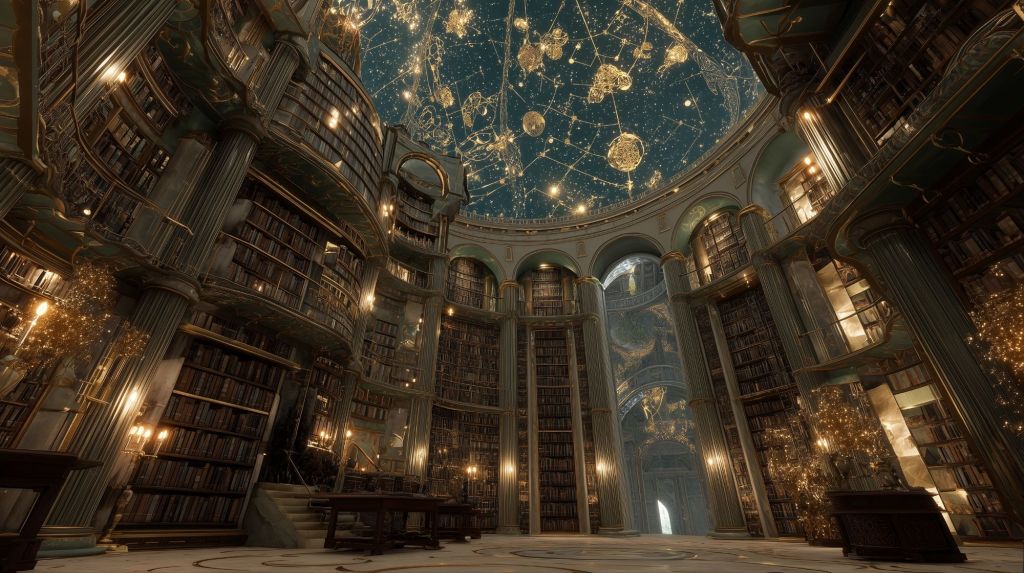
The ancient library of Silverhaven University curved around Matthias like a lover’s embrace, its tiered shelves stretching toward a domed ceiling where constellations had been painstakingly rendered in gold leaf and luminescent crystal. Outside, autumn rain tapped insistent fingers against leaded glass windows, creating a symphony of whispers that had accompanied scholars in this hallowed space for over twelve generations. Matthias traced weathered fingertips across embossed leather spines, some older than the nation itself, their titles barely discernible beneath decades of handling by reverent hands.
He paused at a familiar tome, *Governance and the Soul’s Obligation* by Grand Chancellor Thaddeus Blackwell—the man whose philosophy had reshaped Lumenvale’s political landscape over the past decade. The book’s prominence, positioned at eye level on the most accessible shelf, spoke volumes about its revered status among the university’s leadership. Candlelight caught the gilt edges of its pages, creating a halo effect that seemed, to Matthias, undeservedly beatific.
“Still brooding over Blackwell, I see,” came a melodic voice from behind him. Elara materialized between towering shelves, her scholar’s robes the color of midnight, silver threads at the hem marking her status as Professor of Ethical Philosophy. In her arms she carried a stack of scrolls nearly reaching her chin, yet she moved with the fluid grace that had first captivated Matthias during their student days, decades earlier.
“Not brooding,” he corrected, withdrawing the heavy volume with a familiarity born of countless readings. “Preparing. The Chancellor visits in three days’ time, and the Provost has ‘suggested’ I attend the reception.”
Elara’s laugh drifted through the library like windchimes, earning a disapproving glance from an ancient librarian whose spectacles magnified already owlish eyes. “Suggested, indeed. Poor Matthias, forced to breathe the same air as the architect of everything you oppose.”
“Not everything,” he said, settling into a high-backed chair beside a reading table where a single candle created an island of warm light in the library’s oceanic dimness. “Just the fundamentals of how society should function, the nature of justice, the distribution of resources, the relationship between governance and individual autonomy, and the moral foundation upon which our civilization rests.” His tone was light but couldn’t fully mask the undercurrent of genuine distress.
Elara deposited her scholarly burden onto the adjacent table with a soft thud, then claimed the chair opposite his. Between them, the candlelight formed a neutral territory where their shadows met and mingled on polished mahogany. Outside, the rain intensified, creating a mercurial curtain that transformed the university grounds into impressionistic smudges of lantern light and ancient architecture.
“You could always develop a convenient illness,” she suggested, eyes sparkling with mischief beneath arched brows. “Something appropriately dramatic but not life-threatening. Swamp fever, perhaps.”
“And reinforce the Provost’s accusation that I lack the courage of my convictions?” Matthias shook his head, silver-streaked hair catching the light. “Besides, illness would only postpone the inevitable. Blackwell’s philosophy permeates everything now—curriculum revisions, funding priorities, even the recent changes to the university charter.”
He opened the tome before him, its pages falling naturally to a heavily annotated passage. His own handwriting crowded the margins—not in the careful script he used for official university documents, but in the urgent, slanted hand of a man grappling with ideas that disturbed his intellectual foundations.
Elara leaned forward, reading a passage illuminated by candlelight: *”The common citizen lacks the necessary perspective to determine what serves the greater good. Therefore, governance must be entrusted to those superior minds capable of discerning higher truths beyond the comprehension of ordinary understanding.”*
“Ah, the cornerstone of Blackwellian thought,” she murmured. “Elegant in its simplicity, terrifying in its implications.”
“And devastatingly effective in its implementation.” Matthias closed the book with unexpected force, sending a small puff of dust dancing in the candlelight. “Ten years since his appointment as Grand Chancellor, and look at what Lumenvale has become. A society where citizens are ranked by ‘cognitive capacity,’ where children as young as eight are subject to assessment that determines their educational access, where entire communities can be relocated because the ‘superior minds’ have determined their land serves a higher purpose elsewhere.”
His voice had risen despite himself, prompting another disapproving glance from the librarian. Matthias acknowledged the silent reprimand with a conciliatory nod before continuing in a lower tone.
“What troubles me most is the seductiveness of his argument. The promise of a society guided by pure intellect, free from the messiness of democratic processes. Even our brightest students find it compelling—the notion that they might someday join those rarefied ranks of decision-makers.”
Elara studied him with eyes that had always seen through his academic armor to the vulnerable idealist beneath. “Yet you, one of our most celebrated scholars, find yourself fundamentally opposed. Why, I wonder, when Blackwell’s system would surely place you among those ‘superior minds’?”
The question hung between them like smoke, curling around the edges of their long friendship. Outside, lightning momentarily transformed the library windows into brilliant tableaux, followed seconds later by thunder that seemed to shake the very foundations of the ancient building.
“Because wisdom and moral judgment cannot be measured by the instruments Blackwell has devised,” Matthias finally replied, speaking as though the words themselves caused him physical pain. “Because I’ve witnessed brilliance coupled with profound moral blindness. Because history repeatedly shows that concentrating power in the hands of self-proclaimed intellectual elites inevitably leads to justifications for unconscionable actions.”
He traced the embossed lettering on the book’s cover, each golden letter a barrier between Blackwell’s world and the one Matthias had spent his life defending. “Most of all, because I’ve sat with farmers who can barely read yet possess deeper understanding of justice than colleagues with multiple advanced degrees. I’ve learned more about ethical governance from conversations in village taverns than from scholarly symposia.”
Elara’s expression softened. “You’ve always been stubbornly democratic in your sensibilities. It’s why the Provost finds you so frustrating—and why your lectures consistently overflow with students.”
“Students who will enter a world increasingly shaped by Blackwell’s vision,” Matthias replied. “Where their worth will be determined by assessments that measure only what Blackwell’s system values.”
Rain continued its relentless percussion against ancient windows, occasionally punctuated by thunder that seemed to emphasize Matthias’s concerns. The library had emptied as evening deepened, leaving only the most dedicated scholars hunched over texts in pools of isolated lamplight. The building itself seemed to breathe around them—expanding and contracting with the pressures of weather and time, creaking like an old man settling into familiar discomfort.
“You’ve been writing again,” Elara observed, not a question but a statement of fact. “Something beyond your usual academic papers.”
Matthias smiled faintly, unsurprised by her perception. “A comprehensive critique of Blackwellian philosophy, examining its historical antecedents and projecting its logical outcomes. Less academic, more accessible—something ordinary citizens might actually read.”
“And something that might finally cost you your position here,” she added, concern evident in the slight furrow between her brows. “The Provost has tolerated your dissent thus far because it remains largely confined to scholarly circles. Public opposition would be another matter entirely.”
“Hence my reluctance to develop a convenient illness before the Chancellor’s visit,” Matthias acknowledged. “I need to take his measure in person. To understand what drives him beyond the carefully constructed public persona.”
Lightning flashed again, closer this time, briefly illuminating every corner of the vast library with stark clarity before plunging it back into intimate shadow. The subsequent thunder was immediate and visceral, vibrating through the ancient wooden tables and shelves.
“You believe there’s something to be gained from such an encounter?” Elara asked, skepticism evident in her tone. “Blackwell is not known for engaging with his critics—intellectual or otherwise.”
Matthias closed his eyes briefly, summoning memories of public broadcasts where the Chancellor articulated his vision with mesmerizing eloquence. The man possessed undeniable charisma—a quality that had transformed theoretical philosophy into practical governance with unprecedented speed.
“I believe in the power of direct conversation,” he said finally. “In the possibility that beneath his public certainty, there might exist the capacity for doubt or reconsideration. And if not…” He trailed off, fingers unconsciously tightening around the leather binding of Blackwell’s tome.
“If not, then at least you’ll have looked your intellectual nemesis in the eye before publishing something that might well be labeled seditious under current interpretations of the Public Discourse Act,” Elara finished for him, her voice gentle yet unflinching in its honesty.
The rain abruptly ceased, leaving a sudden silence that felt almost intrusive after hours of atmospheric accompaniment. Through the windows, the clouds began to part, revealing a night sky where stars emerged like hesitant truths after prolonged obscurity.
“I’ve dedicated my life to the belief that wisdom belongs to no single class of people,” Matthias said into the newfound quiet. “That governance must incorporate diverse perspectives, especially from those most affected by its decisions. Blackwell represents the antithesis of everything I’ve taught, everything I believe about human potential and moral development.”
He looked up from the book that had consumed so much of his analytical energy, meeting Elara’s gaze across the small sea of candlelight. “If I remain silent while his philosophy reshapes our society, then what meaning can I possibly attach to my life’s work?”
Elara reached across the table, her fingers briefly touching the back of his hand—a gesture so uncharacteristic that it momentarily startled him. For all their decades of friendship, they had maintained the formal physicality typical of the university’s older generation.
“You’ve never been silent, Matthias,” she reminded him. “Your students carry your ideas into their communities, their professions, their families. The seeds of resistance to Blackwellian thought have been planted in every class you’ve taught.”
“Seeds that may never germinate in the climate he’s creating,” Matthias countered, though her touch had somehow steadied him.
“Perhaps. Or perhaps they merely await the right conditions.” She withdrew her hand, returning to her customary reserve. “I wonder if the Chancellor realizes his most formidable opponent is not among the vocal protesters in Capital Square but here, among ancient books, methodically dismantling his philosophical foundations.”
The library bell tolled softly, signaling the approaching midnight hour when even the most dedicated scholars would be gently but firmly directed toward their quarters. Matthias gathered Blackwell’s volume and his own notes, carefully arranging them in the weathered leather satchel that had accompanied him through three decades of academic life.
“Three days until the Chancellor’s visit,” he mused, rising from the chair that had cradled him through countless hours of reading and contemplation. “Three days to prepare for a conversation that may never happen, with a man who embodies everything I find most dangerous in governance.”
Elara stood as well, gathering her scrolls with practiced efficiency. “Whatever comes of your encounter with Blackwell, remember that ideas outlive their creators. His philosophy seems ascendant now, but history isn’t kind to systems built on fundamental misunderstandings of human nature.”
They walked together through the darkening library, their footsteps echoing against marble floors polished by centuries of scholarly passage. Around them, the accumulated wisdom of generations watched from shelves—some of it profound, some misguided, all of it part of humanity’s ongoing conversation with itself.
“In the meantime,” Elara added as they approached the great doors that separated the library from the rest of the university, “perhaps consider having your manuscript copied. Several times. Stored in different locations.”
Matthias smiled faintly at her practical approach to intellectual rebellion. “Already arranged. Including one copy entrusted to a former student now teaching in Westmark—well beyond Blackwell’s immediate influence.”
Outside, the rain-washed night greeted them with air that smelled of petrichor and possibility. Lanterns illuminated ancient pathways between academic buildings where generations of thinkers had walked before them, grappling with the essential questions that defined their respective eras.
“Good night, Elara,” Matthias said as their paths diverged near the Philosophy Department’s ivy-covered facade. “Thank you for the conversation.”
“Sleep well, old friend,” she replied, her form already blending with shadows as she moved toward her quarters. “Dream of a world after Blackwell.”
Alone, Matthias stood briefly beneath a sky now brilliant with stars, his satchel heavy with the weight of opposing visions for human society. In three days, he would stand in the presence of the man whose ideas threatened everything he valued about governance and human dignity. The encounter would likely change nothing in the larger world—one aging professor’s principled opposition barely registering against the machinery of Blackwell’s expanding influence.
Yet as he made his way toward his small university apartment, Matthias felt a curious lightening of his spirit. Perhaps it was simply the freshness of air after storm, or the unexpected comfort of Elara’s friendship. Or perhaps it was the knowledge that throughout history, the most enduring changes had begun not with dramatic confrontations but with quiet, persistent articulation of alternative possibilities—exactly what he had dedicated his life to providing.
Either way, when he finally reached his rooms and placed Blackwell’s book among his own well-worn volumes, Matthias felt something he hadn’t expected: not dread of the coming encounter, but an almost peaceful certainty about his role in a conversation larger than any single participant. Whatever happened with Blackwell, the essential dialogue about how humans should govern themselves would continue long after both of them had returned to dust.
That night, for the first time in months, Matthias slept without dreaming of falling civilizations or libraries consumed by flame. Instead, he dreamed of students gathered in circles, their faces illuminated not by the harsh certainty of Blackwellian doctrine but by the complex, ever-shifting light of ongoing inquiry—questioning, challenging, and ultimately forging their own understanding of what governance could and should be.
It was, all things considered, not a bad vision to carry into the coming confrontation with the most powerful man in Lumenvale.

 Chadwick Rye
Leave a comment