

The late afternoon sun filtered through the stained glass windows of Thornwood’s Grand Theater, casting prismatic patterns across worn floorboards that had supported generations of performers. Outside, the cobblestone streets hummed with the usual clamor of merchants closing their stalls and taverns opening their doors, but within these hallowed walls, a different kind of preparation unfolded.
Elisande Ravencrest, Master of the Royal Players and keeper of theatrical traditions stretching back three centuries, moved with practiced grace between costume racks and prop tables. Her fingers, calloused from decades of manipulating puppet strings and crafting delicate maskwork, traced the contours of her most prized creations: the Expression Masks of Thornwood.
“Apprentice!” she called, her voice carrying to the rafters where shadows concealed ancient pulleys and forgotten scenery. “The Duke’s entourage approaches. Are the masks prepared for their inspection?”
From the darkness of the prop room emerged Finn, his lanky frame stooped by hours of meticulous work. Smudges of paint adorned his forehead where he’d absentmindedly brushed his hair aside, and wood shavings clung to his worn apprentice robes.
“Almost complete, Master Ravencrest,” he replied, carefully carrying a velvet-lined tray bearing seven exquisitely carved facial masks. “I’ve applied the final lacquer to Sorrow and Joy, but Fury’s tempera needs another hour to properly set.”
Elisande’s eyes, one pale blue, one amber, a mark that had once caused suspicious whispers of fae blood, narrowed as she examined his work. Each mask represented not merely an emotion but an entire language of expression the Royal Players had refined into an art form recognized throughout the Seven Kingdoms.
“These will have to suffice,” she said, lifting the Mask of Joy, its upturned lips and crescent-shaped eyes capturing an essence of delight so pure that even holding it seemed to lighten one’s spirit. “Duke Harrington fancies himself a patron of the theatrical arts, though his understanding barely scratches the surface of true expression.”
Finn nodded, arranging the remaining masks with reverent precision. “Last time he visited, he called them ‘those charming face pictures the players wear,’” he recalled, perfectly mimicking the nobleman’s pompous inflection.
“And yet his gold spends as well as any connoisseur’s,” Elisande replied pragmatically. “Remember your lessons today, Finn. Show him the masks he expects to see, but keep our most sacred expressions hidden from casual view.”
The seven masks on display represented the common language of emotions, Joy with its crescented eyes and upturned lips; Sorrow with downturned features and painted tear tracks; Fury with jagged brows and bared teeth; Love with its half-lidded gaze and gentle smile; Fear with wide eyes and open mouth; Wisdom with serene features and knowing eyes; and Mischief with its asymmetrical grin and single raised brow.
But tucked away in Elisande’s private collection were dozens more, subtle variations and complex combinations that could convey emotions no single word could adequately describe. These were the true treasures of Thornwood’s theatrical tradition, developed over centuries to communicate nuances of human experience that transcended ordinary language.
“Which is your favorite, Master?” Finn asked suddenly, breaking protocol with a question too personal for an apprentice. Yet something in Elisande’s demeanor had shifted as she handled the masks, a vulnerability rarely glimpsed beneath her stern exterior.
Instead of reprimanding him, she considered the question thoughtfully. “An interesting inquiry on today of all days, when we prepare to perform the public face of our guild.” She set down the Mask of Joy and moved toward a locked cabinet at the back of the prop room.
From within, she withdrew a smaller tray containing masks Finn had never seen during his three years of apprenticeship. These were clearly older, the wood darkened with age and handling, their features more subtle than the exaggerated expressions of the performance collection.
“These are the True Faces,” Elisande explained, her voice lowering to a reverent whisper. “Carved by the founders of our guild from the heartwood of the original Thornwood Grove, now long cleared for the Duke’s hunting forest.”
Finn’s eyes widened as she carefully lifted one, a mask that at first glance appeared almost neutral, yet somehow conveyed a complex emotion he instantly recognized but couldn’t name.
“This,” Elisande said, “is my favorite. We call it Kavalai in the old tongue. It represents the bittersweet recognition of a beautiful moment even as it passes away from you, joy and sorrow experienced simultaneously.”
She held it to her face briefly, and though the mask covered only her features, Finn felt as if her entire being transformed. Suddenly he saw not his demanding mentor but a woman who had devoted her life to preserving an art form increasingly treated as mere entertainment rather than the profound emotional language it truly was.
“The masks were never meant to be mere theatrical devices,” she continued, lowering Kavalai to reveal her own features once more. “Before written language spread through the kingdoms, before the Great Libraries cataloged human knowledge, these were how our ancestors communicated complex emotions across language barriers and tribal divisions.”
She returned Kavalai to its velvet nest and selected another, this one bearing a slight, secretive smile and eyes that seemed to look both inward and outward simultaneously.
“Serenth,” she named it. “The quiet pride of watching someone you’ve guided succeed without your help. I’ve worn this one many times when observing your progress from the shadows, though you never knew it.”
Finn felt his cheeks warm at the unexpected praise hidden within her words. Elisande rarely offered direct encouragement, believing that excellence should be its own motivation.
The next mask bore an expression of open wonder, eyes wide and lips parted, yet somehow conveying not simple surprise but a profound awakening.
“Numinalis,” Elisande said. “The moment of witnessing something so beautiful it transforms your understanding of the world. The first time I saw the ocean. The birth of my daughter. The perfect execution of the Tragedy of Lord Kestrel when every element of stage, performance, and audience aligned in transcendent harmony.”
A knock at the theater’s main door interrupted the moment. “The Duke arrives,” came the call from one of the junior players.
With practiced efficiency, Elisande returned the True Faces to their cabinet, locked it with a key she wore around her neck, and smoothed her features into the pleasant but reserved expression expected of a guild master greeting nobility.
“Return these performance masks to their display stands,” she instructed Finn. “Remember, these are what they expect to see, simple emotions easily cataloged and understood. The true language of our craft remains ours alone.”
As she moved toward the entrance hall, she paused, turning back to her apprentice with an unusual moment of candor. “You asked about my favorite… the truth is, I hold each mask as precious for what it can express that words cannot. In this world of increasing literacy and decreasing emotional honesty, our masks may seem antiquated curiosities to men like the Duke.”
Her expression softened momentarily. “But to those who understand, they remain the purest language ever developed, emotions given physical form, allowing us to say to one another: ‘This is how I feel, truly, without the barrier of inadequate words.’”
The heavy wooden doors swung open, admitting Duke Harrington and his entourage. Elisande transformed instantly into the gracious curator of cultural curiosities the nobleman expected, guiding him toward the display of performance masks with practiced commentary about their historical significance and artistic value.
Finn observed from the shadows, noticing how the Duke nodded appreciatively at the craftsmanship while missing entirely the deeper meaning Elisande deliberately omitted from her explanation. The noblemen handled the Mask of Joy with careless familiarity, commenting on its “delightful expression” as if it were merely a decorative object rather than a vessel for communicating one of humanity’s most profound experiences.
Later, after the Duke had departed with promises of patronage and commissioned performances at his upcoming spring festival, Elisande found Finn in the workshop, carefully applying the final details to a mask of his own creation.
“What emotion does this one express?” she asked, studying his work with professional interest.
Finn held up the unfinished mask, its features conveying something complex, a tension between opposing forces held in delicate balance. “I’m not certain there’s a word for it in our language,” he admitted. “It’s the feeling of discovering something precious that has always been hidden in plain sight, combined with the determination to protect it from those who cannot understand its value.”
Elisande took the mask gently, turning it to catch the fading afternoon light that streamed through the high windows. A smile, genuine, not the performed pleasantry she had offered the Duke, softened her features.
“There is a name for this in the old language,” she said. “Vhalior. The guardian’s recognition of worth beyond measure.” She handed it back to him with uncharacteristic gentleness. “It seems you understand the true purpose of our craft better than I realized.”
As dusk settled over Thornwood, transforming the theater into a cavern of shadows and whispers, master and apprentice worked side by side, their fingers giving form to emotions that transcended the limitations of spoken language. In a world increasingly dominated by the written word and political calculation, they preserved something more ancient and true, the unspoken language of human experience, captured in wood and pigment, waiting to be understood by those who remembered how to see beyond the surface of things.
The Masks of Thornwood would never be mere “face pictures” to those who understood their profound purpose: not to hide emotion, but to reveal it in its purest, most honest form.
If The Language of Masks spoke to you—if you believe stories can capture the emotions words often fail to express—then there’s so much more waiting for you.
Subscribe to my blog for more original fantasy stories, glimpses into forgotten worlds, and the timeless magic of storytelling.
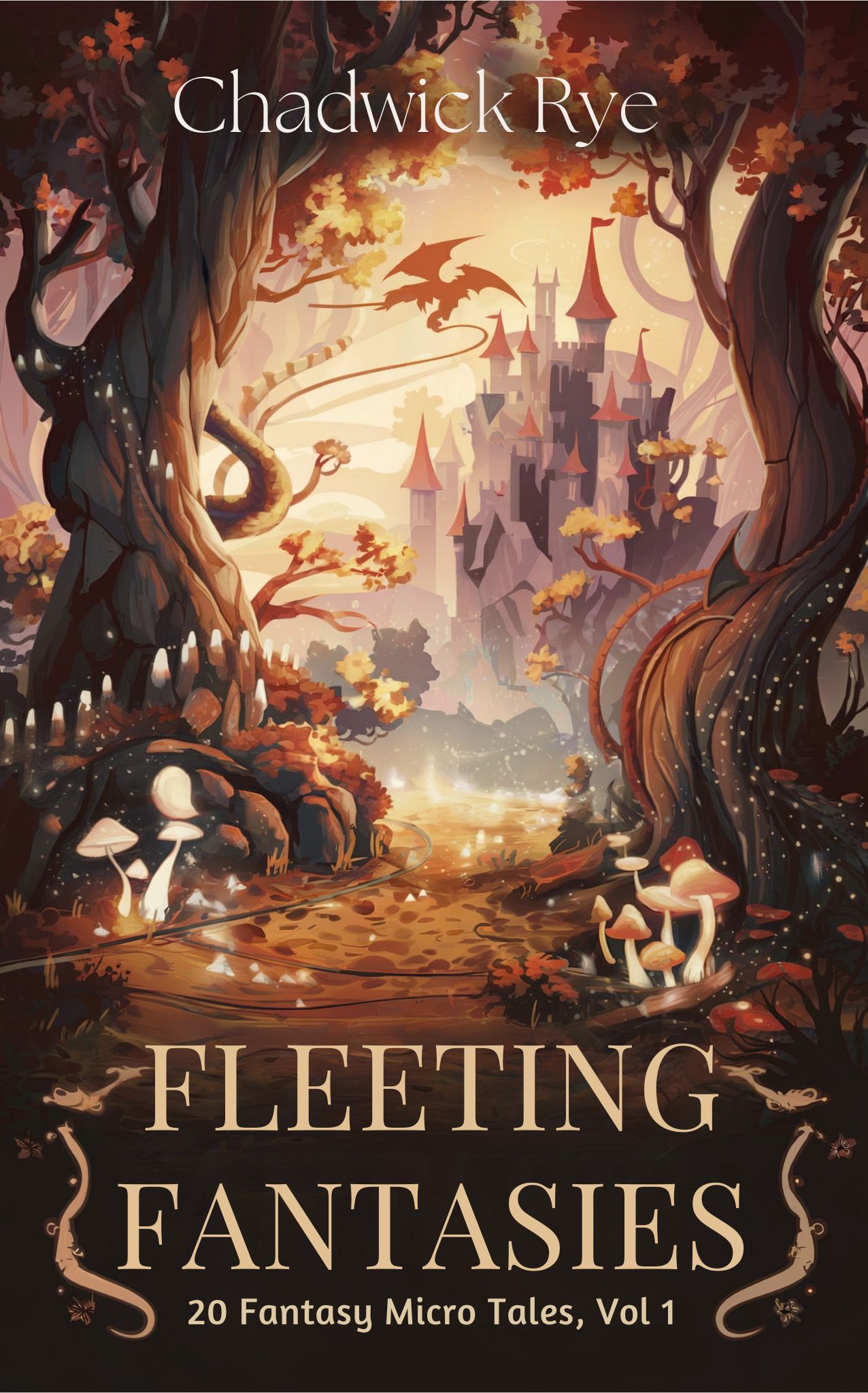
And if you’d like to hold that magic in your hands, explore Fleeting Fantasies—a three-volume collection where twenty of my most beloved tales come together in each book, weaving a tapestry of wonder, mystery, and heart.
✨ Discover Fleeting Fantasies here! ✨
Join me—and let’s keep the ancient language of stories alive.

 Chadwick Rye
Leave a comment