
What is your favorite restaurant?
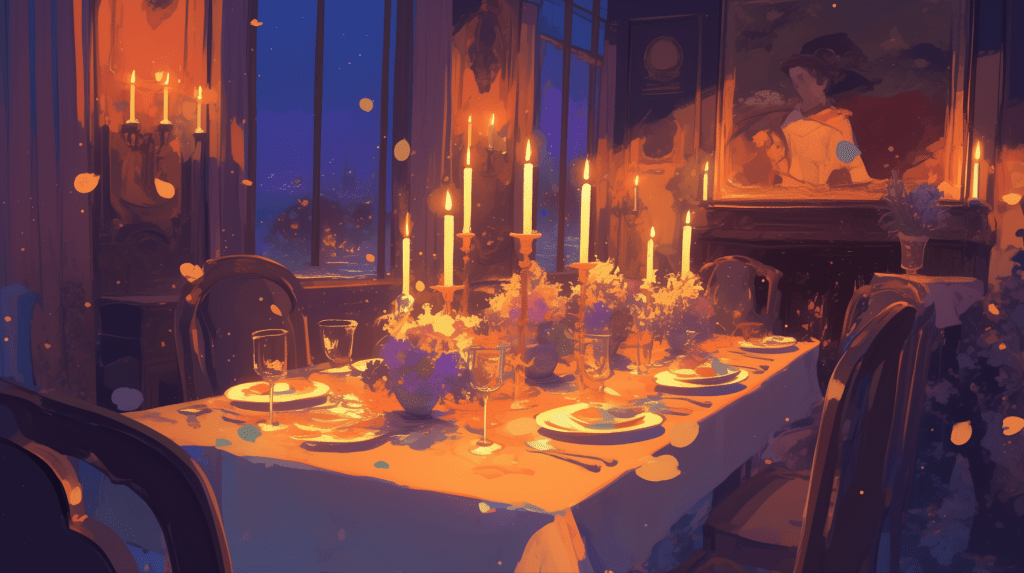
The winter hearth-fires of Castle Ravenscroft cast long shadows across my study as I pen these recollections. Outside, snow blankets the ancestral lands that have borne my family name for seventeen generations. My bones ache with the coming storm, a reliable almanac earned through eight decades of life. I am Lord Ambrose Ravenscroft, once King’s Emissary to the Seven Realms, now simply an old man with a lifetime of memories and a passion for culinary delights that has outlasted most other appetites.
In my travels, I have dined at the tables of emperors and in humble roadside taverns. I have sampled the spiced lotus pods of the Crimson Desert and the crystal ice-fish of the Frozen Wastes. Kings have sought my counsel on matters of state; master chefs have trembled as I lifted their creations to my lips. When one has lived as long as I, perspective becomes the most valuable currency, and I can say with certainty that there is no finer establishment in all the known realms than The Gilded Griffin in the merchant city of Highaven.
Many would expect me to name some opulent banquet hall where gold-flecked wine flows like water and rare delicacies are served upon plates of burnished silver. Others might anticipate my preference for ancient, storied establishments where recipes have remained unchanged since the First Dynasty. The Gilded Griffin is neither, and that is precisely its genius.
Nestled within the labyrinthine streets of Highaven’s Old Quarter, the establishment presents an unassuming facade of weathered oak and leaded glass windows. No garish signs announce its presence; no town criers proclaim its virtues. Knowledge of its existence passes from one discerning palate to another like a treasured secret.
I first discovered The Gilded Griffin thirty years ago, during a diplomatic mission to negotiate trade routes with the Merchant Princes. My carriage had been delayed by unseasonal floods along the King’s Road, forcing our party to seek accommodations in the city rather than continuing to the Princes’ summer palace. My seneschal, Bartholomew, a man whose efficiency was matched only by his knowledge of obscure establishments, suggested we might find comfort at an inn favored by discriminating locals rather than foreign dignitaries.
What appeared from outside to be a modest tavern revealed itself as something extraordinary once we crossed its threshold. The Gilded Griffin’s main hall houses twelve tables crafted from single slabs of ancient blackwood, polished to a gleam that captures and amplifies the light of enchanted lanterns floating gently near the raftered ceiling. Unlike the cavernous dining halls common to noble estates, The Griffin’s intimate quarters create an atmosphere where conversation need not compete with echoes and where each table enjoys the illusion of privacy despite the shared space.
The proprietor, Master Edmund Thorne, greeted us with neither obsequious bowing nor cold indifference, the twin failings of most establishments when faced with nobility. Instead, he offered a respectful acknowledgment that recognized my station without making a spectacle of it. I knew immediately this was a man who understood the subtle art of hospitality.
“My lord,” he said, “we are honored by your presence, though I regret we have no private dining room befitting your rank.”
“The best food,” I replied, “requires no special chambers to enhance its quality.”
A smile of appreciation crossed his features. “Then perhaps you will allow me the privilege of selecting your courses this evening? Our cellars recently received a shipment of Elvish heartvine from the southern provinces that pairs exceptionally well with today’s offerings.”
Thus began my three-decade relationship with what I consider the finest culinary establishment in all the realms.
What elevates The Gilded Griffin above all competitors is not extravagance but thoughtful intention. Master Thorne employs no court-trained chefs who have memorized rigid recipes passed down through ancestral scrolls. Instead, his kitchen is commanded by Mistress Helena, a woman of common birth but uncommon talent who trained under the legendary hedge-witch Agatha of the Western Marshes.
Helena understands what most noble chefs never grasp, that ingredients are not merely components to be assembled but living essences carrying the memories of sun and soil. Her dishes change not only with the seasons but with the phases of the moon, the patterns of rainfall, and the whispers of the land itself.
On that first visit, I was served a humble-appearing stew that transcended the very concept. Within the earthenware bowl swam morsels of venison that had been blessed by druidic rites before the hunt, ensuring the creature’s essence remained harmonious even in death. Root vegetables harvested during the waning gibbous moon provided sweetness without cloying the palate. Herbs gathered at dawn, when dew still clung to their leaves, infused the rich broth with clarity that cut through the richness like summer lightning through storm clouds.
With each subsequent visit over the decades, The Griffin has continued to surprise me. Unlike establishments that rely on exotic ingredients imported at great expense, serving thinly sliced behemoth steaks or phoenix eggs simply for the prestige, Mistress Helena elevates the familiar into the transcendent.
Consider her midsummer specialty: trout caught from the highland streams that very morning, cooked in a parchment envelope with meadow herbs and a splash of elven moonwine. When the parchment is opened at the table, the aroma that escapes is nothing less than the distilled essence of the season itself, the crystallized memory of perfect days when possibility hung in the air like golden pollen.
The Gilded Griffin’s approach to wine and spirits deserves particular mention. Master Thorne maintains relationships with vintners and brewers whose names appear in no merchant registries. His collection includes dwarven stone-ales aged in geothermal caverns for a century, faerie wines fermented under starlight that taste faintly of distant constellations, and mundane-seeming meads that reveal layers of complexity with each sip.
Yet what truly distinguishes this establishment is something far less tangible than exquisite food and drink. The Gilded Griffin possesses an atmosphere of authentic respect, for ingredients, for culinary traditions, for the diverse patrons who cross its threshold. I have dined there alongside merchants, scholars, retired adventurers, and once, memorably, a disguised princess of the Eastern Realms seeking respite from court politics. All are treated with the same measured courtesy.
Master Thorne runs his establishment with the philosophical understanding that true hospitality creates a temporary sanctuary from the hierarchies and conflicts of the outside world. Within those walls, for the duration of a meal, all patrons enter a shared experience where pleasure and appreciation become the only relevant currencies.
In my eight decades, I have witnessed kingdoms rise and fall. I have seen fashion and fancies sweep through court like seasonal fevers. I have observed how the trappings of wealth so often masquerade as quality, convincing even the wisest among us that extravagance equates to excellence.
The Gilded Griffin stands as living testament against such folly. It reminds us that greatness often resides in unexpected places, in the hands of a common-born woman who speaks to herbs as she harvests them, in the cellars of an unassuming building on a winding cobblestone street, in the quiet dedication of a proprietor who believes that every meal should be not merely sustenance but ceremony.
As I sit here in my ancestral study, with winter pressing cold fingers against leaded windows and memories keeping me warmer than the hearth-fire ever could, I find myself longing once more for a seat at those blackwood tables. When spring thaws the mountain passes, perhaps I shall make one final journey to Highaven, to taste Mistress Helena’s early spring lamb with wild ramps and nettles, to sample whatever new treasures Master Thorne has discovered for his cellars, and to lose myself once more in the perfect alchemy that transforms mere dining into transcendent experience.
For what is life, if not a collection of moments where the ordinary briefly touches the divine? And nowhere have I found that transmutation more reliably accomplished than at The Gilded Griffin, the finest restaurant in all the realms, not because it strives for greatness, but because it understands that true excellence requires both mastery and humility in equal measure.

 Chadwick Rye
Leave a comment