
What book could you read over and over again?
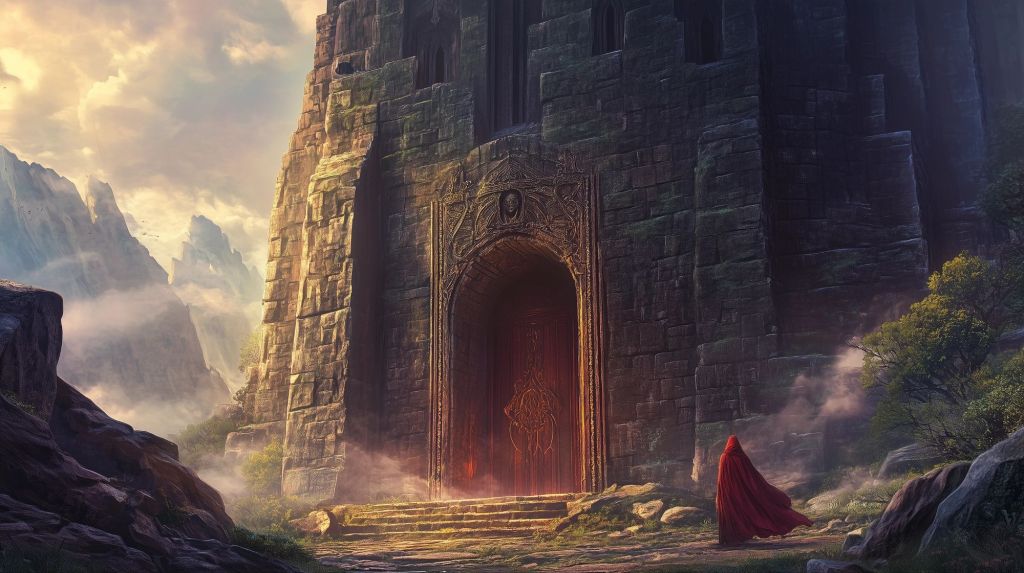
The ancient stones of Sanctimor Tower hummed with arcane energy as I closed the heavy ironwood door behind me. Outside, a tempest raged—not merely weather but a storm of wild magic that turned raindrops to diamond dust and lightning to serpentine runes that lingered too long in the air. Perfect conditions for deep contemplation.
I am Thaddeus Vex, Ninth Archivist of Sanctimor, Keeper of Forgotten Wisdom, Guardian of the Sevenfold Shelves, and—though few remember this particular title—once Court Wizard to three successive monarchs of the now-sunken kingdom of Lysandria. Tonight, as the magical storm batters my sanctuary, a young apprentice has posed a deceptively simple question that has followed me up the winding staircase to my private study.
With gnarled fingers that have turned the pages of ten thousand tomes, I stroke my silver beard and consider her inquiry: what single book would I choose to read repeatedly until the end of my unnaturally extended days?
My chambers reflect the organized chaos of my mind—star charts overlay ancient scrolls, artifacts from vanished civilizations serve as paperweights for fresh translations, and no fewer than seven enchanted quills hover nearby, recording various thoughts as they pass through my consciousness. Six hundred and forty-three years I have walked this realm, and in that time, I have devoured libraries that kings would ransom their firstborn to glimpse.
Yet one volume calls to me more persistently than any other.
I cross to the eastern alcove where my most treasured possessions reside behind wards that would reduce an untrained mind to babbling madness. With a whispered word that causes the candles to flicker blue, I dispel the protective spells and lift a modest leather-bound book from its crystal pedestal. No gilded edges, no jeweled cover—merely time-softened leather the color of rich earth after rain, bearing the faint impressions of hands that have held it through centuries.
“The Cartography of Dreams,” I murmur, settling into my reading chair as the storm outside reaches its crescendo.
The book’s origin remains contested among scholars of the arcane. Some attribute it to Elowen the Dreamspeaker, others to the collective consciousness of the now-extinct Whispering Monks of the Eastern Isles. I have my own theories, of course, but those are secrets I guard more jealously than the location of my phylactery.
What makes this text eternal is not merely its content but its nature. “The Cartography of Dreams” is no ordinary book—it is what we in the highest circles of wizardry call a Palimpsest Arcanum, a text that rewrites itself for each reader while maintaining its essential truth. Each time I open these pages, the words have shifted, rearranged themselves like stars forming new constellations while somehow preserving the same constellations’ essence.
On my first reading, as a brash apprentice not yet burdened by the weight of centuries, it revealed the fundamental patterns of dream-energy and how they might be harnessed for divination. On my hundredth reading, after the fall of Lysandria, it showed me how grief itself could be transmuted into a form of raw power that sustained me through decades of solitude. Last winter, when I feared my mind was finally beginning to fracture under the weight of too many memories, it offered a method of compartmentalizing knowledge that has preserved my sanity for another season.
The book knows what I need before I do—this is its magic, subtle and profound.
I open it now, feeling the familiar texture of vellum beneath my fingertips. The frontispiece shows an intricate map that seems to shift if viewed peripherally—mountain ranges becoming river systems becoming neural pathways. The text begins, as always, with the same sentence:
*”To map a dream is to claim dominion over reality’s shadows.”*
Yet I know from experience that the subsequent passages will have transformed themselves, responding to some unspoken question lurking in the depths of my consciousness.
Tonight, as the magical storm pounds against my tower, the book seems to sense my contemplation of mortality—not fear of death, for I abandoned such concerns centuries ago, but rather the growing weight of accumulated experience, the burden of remembering what others have forgotten.
New words form on the page before me:
*”Memory is not a chronicle but a conversation between past and present selves. The wisest archivists understand that preservation without interpretation leads to knowledge without wisdom.”*
I smile, recognizing the gentle rebuke. How many times have I lost myself in the preservation of knowledge without pausing to integrate it fully? How often have I recorded and categorized without synthesizing?
The true power of this book lies not merely in what it contains but in how it forces me to confront myself anew with each reading. It is both mirror and window, reflection and revelation.
A soft knock at my chamber door interrupts my thoughts. My apprentice, Lyria, stands at the threshold, her eyes wide with that peculiar blend of reverence and intellectual hunger that reminds me so much of myself at her age.
“Master Archivist,” she says, “the storm has penetrated the eastern wards. Several volumes in the Transmutation section are exhibiting… unusual behaviors.”
I close “The Cartography of Dreams” with reluctance, though I know its wisdom will remain with me, metabolized into my thoughts like wine into blood. Before returning it to its pedestal, I pause.
“Lyria,” I say, passing her the book, “take this to your quarters tonight. Read it carefully. Tomorrow, we shall discuss what you found within its pages.”
Her hands tremble as she accepts the unadorned volume, clearly expecting something more visibly magnificent.
“But Master,” she protests, “this doesn’t appear to be—”
“The most valuable books,” I interrupt gently, “rarely announce their worth through external ornamentation. Now come—we have wayward texts to discipline.”
As we descend the spiral staircase toward the troubled eastern wing, I smile privately. Tomorrow, Lyria will discover what I learned centuries ago: that some books read you as thoroughly as you read them, and in that reciprocal revelation lies magic more profound than any spell I’ve mastered in six hundred years of wizardry.
And perhaps, in witnessing her discovery, I shall experience “The Cartography of Dreams” anew once more, through eyes unclouded by the accumulated dust of centuries—the greatest gift an old archivist could hope to receive.
Thank you for reading this short story. I hope that you liked it. Leave me a comment and let me know if you did. Please consider subscribing to my newsletter for special future updates. If you love these stories then you can find two volumes of them in Ebook form on Amazon. You can get the first volume for free at this link.

 Chadwick Rye
Leave a comment