


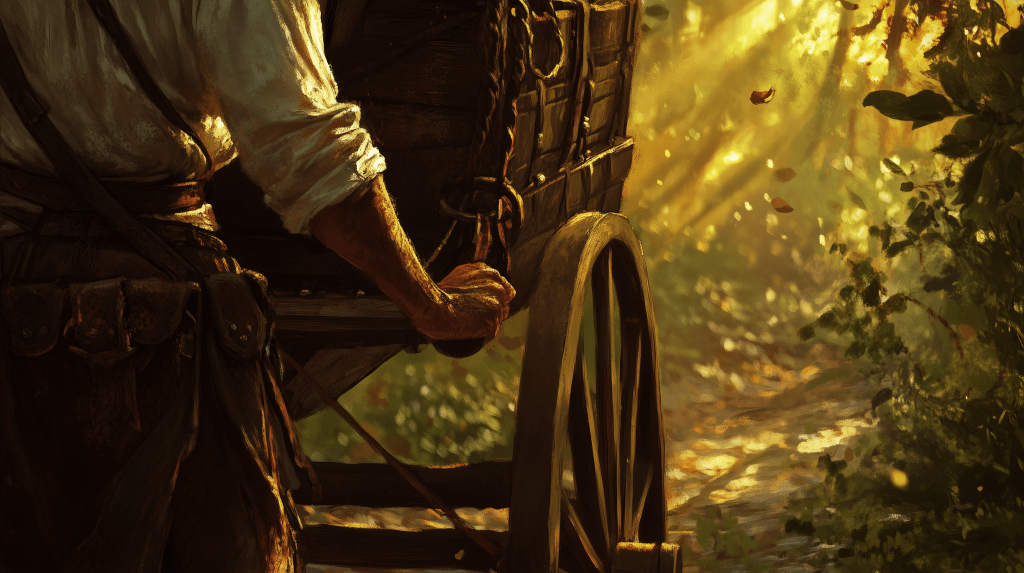
Orlen Fairhaven adjusted the leather straps of his merchant’s wagon as the first golden rays of dawn pierced through the forest canopy. The dew-dampened road ahead wound between ancient oaks whose gnarled branches formed a natural archway, beckoning travelers toward promises unknown. His painted wagon—festooned with colorful banners announcing “Fairhaven’s Curios & Wonders”—creaked in familiar protest as the dappled mare settled into her harness.
Twenty-three years on the trading roads had weathered his once-smooth hands into maps of calluses and scars, each marking a journey, a bargain, a lesson hard-won. The morning ritual remained unchanged despite the countless dawns witnessed from different hillsides, riverbanks, and village outskirts: check the wheels, secure the merchandise, brew the bitter herb tea that kept his mind sharp through long days of haggling and storytelling.
As steam rose from his battered tin cup, Orlen found his gaze drawn to a collection of small wooden figurines nestled in the special velvet-lined box he kept beneath his driver’s seat. Not for sale, these. Never for sale, though many had offered substantial coin over the years.
Each miniature sculpture bore the unmistakable mark of children’s hands—some crudely fashioned, others surprisingly deft—crafted by youngsters in a hundred different settlements along his trading routes. A veritable menagerie of imagination: dragons with mismatched wings, knights with swords larger than their bodies, ships with impossible sails, and creatures that existed nowhere in the natural world.
The sight of them sent his thoughts tumbling backward through time, past the merchant ledgers and trading contracts, beyond his apprenticeship with old Master Redwick, into the crystalline memories of childhood in the coastal village of Mistpeak.
“Tell me again, Papa!” five-year-old Orlen had demanded, bouncing on his father’s knee as the fisherman mended nets by lamplight. “Tell me about the dragon ships!”
His father’s chuckle rumbled like distant thunder as weather-worn fingers continued their practiced weaving. “The Northmen’s vessels? With their serpent heads and striped sails?”
“Yes! The ones that carry treasures from beyond the edge of the world!”
The older man’s eyes crinkled at the corners, amusement dancing in their depths. “And what would you know of such things, little fish? Have you been listening to the harbor tales again?”
Young Orlen had nodded vigorously, sending sandy-colored curls bouncing across his forehead. “Merchant Thellian says he’s traveled to places where mountains breathe fire and trees bear fruits of gold! He showed me a shell that sings the ocean’s song even when you’re far from water!”
His mother, kneading dough at the humble kitchen table, had exchanged knowing glances with his father. “And is that what you wish to be when you grow tall? A traveling merchant like Thellian?”
The question had ignited something in his small chest—a certainty as solid as the village stones beneath his feet. “I’m going to be the greatest merchant ever,” he’d declared with absolute conviction. “I’ll have a wagon painted with stars and moons, and I’ll carry wonders from every corner of the world!”
His father had ruffled his hair, calloused hands gentle against the boy’s scalp. “That’s quite a dream for such a small fisherman’s son.”
“I’ll bring you back a shell that sings louder than Thellian’s,” Orlen had promised. “And a crown for Mama, made by the forest people who speak to trees.”
His mother had laughed then, the sound like the silver bells that rang when fishing boats returned to harbor. “I’d be content with a son who remembers to wash his hands before supper, little merchant.”
But something in her eyes—something warm and knowing—had told him she believed in his declaration, despite its improbability in a village where sons typically followed their fathers into the same trades that had sustained families for generations.
The memory dissolved as a squirrel darted across the forest path, startling Orlen’s mare back to attention. He tucked the box of figurines safely beneath his seat, patted his inside pocket where he kept his most precious inventory—the singing shell from distant shores that had once captured a little boy’s imagination, now his talisman on every journey.
Twenty-three years of trading had taken him from the coastal cliffs of his birthplace to desert bazaars where the sun bleached bones and dreams alike, from mountain villages accessible only by goat paths to sprawling cities where merchants vied for attention like peacocks displaying their plumage. His wagon—indeed painted with celestial symbols as his five-year-old self had envisioned—had carried silk and spices, artifacts and oddities, stories and songs.
What would that wide-eyed child think of the man he’d become? Not the greatest merchant in the world, certainly. Not the wealthiest, nor the most renowned. But a man who had kept his promise to himself in ways that mattered more than coin or reputation.
Orlen finished his tea, tucked the cup into its traveling pocket, and clicked his tongue to set the mare in motion. The next village lay a half-day’s journey ahead—Oakhollow, if he remembered correctly. A small settlement known for its woodcarvers and honey wine.
As the wagon rocked into gentle motion, he hummed a trader’s counting song, the rhythm matching the steady clip-clop of his mare’s hooves against the packed earth. The morning sun warmed his face, and for a moment—just a heartbeat—he felt the same exhilaration that had filled his five-year-old chest when Merchant Thellian had unfurled maps of lands beyond imagination.
Children often flocked to his wagon when he arrived in villages, drawn by the colorful banners and promises of exotic treasures. He made it a point to carry small, affordable wonders specifically for their meager allowances—polished stones that glowed faintly in darkness, tiny glass vials of color-changing sand, seeds from foreign lands that bloomed into unusual flowers.
“What will you be when you grow tall?” he sometimes asked them as they examined his wares with wide-eyed fascination. Their answers came with the same certainty he had once possessed: dragon-slayers, master bakers, ship captains, royal guards.
He never told them how improbable their dreams might be, never suggested more practical pursuits. Instead, he would select a small token from his special collection—perhaps a carved wooden star or a feather from an exotic bird—and press it into their small palms.
“For when you begin your journey,” he would tell them with a conspiratorial wink.
Because sometimes, against all odds and expectations, a fisherman’s son with salt in his hair and impossible dreams in his heart might indeed grow up to become exactly what his five-year-old self had imagined. And those children deserved someone who believed in the power of their declarations, just as his mother had believed in his.
The road curved ahead, revealing new horizons through the thinning trees. Orlen Fairhaven, once a wide-eyed child dreaming of painted wagons and distant shores, now a merchant with silver threading through his beard and stories etched into his skin, adjusted his course and continued forward—guided still by that five-year-old’s unwavering compass.

 Chadwick Rye
Leave a comment