What’s something most people don’t understand?
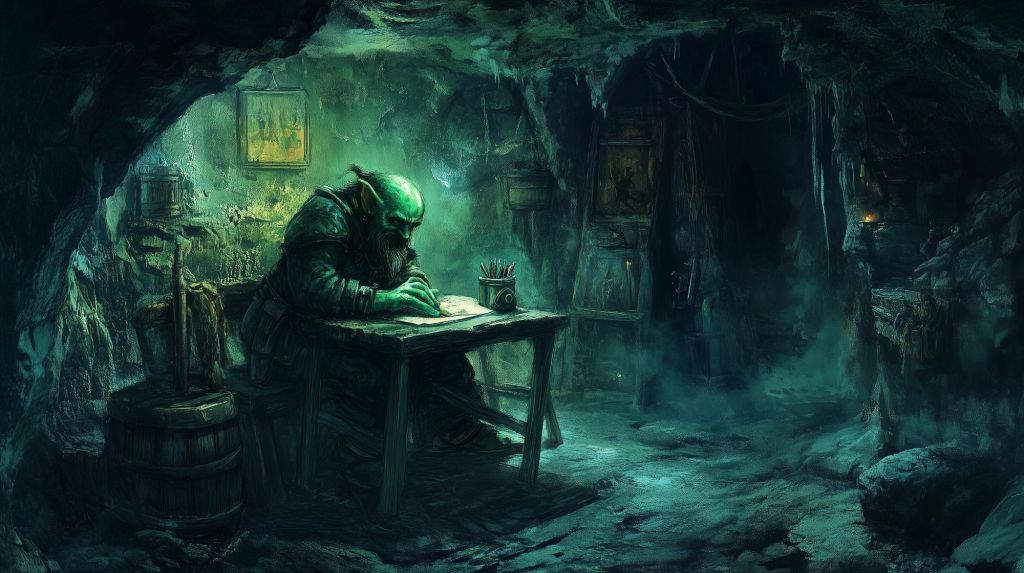
Nix Quickfingers hunched over the diminutive writing desk he’d salvaged from a human child’s dollhouse, his green-tinged fingers smudged with the crushed blackberry ink he’d brewed in an abandoned thimble. The flickering glow of a captured firefly—housed in a delicate glass vial suspended from the ceiling of his burrow—cast dancing shadows across the parchment (once the wrapping of a baker’s loaf, now carefully smoothed and preserved).
Overhead, the roots of the ancient oak tree that sheltered his dwelling twisted through the packed earth ceiling like gnarled fingers, occasionally releasing a soft shower of soil when the Tall Folk walked the garden paths above. Nix paused in his writing, ears twitching at the sound of human footsteps—heavy, purposeful, oblivious to the complex network of goblin tunnels just beneath their heels.
He dipped his quill—fashioned from the molted feather of a wren—and continued his response to the philosophical inquiry posed during the last New Moon Council:
*What do the Tall Folk fail to understand?*
A wry smile twisted Nix’s features, revealing teeth like uneven pearls in a sea of olive-green.
They don’t understand *value*.
To humans, worth is measured in gleaming metals and faceted stones, in massive dwellings filled with possessions that gather dust, in controlling stretches of land too vast for a single being to truly know. Their equations are simple, binary, devoid of nuance—more is better, bigger signifies importance, possession equals worth.
How peculiar they find us, with our collections of broken clockwork, discarded buttons, and fragments of colored glass. I’ve watched the gardener’s apprentice kick aside a perfect snail shell with casual disregard—the same shell that would be treasured in our community, admired for its mathematical precision and opalescent interior. A treasure that costs nothing, weighs nothing, yet contains the secret patterns of the universe.
The humans above believe we steal from them out of mischief or necessity. They set their traps, nail their windows shut, secure their larders against our “thieving hands.” They never pause to consider that what we take is almost exclusively what they have discarded or forgotten—the bent spoon with the wonderfully smooth handle, the single earring lost months ago, the frayed ribbon once wrapped around a gift now unremembered.
Last autumn, I spent seventeen nights gradually relocating a collection of multicolored bottle shards from the compost heap to my personal gallery. The effort nearly cost me my tail when the house-cat discovered my midnight excursions. Yet to see those fragments arranged by color and size, to witness how they transform ordinary moonlight into jewel-toned magnificence—this is wealth beyond any human treasury.
Our elders teach that true value lies in usefulness, in beauty, in the histories objects contain. The bent nail pulled from a rotting fence post represents not merely a piece of metal but the story of the fence itself—who built it, what it protected, why it was abandoned. When we repurpose this nail as a cooking hook or scribing tool, we honor its continued journey.
Humans measure wealth by accumulation. We measure it by transformation.
Consider my writing desk—once a discarded toy, now the center of intellectual pursuit, enhanced with cushions crafted from abandoned handkerchiefs, illuminated by firefly light freely given (we feed them honeysuckle nectar and release them after three days of service). The human child who once owned this desk would not recognize its current dignity, its elevation from plaything to scholar’s workspace.
Perhaps most puzzling is their inability to comprehend the value of invisibility. They build ever skyward, announce their presence with smoke and noise and light that banishes darkness. Meanwhile, we thrive in the spaces between, in the overlooked corners, in the margins of their awareness. This is not mere survival strategy but philosophical choice. There is power in being unseen, wisdom in observing without being observed.
The irony does not escape me that I write this manifesto on paper they created, with ink made possible by berries from their garden, in a home that exists only because their oak tree provides shelter. We are not separate from the Tall Folk—we are symbiotic, though they remain largely unaware of their silent partners.
Perhaps that is the greatest misunderstanding of all. Humans believe themselves to be the primary characters in this world’s story, the measurers rather than the measured. They fail to comprehend that value is assigned not merely by those with the loudest voices or tallest bodies, but by every creature that perceives and interprets.
Tonight, as the family above sleeps in their grand house, dreaming of greater fortunes and higher stations, I will add to my collection a single perfect raindrop preserved in tree sap—a jewel no goldsmith could craft, worth nothing in their markets yet priceless in the intricate economy of wonder that sustains our kind.
Nix set down his quill as the firefly’s light pulsed in gentle rhythm, signaling its readiness to return to the night sky. He carefully opened the glass vial, allowing the luminous insect to spiral upward through the root-woven ceiling via a narrow tunnel designed specifically for this purpose.
Darkness reclaimed the burrow, but Nix didn’t immediately reach for the matchstick and candle stub that served as emergency illumination. Instead, he sat quietly in the velvet blackness, listening to the nighttime symphony filtering down from above—crickets in mathematical conversation, an owl’s questioning call, the whispered secrets of leaves stirred by summer wind.
Tomorrow, he would share his reflections with the Council, adding his voice to the collective wisdom that had sustained goblin-kind through centuries of coexistence with creatures who couldn’t see the riches scattered at their feet or recognize the value of being small in a world obsessed with greatness.
Nix’s fingers found a smooth river stone on his desk—his thinking stone, worn to perfect comfort by generations of goblin hands before his. He smiled in the darkness, turning the stone over and over.
Perhaps understanding wasn’t necessary. Perhaps it was enough that goblins recognized the precious mathematics of existence, the value of small things, the wealth in transformation rather than accumulation.
After all, misunderstanding had its advantages. It meant the humans would continue discarding perfectly wonderful treasures, never knowing that beneath their floorboards and garden paths, an entire civilization collected, repurposed, and celebrated the overlooked wonders of their shared world.
And that, Nix decided, was a fair exchange indeed.

 Chadwick Rye
Leave a comment