


The Man Who Found Me
Being the first entry in the personal chronicle of Esbeth Ironwood, formerly of the Sylvan Reaches, now Lady of Stonewatch Tower and its surrounding lands, written in the thirty-seventh year since my liberation.
The prompt in the journal before me seemed simple enough. Describe a man who has positively impacted your life.
But i have sat at this desk for the better part of an hour, watching snow fall beyond the tower window, my quill hovering above parchment that remains stubbornly blank. Not because I lack an answer—the answer is so obvious it hurts—but because I do not know where to begin. How does one compress twenty-two years of salvation into words? How does one describe the man who pulled them from darkness so complete that light itself had become a forgotten concept?
Rosco Ironwood died three winters past. Quietly, in his sleep, which he would have hated. He always said he wanted to go down fighting, blade in hand, cursing whatever fool was stupid enough to finally best him. Instead, his heart simply… stopped. Gave out. I found him in the morning, still in his chair by the fire, a half-finished cup of tea grown cold beside him.
He left me everything. The tower. The lands. His weapons, his books, his modest fortune accumulated through decades of mercenary work. But more than that—more than any material inheritance—he left me myself. The woman I am today exists only because a scarred old soldier decided that a broken elf girl was worth saving.
This chronicle is my attempt to immortalize him. Not as the legend that traveling bards have begun to construct—Rosco the Grim, the Silver Wolf of the Border Wars, the man who killed thirty men at Ashford Bridge—but as the man I knew. The one who sang off-key while cooking breakfast. The one who talked to his horse like she could understand him (she could, I’m convinced of it). The one who sat with me through countless nightmares, never asking questions, just simply present until the shaking stopped.
I will begin where we began: the day he found me.
I did not know the dungeon had been abandoned.
Time had ceased to hold meaning long before my captors departed. Days blurred into nights blurred into days again, marked only by the arrival of food—when they remembered—and the footsteps that sometimes preceded pain. I had learned to exist in a kind of half-sleep, consciousness dimmed to a guttering candle flame, just enough awareness to respond when commands were given but not enough to fully inhabit the ruined vessel of my body.
The water came slowly at first. A trickle through cracked mortar, pooling in the corner where the floor dipped lowest. I watched it spread with detached curiosity, too weak to move from my usual position against the far wall. By the time it reached my bare feet, I understood what it meant. The winter rains had come, and without someone to maintain the drainage channels, the dungeon would flood.
I would drown in a cage, and no one would ever know.
There is a strange peace that comes with accepting death. I had fought it for so long—fifteen years, though I would not learn that number until much later—clinging to survival through spite and stubbornness and some flickering ember of hope that refused to be extinguished no matter how I tried. But watching that black water rise, feeling its cold fingers climb my ankles, my calves, I finally let go.
Soon, I thought. Soon it will be over.
So I closed my eyes and waited. Waited for the release of death.
The footsteps, when they came, seemed like a dream. Heavy boots on stone, accompanied by the soft clink of armor and a low voice muttering in a language I had not heard in years. Common tongue. Human speech. My eyes opened despite themselves, some survival instinct overriding my surrender.
Torchlight flooded the corridor.
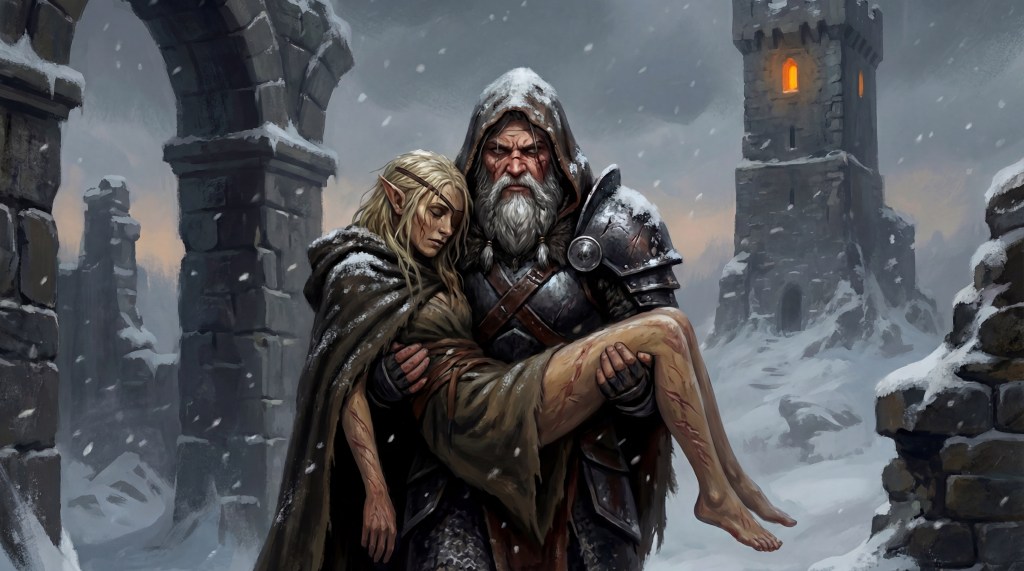
He was enormous. That was my first impression—a mountain of a man, broad-shouldered and thick with muscle despite the silver in his beard and the lines carved deep around his eyes. Dark armor covered him like a second skin, fur-lined against the cold, and a sword hung at his hip that looked large enough to cleave me in two with a single stroke. Scars marked his face: a pale line through his left eyebrow, another curving along his jaw, a third disappearing into his hairline. Fresh wounds too, barely scabbed, suggesting a recent fight.
He looked like every nightmare I had ever had.
I scrambled backward, or tried to. My legs would not obey. The water had reached my waist now, and the cold had stolen what little strength remained. All I managed was a pitiful crawling motion that pressed me harder against the stone wall, as if I could somehow phase through it and escape.
The man stopped before my cell. The torchlight caught his eyes—pale gray, like winter storm clouds—and I watched them move across my body with an expression I could not read. Taking inventory of my scars, perhaps. Calculating my value. Determining what use a half-drowned elf might serve.
“Please,” I heard myself say. The words came out in elvish, broken and hoarse from disuse. “Please, no hurt. Esbeth be good slave. Esbeth obey. Please.”
I hated myself for saying it. Hated the pathetic, crawling thing I had become. But survival instinct cares nothing for dignity. Fifteen years of conditioning had taught my tongue to shape those words before my mind could intervene.
The man’s expression changed. Something flickered across those storm-gray eyes—something that looked almost like pain—before his features settled into careful neutrality. He knelt, slowly, bringing himself closer to my level. The motion was deliberate, unthreatening, like approaching a wounded animal.
And then he spoke in elvish.
“Calm yourself, child. I am not here to harm you.”
His accent was terrible. The consonants were too hard, the vowels flattened by a human tongue unused to the language’s flowing cadences. But the words themselves were correct, and more than that—they were gentle. I had not heard gentleness in any language for longer than I could remember.
I stared at him, unable to process what I was hearing.
“I am going to get you out of there,” he continued, still in that rough elvish. “The water is rising. You will drown if you stay. Do you understand?”
I managed a nod. My teeth had begun to chatter, whether from cold or fear or both.
The man rose and examined the cell door. Iron bars, rusted but still solid, secured by a lock that had long since seized shut from neglect. He tested the mechanism, grunted in dissatisfaction, then stepped back and rolled his shoulders like a laborer preparing for heavy work.
What happened next, I did not understand until years later when Rosco finally explained the nature of his abilities. At the time, I saw only this: the man closed his eyes, breathed deep, and when he gripped the bars again, something shifted in the air around him. A pressure, a weight, a sense of force gathering like a storm about to break.
He pulled.
The metal screamed. Rivets popped from ancient iron as he groaned and grunted. The entire door tore free from its hinges in a shower of rust and debris, and the man cast it aside like it weighed nothing at all. It crashed against the far wall with enough force to crack the stone.
I should have been terrified. This display of impossible strength should have confirmed every fear racing through my mind. Instead, I felt only numb shock as he stepped into the cell, water splashing around his armored boots, and crossed the distance between us in three long strides.
“Please,” I whispered again, the word escaping without my permission. “Please—”
He stopped. Looked down at me with those storm-cloud eyes. And then, very slowly, he unclasped the heavy cloak from his shoulders and held it out toward me.
“You are cold,” he said in elvish. “And your clothing is… insufficient. Take this.”
When I did not move—could not move—he pulled me from the water with his strong yet gentle hands and draped the cloak around my shoulders himself. The wool was thick and warm, lined with fur that held the heat of his body. It smelled of woodsmoke and horse and something metallic, like old blood. It was the most luxurious thing I had touched in fifteen years.
“Can you walk?”
I tried. My legs buckled immediately, and I would have fallen if his hand had not caught my arm. His grip was firm but not painful—controlled strength, carefully moderated.
“No matter,” he said. “I will carry you.”
Before I could protest—not that I had the strength for protest—he lifted me. One arm beneath my knees, the other supporting my back. A princess carry, my mother had called it once, long ago, when I was small and she would carry me to bed after I fell asleep by the fire. The memory surfaced unbidden, sharp as broken glass.
I made a sound. Not quite a sob, not quite a whimper, something in between that I could not control. The man—Rosco, though I did not yet know his name—said nothing. He simply adjusted his grip to hold me more securely and began walking.
The journey through the dungeon passed in fragments. Dark corridors lit by his torch. Stairs that climbed endlessly upward. The sound of water dripping somewhere behind us, the flood claiming territory we had abandoned. At some point I closed my eyes, too exhausted to keep them open, and let myself drift in the strange safety of this stranger’s arms.
Cold air hit my face like a slap.
My eyes flew open to a world transformed. Snow fell in thick curtains from a sky the color of wet slate, blanketing the ruins of what had once been a keep’s courtyard. Everything was white and gray and silent, the kind of hush that only comes with heavy snowfall, as if the world itself was holding its breath.
I had not seen snow in fifteen years. Had not felt clean air in my lungs, had not seen the open sky above my head in so long. The sensation overwhelmed me—too much space, too much light, too much everything after so long in darkness.
A sound escaped my throat. This time it was definitely a sob.
Rosco’s arms tightened around me. Not painfully. Protectively. Like he was trying to shield me from the cold, from the snow, from whatever demons had followed us out of that flooded hell.
“Not far now,” he murmured in rough elvish. “I have a camp nearby. Fire. Food. You are safe.”
Safe. The word meant nothing to me. Safety was a concept from another life, another world, a fairy tale that frightened children told themselves to keep the darkness at bay. I had stopped believing in safety somewhere around the third year, when I finally understood that no one was coming for me. No rescue. No liberation. No hero emerging from the shadows to carry me to freedom.
And yet.
Here I was. Being carried through falling snow by a scarred old soldier who spoke terrible elvish and had torn an iron door from its hinges to reach me.
The watchtower emerged from the white like a ghost made solid. Ancient stone, crumbling in places but still standing, with light flickering in a narrow window halfway up. Rosco had made camp there—I could see the dark shape of a horse sheltered beneath an overhang, could smell woodsmoke on the wind.
He carried me inside without pausing, up a winding stair, into a circular room where a fire burned bright in a makeshift hearth. Bedrolls and supplies lined the walls. A pot hung over the flames, something inside it bubbling with the smell of meat and herbs.
Rosco set me down beside the fire with the same careful deliberation he had shown throughout our journey. He arranged the cloak around me, added another blanket from his supplies, then knelt to check that I was close enough to the flames for warmth but not so close as to risk burns.
“Rest,” he said in elvish. Then, switching to Common with obvious effort: “You are safe now. I will not let anyone hurt you. I swear it.”
I looked up at him—this mountain of a man, this killer with gentle hands, this stranger who had walked into darkness and carried me out—and found that I could not speak. Could not find words in any language for what I was feeling.
So I simply nodded, and let my one good eye close, and for the first time in fifteen years, I slept without dreaming of chains.
That was our beginning, Rosco and I. A flooded cell and a broken door and a walk through falling snow. He did not know, then, what he was taking on. Did not realize that the half-drowned creature he had saved would become his ward, his student, his family. That we would spend twenty-two years together. Providing healing and warmth to each other.
But that is a story for another entry. For now, let this serve as my answer to the prompt:
Describe a man who has positively impacted your life.
His name was Rosco Ironwood. He found me drowning in darkness, and he carried me into the light.
I will spend the rest of my days trying to deserve and repay that gift.

 Chadwick Rye
Leave a comment