
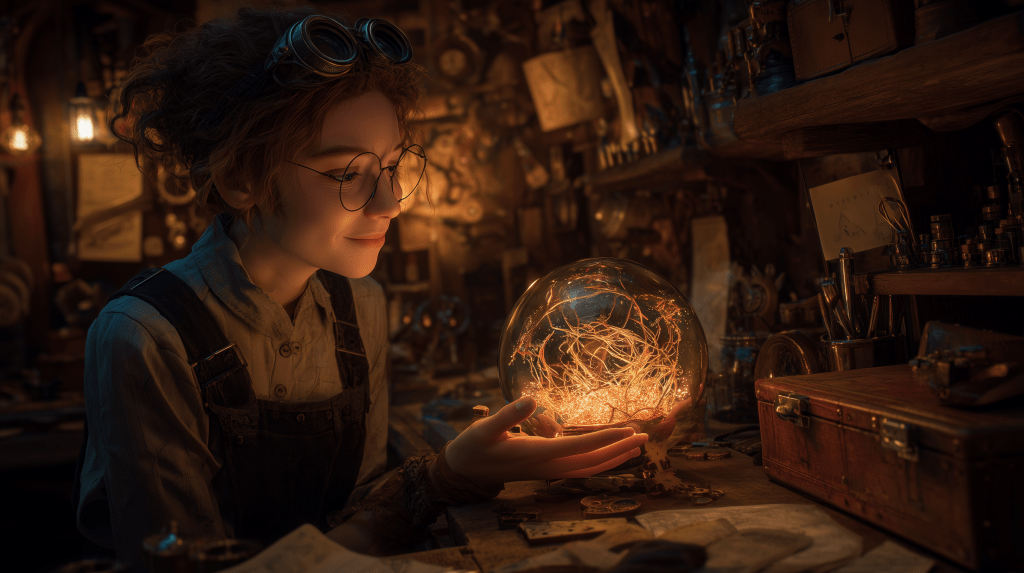


June Timekeep kept the most precious object she’d ever found in a velvet-lined box beside her workbench, where forty years of watchmaking had left permanent stains on the heartwood surface. The box itself was unremarkable—scuffed leather corners, tarnished brass clasps, the kind of container that might hold a modest inheritance or love letters from a long-dead romance. But what resided within had shaped her entire life, had called her to a profession, had whispered possibilities into her young ears that transformed a foundling child into Lumenvale’s most sought-after chronometer craftsman.
She opened the box now, as she did every morning before beginning her day’s work, and gazed upon the impossible thing she’d discovered thirty-seven years ago in the muddy shallows of the Luminescent River.
It pulsed with faint bioluminescence—a rhythmic glow that matched no natural heartbeat, that followed patterns too perfect to be organic yet too fluid to be purely mechanical. The object was roughly the size of a robin’s egg, its surface a seamless fusion of what appeared to be living bronze and some kind of crystalline tissue that refracted light in ways that hurt to contemplate too directly. Delicate filaments extended from its core like veins or wires—she’d never been certain which—and when she held it close to her ear, it produced a sound that was simultaneously ticking clockwork and beating heart.
A fragment of Mechanican bio-technology, she’d eventually learned. A piece of what the Clockwork Empire called a “living timepiece”—devices that measured time through the life cycles of symbiotic organisms fused with precise mechanical components. How it had ended up in Lumenvale’s river, thousands of miles from the thinking cities of Mechanicus, she’d never discovered. Perhaps dropped by a traveling merchant. Perhaps discarded as malfunctioning. Perhaps escaped, for reasons known only to itself.
But eight-year-old June, barefoot and river-soaked, hunting for pretty stones to add to her meager collection, had plucked it from the shallows and known immediately that she’d found magic.
Thirty-seven years earlier…
The river stones were warm beneath Elara’s feet, sun-heated and smooth from centuries of current. She’d snuck away from the Foundling House again—a transgression that would earn her kitchen duty if Matron Grayson discovered her absence—but the pull of the Luminescent River during low tide was irresistible to a child who possessed nothing but river stones and stubborn dreams.
Her small leather pouch already contained three treasures: a piece of green glass worn smooth by water, a fragment of pottery with part of a painted flower still visible, and a stone with what looked like a fossilized leaf embedded in its surface. Not valuable by adult standards, but to Elara, each one represented a story, a connection to something larger than the orphanage’s gray walls and daily gruel.
The shallows near the Old Harbor docks were the best hunting grounds. Here, the river deposited debris from upstream—goods dropped from merchant barges, offerings cast into the current by worshipers at the Crystal Spires’ reflection shrines, and occasionally, items from realms beyond Lumenvale that had traveled the trading routes and somehow found their way into the water.
It was in a pocket of still water, caught between two rocks and partially buried in silt, that June saw the glow.
At first, she thought it might be a firefly trapped beneath the surface, or perhaps one of the bioluminescent river snails that sometimes washed up during storms. But as she knelt in the shallow water, her hands already reaching despite not knowing what she’d find, the glow pulsed with a rhythm that made her young heart respond in kind.
Her fingers closed around something warm. Not hot, but body-temperature warm, as if it had been recently held by living hands. She pulled it free from the silt, water streaming off its surface, and gasped.
It was beautiful in a way she had no words for. The bronze-and-crystal sphere caught the afternoon sunlight and somehow transformed it, refracting the light into patterns that seemed to move independently of the object itself. And it was alive—not in the way plants were alive, or even animals, but alive in some strange way that defied her eight-year-old understanding of how things could be.
The ticking—that soft, precise rhythm she would later learn to identify as chronometric pulses—felt like a lullaby directly transmitted into her bones. She held it close to her ear and listened, entranced, as the river flowed around her ankles and the world contracted to just her and this impossible thing she’d found.
“What are you?” she whispered.
The object pulsed brighter, as if responding to her voice.
June knew with a certainty that transcended logic that she had to keep this. Whatever it was, wherever it came from, it was meant for her. The universe had placed it in her path for reasons that would unfold in time. She wrapped it carefully in her spare shift, tucked it into her leather pouch alongside her other treasures, and ran all the way back to the Foundling House with her heart pounding harder than it ever had before.
Present day…
The memory still carried the crystalline clarity of truly transformative moments. June smiled as she lifted the bio-mechanical heart from its velvet nest, feeling its familiar warmth against her palm. Thirty-seven years, and it had never stopped its steady rhythm. Never dimmed. Never failed.
She’d hidden it at first, terrified that Matron Grayson would confiscate it as “unsuitable for children” or sell it to pay for orphanage expenses. But secrets have a way of shaping those who keep them. The hidden treasure became an obsession, a focus for a lonely child’s curiosity and imagination.
June had spent hours studying it by candlelight after the other foundlings fell asleep. She’d traced the patterns of its filaments with gentle fingers, trying to understand how something could be simultaneously metal and alive. She’d timed its pulses, discovering with wonder that it maintained perfect consistency—sixty beats per minute, never varying, more accurate than any clock in Lumenvale.
The obsession led her to books. The Foundling House had a small library—mostly primers and moral tales—but Elara begged, borrowed, and occasionally stole access to real books from the Academy’s public reading rooms. She devoured everything she could find about clockwork, about mechanics, about the rumors of Mechanicus and its fusion of magic and machinery.
By age twelve, she could disassemble and reassemble every clock in the Foundling House. By fourteen, she’d apprenticed herself to Master Chronos, the elderly watchmaker whose shop sat in the shadow of the Crystal Spires. By sixteen, she’d revealed her secret treasure to her master, who’d gone pale and silent before saying: “Child, do you understand what you possess?”
She hadn’t, not really. But Master Chronos had explained: living timepieces from Mechanicus were worth fortunes. They were considered the pinnacle of chronometric achievement—devices that would outlive their owners, that never required winding, that adjusted themselves to account for the subtle variations in time’s flow that plagued all mechanical devices.
“You could sell this,” he’d said, holding the bio-mechanical heart with reverent care. “Purchase a shop of your own. Live comfortably for years.”
But June had shaken her head, already knowing her answer. “It’s not for selling. It’s for learning from.”
And learn she had.
The bio-mechanical heart became her teacher in ways no human master could match. She studied its construction with the intensity of someone decoding ancient scripture. The way its organic components interfaced with mechanical precision. How it maintained energy through some process that seemed to extract power from ambient magic itself. The harmonics it produced—barely audible but measurably affecting nearby timepieces, synchronizing them, improving their accuracy.
Her own work began to incorporate principles she’d intuited from studying the Mechanican artifact. She couldn’t replicate its bio-technological fusion—that was beyond current Lumenvale capabilities—but she could apply its underlying philosophy: that timekeeping was not just about gears and springs, but about creating harmony between different types of systems.
The pocket watch she’d crafted for the Merchant Guild’s Master combined traditional mechanics with crystal resonators that synchronized with Lumenvale’s ambient magic fields. It never gained or lost a second, even during magical storms that threw other timepieces into chaos. The commission had made her reputation.
The clock she’d built for the Grand Archive incorporated harmonic principles that allowed it to maintain accuracy across temporal anomalies—essential for a library where some sections experienced time differently than others. Scholars still spoke of it as the most reliable timepiece in the city.
And the personal chronometer she wore at her own wrist, her masterwork, drew directly from lessons learned from the bio-mechanical heart. It was beautiful—silver and crystal, with exposed mechanisms that moved like living things—but more importantly, it was alive in the same way her found treasure was alive. Not literally biological, but possessed of a quality that transcended pure mechanism. It responded to her emotional state, ran slightly faster when she was excited, slowed when she was calm, yet never deviated from true time by more than a heartbeat.
Now, at forty-five years old, with her name spoken in the same breath as the great chronometers of three generations past, June could trace every success back to that moment in the river. To a child’s instinct to pick up something glowing. To the decision to keep rather than sell. To the obsessive study of an object that shouldn’t exist yet did.
The bio-mechanical heart pulsed in her palm, its rhythm unchanged since that first day. Sixty beats per minute, perfect and eternal.
A knock on her workshop door interrupted her morning meditation. “Master Timekeep? Your appointment with the Academy delegation is in twenty minutes.”
June carefully returned the bio-mechanical heart to its velvet nest, closed the box, and straightened her workshop apron. The Academy wanted to commission a great clock for their new Observatory—a timepiece that could track not just hours and minutes, but the complex temporal patterns associated with astronomical phenomena. It was the kind of commission that would define the later years of her career.
But before she met with them, before she discussed specifications and timelines and the technical challenges of synchronizing mechanical time with celestial time, she needed this moment. This daily ritual of opening the box and acknowledging the impossible thing that had chosen her, that had whispered possibilities into a foundling child’s ears and transformed her into something she’d never imagined she could become.
“Thank you,” she whispered to the pulsing heart. “For finding me. For teaching me. For being the coolest thing I ever found and kept.”
The bio-mechanical heart pulsed brighter—just for a moment—and June could almost believe it understood. That on some level beyond her comprehension, it was pleased to have been found by someone who would spend a lifetime trying to understand its mysteries rather than simply profiting from its sale.
She touched the box once more, a gesture somewhere between prayer and promise, then turned to meet her clients. In her mind, she was already designing the Observatory clock, incorporating principles learned from thirty-seven years of studying an object that shouldn’t exist. Principles about harmony between different systems. About drawing power from ambient magic. About creating mechanisms that responded to the world around them while maintaining perfect precision.
The coolest thing she’d ever found had been more than a treasure. It had been a calling. A teacher. A companion through decades of solitary work. The silent heart that had given rhythm to her life’s purpose.
And tomorrow morning, as she had every morning for thirty-seven years, she would open that velvet-lined box and say thank you again. Because some things, once found, were worth keeping forever—not for their monetary value, but for the way they transformed everything that came after.
Through the workshop window, the Crystal Spires caught the morning light and sang their harmonic resonances. Somewhere in the city, dozens of her timepieces kept perfect rhythm, each one descended from lessons learned from an impossible object found in river shallows by a barefoot child.
The bio-mechanical heart pulsed in its box. Sixty beats per minute. Steady as stone. Eternal as starlight.
And in June Timekeep’s chest, her own heart beat in perfect synchronization, as it had for thirty-seven years, following the rhythm of the coolest thing she’d ever found and kept.

 Chadwick Rye
Leave a comment