How much would you pay to go to the moon?
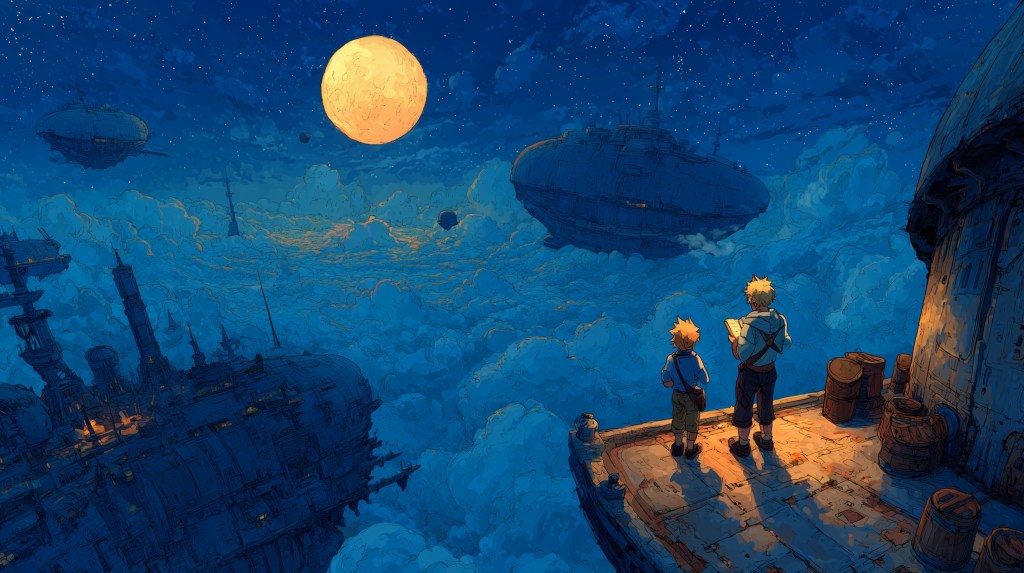
The observation deck of Skyholm’s eastern platform jutted into open air like a defiant finger pointing at the impossible, and it was here that Finn Windcaller found his cousin Tomas already positioned with his back against the crystalline railing, arms crossed, jaw set in the particular expression that meant he’d been thinking again—which never ended well for either of them.
“No,” Tomas said before Finn had even opened his mouth.
“You haven’t heard my revised proposal—”
“I don’t need to hear it. The answer is still no. We don’t have the coin, Finn. We’ve never had the coin. We’re not going to suddenly have the coin because you’ve rearranged the numbers in your little notebook for the hundredth time.”
Finn ignored this categorically false assessment and settled onto the railing beside his cousin, pulling the worn leather journal from his satchel with the careful reverence of someone handling sacred text. Below them, Aethermoor’s floating cities drifted through their eternal dance across cloudscape that shifted from pearl to rose as afternoon sun angled toward evening. Wind-ships traced paths between the platforms, their living hulls breathing in rhythm with the atmospheric currents that kept the entire civilization aloft.
And above—always above, always present, always calling—the moon hung in the deepening sky like a promise written in silver light.
“Master Corvain’s shipwright collective,” Finn began, flipping to the most recent page of calculations, “has revised their estimate for a moon-capable vessel. If we commission the basic hull without luxury fittings, eliminate the passenger quarters we don’t need, and use standard propulsion crystals instead of the military-grade ones—”
“Still thirty-five hundred gold sovereigns,” Tomas interrupted. “Which is approximately thirty-five hundred more than we currently possess.”
“Thirty-four hundred and ninety-seven more, technically. We have three sovereigns saved.”
“Oh, well, in that case, we’re practically there.” Tomas’s sarcasm could have cut crystal. “Another decade of saving our apprentice wages and we’ll almost have enough for the down payment.”
Finn refused to let his cousin’s pessimism contaminate the vision that had been crystallizing in his mind since childhood—the moment he’d first looked up at the moon and understood with absolute certainty that humans weren’t meant to remain earthbound, weren’t meant to limit themselves to floating cities when an entire celestial body waited above like fruit hanging from a branch just beyond reach.
“Master Corvain said if we could provide proof of concept—demonstrate that lunar travel is actually possible, not just theoretical—his investors might be willing to fund the construction in exchange for percentage of discovery rights.”
“Proof of concept requires actually going to the moon,” Tomas pointed out with infuriating logic. “Which requires a ship we can’t afford to build. You see the problem, yes? The circular impossibility of your brilliant plan?”
“Not if we commission a smaller vessel first. A proof run to test the principles.”
“With what money, Finn? We’re seventeen and fifteen respectively. We’re apprentice engineers earning barely enough to feed ourselves, living in quarters so small we can’t both stand up simultaneously. Our families think we’re idiots for even considering technical trades instead of respectable positions in atmospheric maintenance or platform administration. We have three gold sovereigns, half a notebook of theoretical calculations, and a dream that anyone with sense would recognize as complete fantasy.”
The assessment stung because it was accurate. Finn closed his journal, his fingers tracing the worn leather as if touch could somehow transmit the certainty that lived in his bones—that this wasn’t fantasy, that the moon was achievable, that someone just needed courage and determination and enough disregard for practical constraints to actually attempt what everyone else dismissed as impossible.
“Torven Skywright went from apprentice to master shipbuilder in eight years,” Finn said quietly. “Started with nothing, convinced investors to fund his experimental designs, revolutionized how we construct living vessels. Everyone told him he was chasing fantasy too.”
“Torven had family connections,” Tomas countered, though his tone had softened fractionally. “His mother was on the Engineering Council. His uncle ran the largest shipyard in Aethermoor. We have Master Corvain tolerating our presence in his workshop because we showed aptitude for mechanical theory, and we have each other, which means we have one and a half people with sense between us on good days.”
“So we need connections.” Finn stood, his mind already spinning through possibilities, calculating angles that might transform impossible into merely difficult. “We need to meet people who have resources, who have vision, who understand that the first people to reach the moon will make history and fortune simultaneously.”
“We need,” Tomas said flatly, “to accept that some dreams are too expensive for people like us. That wanting something desperately doesn’t make it achievable. That maybe we should focus on becoming competent engineers, building respectable careers, saving our money like sensible people instead of chasing fantasies that will leave us broke and disappointed.”
The words hit like physical blows, not because Tomas was being cruel but because he was being honest—articulating the doubts that Finn fought every morning when his small savings seemed to mock rather than encourage, when the gap between three gold sovereigns and thirty-five hundred felt less like distance and more like unbridgeable chasm.
Below them, a wind-ship passed close enough that they could hear its hull’s breathing, the rhythmic expansion and contraction that drew atmospheric essence to fuel its impossibly graceful flight. Someone had built that vessel once, had looked at empty sky and imagined living wood shaped into forms that could navigate between the floating platforms. Someone had figured out how to crystallize music into propulsion, how to grow hulls that breathed and healed themselves, how to make the impossible routine through application of knowledge and resources and stubborn refusal to accept limitations.
“I’m going to the moon,” Finn said quietly, the declaration emerging with the weight of vow rather than mere statement of intent. “I don’t know how yet. I don’t know when. But I’m going, Tomas. Even if it takes thirty years to save the money, even if I have to build the ship myself from salvaged materials, even if everyone thinks I’m chasing fantasy that sensible people would abandon.”
Tomas was silent for a long moment, his eyes tracking the wind-ship’s progress as it maneuvered toward Skyholm’s northern docks. When he finally spoke, his voice carried resignation mixed with something that might have been reluctant admiration.
“You’re completely insane. You know that, right? Completely, utterly divorced from practical reality.”
“Probably.”
“And you’re going to drag me along on this ridiculous quest because you’re my cousin and I apparently lack the sense to abandon you to your delusions.”
“Hopefully.”
Another silence, this one feeling less like argument and more like the comfortable space between people who’d known each other since childhood, who’d shared dreams and doubts in equal measure, who understood that sometimes the only thing more foolish than chasing impossible goals was facing them alone.
“Fine,” Tomas said eventually. “But we’re doing this intelligently. No more vague fantasies about somehow acquiring thirty-five hundred gold sovereigns through miracle and determination. We need actual plan. Concrete steps. Realistic assessment of what’s achievable versus what’s pure delusion.”
Finn felt something ignite in his chest—not quite hope, too fragile for that, but possibility. The kind of spark that preceded fire if properly tended and protected from the winds that sought to extinguish it.
“Master Corvain is judging the Engineering Festival next month,” he said, his mind already assembling pieces into potential strategy. “First prize is fifty gold sovereigns and apprenticeship advancement. If we entered a moon-ship design—not full vessel, just the theoretical framework with proof of concept calculations—”
“Fifty sovereigns doesn’t get us much closer to thirty-five hundred,” Tomas pointed out, though his objection carried less force than before. “And we’d be competing against apprentices with more experience, better resources, family connections—”
“But we’d be noticed,” Finn interrupted, his words tumbling out with gathering momentum. “By Master Corvain, by the Engineering Council, by the investors who attend looking for innovative projects to fund. The prize matters less than the visibility, the chance to demonstrate that we’re serious, that moon travel isn’t just boyish fantasy but legitimate engineering challenge with workable solutions.”
Tomas pulled his own notebook from his pocket—smaller than Finn’s, filled with the precise technical drawings and mathematical calculations that balanced Finn’s visionary enthusiasm with practical engineering knowledge. He flipped through pages covered with propulsion theories, hull stress calculations, atmospheric transition models that had occupied their every spare moment for two years.
“We’d need working model,” he said slowly, his engineer’s mind already engaging with the problem despite his stated skepticism. “Festival rules require physical demonstration of principles, not just theoretical papers. Can’t show working model of something that requires vessel we can’t afford to build.”
“Scaled model,” Finn suggested. “One-tenth size, simplified propulsion, basic demonstration that the principles work at smaller scale before attempting full vessel.”
“Still expensive. Materials for even scaled model would consume most of our savings.”
“Investment in our future. You said we needed concrete steps rather than vague fantasy. This is concrete—enter the festival, demonstrate competence, attract attention from people who might actually fund the full project.”
Tomas’s fingers traced through his notebook, his expression showing the internal calculation Finn recognized—weighing risk against potential reward, practical constraints against the pull of possibility that had infected them both despite his proclaimed realism.
“If we fail,” Tomas said finally, “if we spend our savings on materials for a model that doesn’t impress anyone, doesn’t win the prize, doesn’t attract investor attention—we’ll have set ourselves back months. Maybe years.”
“And if we don’t try, we guarantee failure. We remain apprentices earning minimal wages, watching our dream recede further every year while we save three gold sovereigns toward a thirty-five-hundred-sovereign goal.”
“I hate that you’re right.” Tomas closed his notebook with decisive snap. “I hate that you’ve infected me with your insane optimism, that I’m now complicit in this ridiculous scheme, that I’m actually considering spending money we desperately need on a gamble that any sensible person would recognize as terrible idea.”
“But you’re in?”
“I’m in. Because apparently I’m as stupid as you are, and because someone needs to make sure your brilliant visions don’t kill us both through negligence of basic engineering principles.” He stood, his posture straightening with the particular determination that accompanied commitment finally made. “But we’re doing this properly. Full technical specifications, stress calculations, propulsion theory verified by multiple models. If we’re going to chase this fantasy, we’re going to do it with actual engineering competence rather than just enthusiasm and hope.”
The sun had settled toward the horizon, painting Aethermoor’s floating cities in shades of amber and rose, casting long shadows across platforms where thousands of people pursued their ordinary lives—working, eating, loving, dying without ever looking up at the moon and feeling the pull that had defined Finn and Tomas’s existence since childhood.
“We should start with propulsion calculations,” Finn suggested, pulling his journal back out. “If we can demonstrate superior efficiency in atmospheric transition, show that lunar distance is achievable with existing crystal technology properly optimized—”
“Start with structural integrity,” Tomas corrected. “Propulsion means nothing if the hull fails during atmospheric exit. We need to prove the vessel can survive the transition without catastrophic failure.”
They descended into the familiar rhythm of collaboration that had characterized their partnership—Finn’s visionary leaps balanced by Tomas’s engineering precision, enthusiasm tempered by calculation, dream anchored by the technical knowledge that would transform fantasy into achievable reality.
Around them, Aethermoor continued its eternal drift through cloud and sky, its people secure in their floating cities, content with the miracle of platforms that defied gravity without needing to push further, to reach higher, to claim the silver promise that hung above like fruit waiting to be plucked by those foolish enough to build ladders toward the impossible.
Three gold sovereigns. Thirty-five hundred required. A gap that should have been crushing, that any sensible person would recognize as insurmountable for two apprentice engineers with minimal resources and maximum ambition.
But Finn Windcaller looked at his cousin bent over calculations, looked up at the moon beginning its nightly vigil above, and felt certainty settling into his bones—not confidence exactly, too fragile for that, but determination. The kind that preceded every impossible achievement, every leap beyond accepted limitations, every moment when humans decided that wanting something desperately might actually be sufficient motivation to make it real.
They didn’t have the money. Not yet. Might never have it, might spend their lives chasing a dream that remained forever beyond reach.
But they had each other, had knowledge and determination and the stubborn refusal to accept that practical constraints should override vision. Had three gold sovereigns and a plan and the moon hanging above like a challenge written in silver light.
And sometimes—just sometimes—that was enough to begin.

 Chadwick Rye
Leave a comment