
What could you try for the first time?
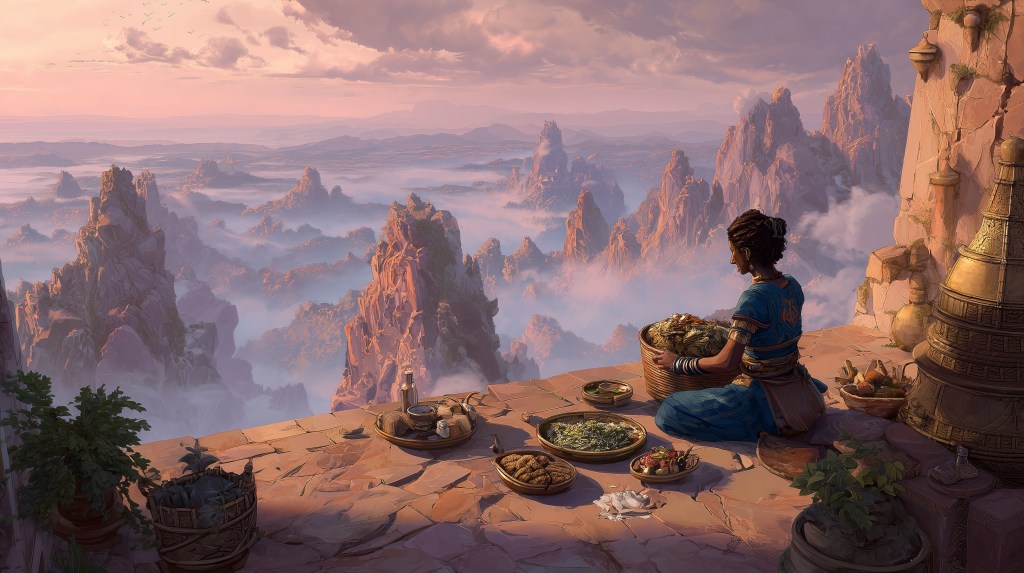
The walking mountain’s rhythm had taken Isadora three days to internalize—the subtle sway as Grandfather Ironheart’s stone limbs carried entire civilizations across terrain that shifted from grassland to forest to river valley with the patient inevitability of geological time. Now, standing at the railing of the communal dining terrace carved into the mountain’s eastern flank, she felt the motion in her bones, that gentle rocking that Peak-riders claimed was the planet’s heartbeat made manifest.
Below, the landscape transformed as they moved, morning mist curling away from forests that would be behind them by evening, meadows flowing past like water around the mountain’s massive stride. The air smelled of turned earth and wild sage, carrying undertones of something cooking—smoke and spice and promises of sustenance she couldn’t yet identify.
Isadora had traveled eight months to reach Nomados, drawn by rumors of cuisine that existed nowhere else in the known world. As a culinary chronicler from Lumen Vale, she’d documented the refined dishes of crystal-city nobility, the robust fare of merchant caravans, even the experimental fusion cuisine emerging from Aethermoor’s floating districts. But the Peak-riders’ food remained mysterious, barely mentioned in academic texts, described in travelers’ tales with the vague reverence people reserved for experiences that transcended simple description.
“First timer?” The voice belonged to a woman perhaps ten years Isadora’s senior, her bronze skin marked with the ritual scars that identified her as a Deep-Stone Speaker. She carried a woven basket that released tendrils of steam and an aroma that made Isadora’s stomach clench with sudden, desperate hunger.
“That obvious?” Isadora managed, tearing her attention from the basket to meet the woman’s knowing smile.
“You’ve got the look. Part wonder, part terror, complete fascination with the motion. I’m Kerra Earthsong, and I’ve been asked to serve as your guide to our culinary traditions.” She set the basket on a low stone table that had been carved directly from the mountain’s substance, its surface polished smooth by generations of use. “Elder Thane mentioned we had a food scholar joining us. Said you were seeking signature dishes you’d never encountered.”
“Isadora Flamekeeper, culinary chronicler and apparently transparent in my inexperience.” She settled onto the cushioned stone bench across from Kerra, her journal already emerging from her leather satchel with the automatic reflex of someone who documented everything. “I’ve spent my career studying how cultures express themselves through food, but the Peak-riders remain… elusive in traditional scholarship.”
Kerra’s laugh carried the warmth of someone who understood being misunderstood. “That’s because most scholars can’t stomach the commitment required to truly understand our cuisine. It’s not just food—it’s philosophy, geology, constant adaptation to the mountain’s migration. What you eat depends on where we are, what the earth provides, how the stone-songs guide our harvesting.”
She began unpacking the basket with the careful precision of someone handling precious artifacts. First came a shallow bowl carved from dark wood, its interior stained by years of service. Then came the food itself, each item presented with explanation that transformed mere sustenance into story.
“Moss-bread,” Kerra announced, placing three small rounds on the bowl. “Baked in volcanic vents that Grandfather Ironheart passes over during the southern migration. The heat varies with the mountain’s proximity to geothermal activity, so no two batches taste identical.”
The bread looked unremarkable—dense, dark, with a texture that suggested it would be heavy as stone. But when Isadora accepted the offered piece and bit cautiously, her assumptions shattered. The exterior was crisp with a slight char that provided bitter counterpoint to the interior’s unexpected softness. The moss itself—a variety that grew only on the walking mountains’ northern slopes—imparted an earthy complexity that reminded her simultaneously of forest floors after rain and the mineral tang of deep well water.
“This is extraordinary,” she murmured, reaching for her journal with one hand while holding the bread with religious reverence in the other. Her quill moved rapidly across the page: *Moss-bread challenges every assumption about field rations and traveling cuisine. The char suggests recent baking despite days of travel. Question: Do they maintain mobile ovens, or is the bread itself designed to improve with age?*
Kerra watched with the satisfaction of someone witnessing expected revelation. “The moss contains compounds that prevent staleness. Peak-rider legend claims the first bakers discovered the recipe by accident when they stored ordinary bread near moss beds and found it somehow improved. Now it’s our staple—nutritious, portable, and unlike anything produced by static civilizations.”
The next item required more careful presentation. Kerra unwrapped oiled cloth to reveal what appeared to be dried meat strips, their surface glistening with crystalline deposits that caught the morning light like scattered diamonds.
“Salt-stepped game,” she explained, using the term as if Isadora would understand its significance. “We preserve meat by carrying it through Grandfather Ironheart’s full migration cycle. Each territory we pass through, we expose it to different air, different mineral content, different wild herbs. The salt comes from deposits we pass only once per year. By the time the cycle completes, the meat has absorbed essence of an entire journey.”
Isadora accepted a strip with scholarly caution, aware that she was handling not just food but compressed geography, time made edible. The first bite released flavors in layers—salt and smoke obviously, but beneath that, something green and growing, then mineral richness, then subtle spice that built slowly rather than announcing itself with immediate heat.
Her journal entry attempted inadequate capture: *Meat that functions as flavor map of annual migration. Each bite contains multiple terrains, seasons compressed. The salt acts as preservative and vehicle for environmental essence. Traditional food preservation assumes static location—this technique weaponizes mobility itself.*
“You’re beginning to understand,” Kerra observed, her expression carrying approval mixed with challenge. “Peak-rider cuisine isn’t about recreating the same dish repeatedly. It’s about partnering with geography, letting location and motion contribute ingredients that sedentary cooking can never access.”
The basket continued revealing its treasures. Root vegetables that had been slow-roasted in earth heated by the mountain’s own internal warmth, their flesh transformed into something between vegetable and candy, sweetness concentrated through geological patience. Preserved fruits that had been packed in honey and herbs, then carried through temperature variations that created fermentation too complex for intentional replication.
But it was the final item that made Isadora’s breath catch—a small clay jar sealed with wax, its contents unknown but clearly significant by the reverence Kerra displayed while opening it.
“Stone-heart stew,” she announced quietly, pouring thick, dark liquid into a cup carved from obsidian. “This is… well, this is what you traveled eight months to discover, though you didn’t know to name it.”
The stew’s appearance was unpromising—murky brown-gray, thick as mud, releasing steam that carried scents she couldn’t immediately parse. But Kerra’s expression communicated that appearance was irrelevant, that what mattered happened beyond visual assessment.
Isadora brought the cup to her lips, inhaling deeply before tasting. The aroma spoke of earth and time, of patience measured in eras rather than hours. Then she drank.
The experience defied her entire framework for understanding flavor. This wasn’t taste in any conventional sense—it was sensation that bypassed her tongue and spoke directly to something deeper. She felt the mountain’s weight, the slow patience of stone worn smooth by weather and time. She tasted the mineral-rich water that seeped through ancient rock, the fierce heat of the earth’s molten heart, the cool wisdom of caves that had never known sunlight.
Tears leaked from her closed eyes—not from emotion exactly, though emotion was certainly present, but from the overwhelming intensity of experiencing something her body had no prior context for processing. This was food that required not just taste buds but geological consciousness, the willingness to let her human awareness expand to encompass timescales and perspectives that belonged to the mountains themselves.
When she finally opened her eyes, Kerra was watching with the knowing patience of someone who had witnessed this transformation before.
“What…” Isadora’s voice emerged rough, her throat tight with trying to articulate the impossible. “What was that?”
“That,” Kerra replied gently, “was the reason Peak-riders never become sedentary, why those who taste it often never leave the walking mountains. It’s made from ingredients we harvest throughout the year—certain mushrooms that grow only in volcanic soil, herbs found exclusively in the deepest caves, mineral deposits dissolved from specific rock formations. But the essential ingredient is motion itself, the constant passage through different elevations and climates that allows fermentation processes impossible in static locations.”
She paused, her expression growing serious. “It’s also made with one ingredient we never discuss with outsiders, never document, never export. An ingredient that requires connection to the mountains themselves—their consciousness, their memory, their stone-songs.”
Isadora’s scholarly instincts warred with the still-reverberating experience of what she’d just consumed. Part of her wanted to demand specifics, to document every component and technique. But another part—the part that still felt the mountain’s heartbeat in her bones—understood that some knowledge couldn’t be reduced to recipe and replication.
“I understand,” she said finally, her hand moving to close her journal despite the professional imperative to record everything. “Or rather, I understand that I can’t understand, not completely, not as an outsider.”
Kerra’s smile transformed her weathered features. “That’s more wisdom than most scholars manage. The Stone-heart stew isn’t food to be documented—it’s experience to be honored. You can write about its effects, your response to it, the way it changed your consciousness. But the actual recipe…” She shrugged eloquently. “That belongs to the mountains and those who walk with them.”
The morning progressed with Kerra guiding Isadora through Peak-rider culinary philosophy, each dish revealing new aspects of what it meant to cook while in constant motion. They ate fermented grains that had spent months in clay vessels strapped to the mountain’s back, absorbing vibrations that influenced yeast cultures in ways laboratory fermentation could never replicate. They tasted pickled vegetables preserved in brines that changed composition as the mountain passed through different mineral zones. They sampled breads leavened with wild yeasts captured from winds that blew across territories the mountain would visit only once per generation.
Each dish challenged Isadora’s assumptions about what food could be and do. She’d studied cuisine as cultural expression, as nutritional science, as artistic medium. But Peak-rider food functioned as something else entirely—as partnership with geology, as chronicle of motion, as communion with consciousness that transcended human categories.
By midday, when Grandfather Ironheart paused near a river valley for the community’s daily rest period, Isadora sat with her journal open but her quill still. The pages before her contained fragmented notes, half-finished descriptions, attempts to capture experiences that existed beyond language’s capacity to hold them.
“Struggling with documentation?” Kerra had returned from overseeing the communal preparation for evening meal, her hands dusted with flour from whatever baking project occupied the mobile ovens.
“I’m struggling with the fundamental assumption that everything can be documented,” Isadora admitted, gesturing at her inadequate notes. “My entire career is built on the premise that if I observe carefully enough, record precisely enough, I can transmit culinary knowledge to others who weren’t present for the original experience. But your cuisine…” She shook her head, frustrated by her own limitations. “It requires context that can’t be separated from the food itself. The motion. The mountain’s consciousness. The philosophical framework that treats eating as geological communion.”
“So you’re discovering that some experiences resist reduction to recipe.” Kerra settled beside her, close enough that their shoulders touched—a gesture of solidarity rather than mere proximity. “This bothers you.”
“It bothers the scholar in me who wants to catalog and preserve everything.” Isadora closed her journal with a decisive snap. “But the person in me—the one who actually experienced the Stone-heart stew—understands that some things are meant to be lived rather than documented, that trying to capture them in words diminishes rather than preserves them.”
“And that’s the actual lesson Peak-rider cuisine teaches,” Kerra replied, her voice carrying the particular satisfaction of someone watching a student grasp concept that couldn’t be directly taught. “Food can be many things—fuel, pleasure, art, medicine. But at its highest expression, it becomes doorway to consciousness that transcends individual experience. You can’t document a doorway. You can only decide whether to walk through it.”
The afternoon dissolved into participation rather than observation. Kerra invited Isadora into the communal kitchen—a series of terraced platforms carved into the mountain’s eastern face, where cooking fires burned in stone hearths that had been maintained for generations, their flames never extinguishing even during the most violent weather.
Here, Isadora learned not recipes but principles. How to judge the mountain’s proximity to volcanic vents by the way heat conducted through stone floors. How to time fermentation based on Grandfather Ironheart’s migration speed through different climatic zones. How to harvest wild ingredients during the mountain’s brief pauses without damaging the ecosystems they moved through.
She worked alongside Peak-riders whose expertise had been earned through decades of practice, her hands learning what her mind couldn’t quite grasp—the feel of properly developed moss-bread dough, the sound salt-stepped meat made when it had reached ideal preservation, the smell of Stone-heart stew that indicated readiness for the final, secret ingredient.
By evening, when the communal feast began, Isadora had transformed from observer to tentative participant. She carried dishes to the great terrace where Peak-riders gathered for their daily meal, served food with the careful attention of someone handling precious artifacts, and eventually settled among strangers who had become something approaching colleagues through shared work in the kitchens.
The feast itself revealed another dimension of Peak-rider culinary culture. This wasn’t formal dining or careful presentation—it was joyful chaos, voices raised in conversation and song, children darting between tables, elders holding court with stories that connected current dishes to historical migrations. Food circulated in communal bowls, everyone serving everyone, the meal structure emphasizing community over individual consumption.
Isadora found herself seated between Kerra and an elderly man whose scarred hands spoke of decades working with stone and soil. He offered her a plate containing items she hadn’t yet tried—small rolls filled with something that smelled of herbs and smoke, roasted tubers that glistened with rendered fat, pickled vegetables whose colors suggested they came from plants that grew nowhere near Lumen Vale.
“First time at Peak-rider feast?” he asked, his voice carrying the particular roughness of someone whose lungs had processed decades of stone dust and mountain air.
“That obvious?” Isadora echoed her earlier response to Kerra, earning a laugh that revealed missing teeth.
“You’re still trying to understand everything intellectually,” he observed, not unkindly. “Cataloging flavors, analyzing techniques, maintaining distance even while participating. But Peak-rider food doesn’t reveal itself to analysis. You have to surrender to the experience, let it teach you directly rather than filtering everything through conceptual framework.”
The insight struck deep, exposing assumptions Isadora hadn’t realized she carried. Her entire approach to culinary study had been fundamentally distant—observing, recording, analyzing from position of scholarly remove. But what if some knowledge required different relationship? What if understanding Peak-rider cuisine demanded abandoning the observer stance and fully inhabiting the experience?
She set down her journal—hadn’t even realized she’d been holding it—and picked up the herb-filled roll with both hands. This time, she didn’t pause to analyze appearance or aroma. She simply bit, chewed, swallowed, and let sensation wash through her without attempting immediate intellectual capture.
The flavors arrived as integrated experience rather than deconstructed components. Herbs she couldn’t name, meat from animals she’d never seen, bread baked in ovens fueled by wood from forests she’d passed through days ago without recognizing. The entire meal told story of motion and adaptation, of people who had learned to find home in movement rather than location, who had transformed constant migration from hardship into philosophy.
Around her, the feast continued its joyful chaos. Someone began singing in the throat-song style that Peak-riders used to communicate with the mountains themselves, the sound somehow synchronizing with Grandfather Ironheart’s rhythmic movement. Others joined, creating harmonies that felt less like human music and more like geological consensus, the mountain and its passengers achieving momentary unity of purpose.
Isadora found herself swaying with the combined rhythms—the mountain’s stride, the throat-songs’ harmonics, the pulse of her own heartbeat synchronized with both. For the first time since arriving, she wasn’t trying to document or understand. She was simply present, part of the experience rather than observer of it.
Later, when the feast had dissolved into smaller conversations and eventual dispersal toward sleeping quarters, Kerra found Isadora still sitting on the terrace, watching stars emerge above landscape that continued changing even as darkness fell.
“So,” Kerra said, settling beside her with the comfortable familiarity of friendship that had somehow formed over a single day of shared labor and revelation. “Will you write about this? Publish your chronicle of Peak-rider cuisine for the sedentary scholars back in Lumen Vale?”
Isadora considered the question seriously, aware that it wasn’t merely professional inquiry but test of what she’d actually learned. “I’ll write about it,” she said finally. “But not as documentation or recipe collection. I’ll write about the impossibility of documentation, about cuisine that requires geological consciousness, about food that functions as doorway rather than destination.”
She paused, aware that her answer was still incomplete. “And I’ll write about the choice I’m facing—whether to return to Lumen Vale and my comfortable career documenting cuisines I can comprehend from safe distance, or to stay here and learn what it actually means to eat as Peak-riders eat, to let food become communion with consciousness that transcends human categories.”
“You’re thinking about staying.” Not a question but recognition.
“I’m thinking about trying,” Isadora corrected. “About attempting to learn whether I can surrender my need to understand everything intellectually, whether I can develop the kind of consciousness that allows true partnership with geological time and mountain-songs and food that changes based on location and motion.”
Kerra smiled, her expression carrying satisfaction and welcome in equal measure. “Then I should tell you—the kitchen collective has been discussing whether to offer you apprenticeship. Usually we don’t accept outsiders, especially scholars who come seeking to extract knowledge for external publication. But you…” She gestured at Isadora’s closed journal, at the way she’d been sitting in comfortable silence rather than filling it with questions. “You show signs of understanding that some knowledge can only be earned through direct experience, through surrendering observer stance and accepting participant role.”
“What would apprenticeship entail?”
“Minimum commitment of one full migration cycle—approximately thirteen months. You’d work in the kitchens, learning not recipes but principles. You’d participate in harvest expeditions when we pass through territories that provide specific ingredients. You’d learn throat-songs that allow communication with the mountain’s consciousness. And eventually, if you proved capable, you’d be taught how to prepare Stone-heart stew, including the secret ingredient we never discuss with outsiders.”
Thirteen months. More than a year of abandoning her career, her comfortable apartment in Lumen Vale’s Scholar Quarter, the professional reputation she’d spent a decade building. A year of constant motion, of learning to find stability in movement rather than location, of surrendering intellectual frameworks that had defined her entire approach to culinary study.
But also: thirteen months of experiencing cuisine that existed nowhere else, of developing consciousness that could encompass geological time, of learning what it meant to eat not for sustenance or pleasure but for communion with something vaster than human categories could contain.
Isadora felt the mountain’s rhythm in her bones, that gentle sway that Peak-riders claimed was the planet’s heartbeat. She tasted lingering flavors from the feast—moss-bread and salt-stepped game and those mysterious pickled vegetables. She remembered the overwhelming experience of drinking Stone-heart stew, of touching consciousness that transcended her limited human awareness.
Some experiences, she was learning, couldn’t be documented or studied from safe distance. Some knowledge required transformation rather than observation, demanded that the knower become different in the process of knowing.
“I accept,” she said quietly, the words emerging before conscious decision had fully formed. “I accept the apprenticeship.”
Kerra’s smile transformed into something approaching joy. “Good. Then tomorrow, we begin properly. The communal kitchen starts preparations before dawn—Grandfather Ironheart will pass through territory with wild herbs that only grow at this specific elevation during this particular season. If we harvest correctly, we’ll have ingredients for a preserve that won’t be possible again for another year.”
“And if I decide, after the full cycle, that I want to return to Lumen Vale?”
“Then you return with knowledge that will transform how you understand cuisine, consciousness, and the relationship between consumption and awareness. The apprenticeship isn’t trap—it’s doorway. What you do after walking through it remains your choice.”
That night, in the small sleeping chamber assigned to her, Isadora opened her journal one final time. But instead of attempting documentation of the day’s experiences, she wrote only this:
*Day One of Peak-rider Apprenticeship:*
*Today I learned that some food cannot be reduced to recipe, that some experiences resist documentation, that some knowledge requires transformation rather than observation. I came seeking signature dishes I’d never tried. I found instead doorway to consciousness I never knew existed.*
*Tomorrow, I begin learning whether I can walk through that doorway, whether I can become someone capable of partnership with geological time and mountain-songs and food that functions as communion rather than mere sustenance.*
*I’m terrified. I’m exhilarated. I’m surrendering everything I thought I knew about culinary study and discovering something far more profound beneath the comfortable frameworks I’ve been hiding behind.*
*This is what I came seeking, though I didn’t know to name it until I’d already found it.*
She closed the journal and extinguished the lamp, settling into the narrow bed that swayed gently with Grandfather Ironheart’s endless stride. Outside her window, landscape continued transforming even as she drifted toward sleep—forests becoming grasslands, valleys shifting to hills, the constant change that Peak-riders had learned to call home.
And somewhere in the darkness, carried by wind and stone-songs and the mountain’s patient heartbeat, was the promise of tomorrow’s harvest, of ingredients that would teach her something she couldn’t yet comprehend, of food that would continue transforming her understanding of what eating could be and mean and accomplish.
Isadora smiled and surrendered to sleep, letting the mountain’s rhythm become her lullaby, already learning the first lesson Peak-rider cuisine had to teach: that some experiences couldn’t be prepared for or controlled, only accepted with open hands and consciousness willing to be changed by what it encountered.
Tomorrow would bring wild herbs and new techniques and continued transformation. Tonight brought rest and integration and the quiet satisfaction of having chosen doorway over documentation, experience over intellectual safety, becoming over merely knowing.
The feast, she was discovering, had only just begun.

 Chadwick Rye
Leave a comment