What would your life be like without music?
Kael Stormwright pressed his ear against the cold metal door of the abandoned wind-turbine chamber, his pulse synchronizing with the rhythmic thrumming that echoed from within the Cloudspire’s forgotten depths. Twenty-three floors below the pristine observation decks where Aethermoor’s elite gathered to compose their ethereal wind-songs, in the industrial bowels where compressed air was harvested and crystallized starlight refined, something revolutionary was taking shape.
The sound bleeding through the reinforced steel wasn’t the gentle harmony that had defined Aethermoor’s musical tradition for centuries. It wasn’t the delicate interweaving of wind-chimes and crystal resonance that played in the floating city’s grand conservatories. This was something raw, something that spoke to the grinding reality of keeping impossible cities aloft through sheer mechanical will and the sweat of those who worked in shadows.
Kael’s weathered hands—scarred from years maintaining the great wind-engines that kept his section of the city airborne—trembled as he activated the chamber’s entry sequence. The heavy door swung inward on massive hinges, releasing a wall of sound that hit him like a physical force.
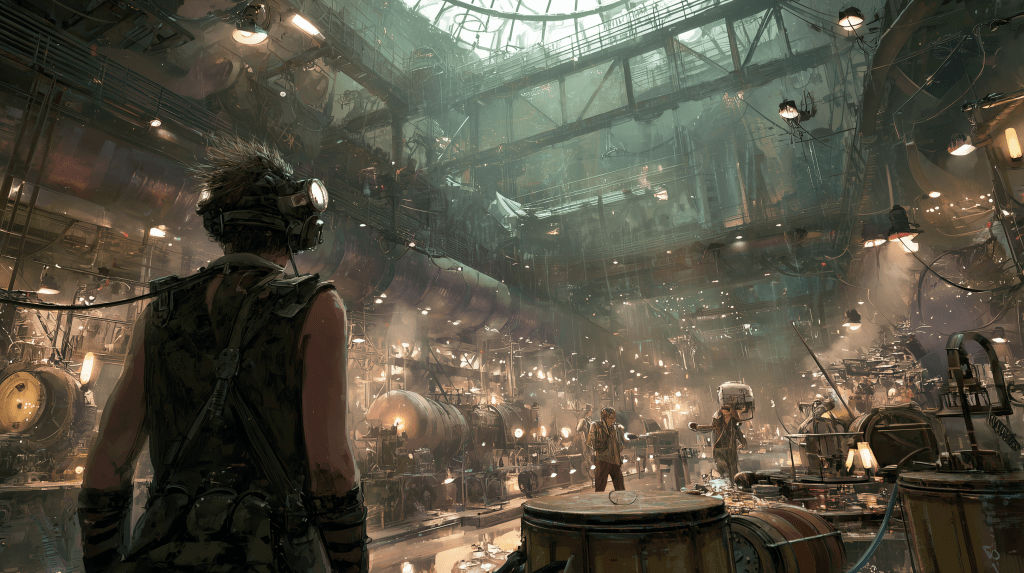
Inside, illuminated by the harsh glow of maintenance crystals, four figures bent over instruments that would have horrified the Academy of Harmonic Arts. Vera Ironlung stood behind a percussion array constructed from recycled engine parts—massive drums fashioned from pressure vessels, cymbals forged from worn turbine blades, all arranged with the precision of someone who understood both rhythm and machinery. Her arms moved in controlled fury, coaxing sounds from metal that had never been intended for music but somehow sang with more honesty than any traditional instrument.
Beside her, Jax Copper-throat drew sounds from a stringed instrument that bore only passing resemblance to the crystalline harps favored by Aethermoor’s established musicians. His creation incorporated salvaged power cables as strings, their tension controlled by modified engine governors, producing tones that ranged from melodic warmth to grinding dissonance depending on how the wind-pressure varied throughout the city’s atmospheric cycle.
The vocalist—a young woman called Raven Skybreaker—stood at the chamber’s center with her eyes closed and her fists clenched, her voice rising above the instrumental chaos in patterns that defied everything Kael had learned about proper singing technique. Where traditional Aethermoor vocalists sought to blend with wind-harmonies and complement natural acoustics, Raven’s approach was confrontational, aggressive, her voice cutting through the mechanical symphony like a blade through silk.
But it wasn’t noise.
That was what separated Kael from the countless critics who dismissed this emerging musical form as industrial accident rather than artistic evolution. Where others heard cacophony, he perceived complex emotional architecture. Where they detected only volume and aggression, he recognized the subtle interplay of rhythm and melody that spoke directly to experiences the traditional music could never address.
The song—if conventional terminology could be applied to what they were creating—told the story of life in Aethermoor’s working districts. It captured the bone-deep exhaustion that came from twelve-hour shifts maintaining atmospheric processors, the constant anxiety of knowing that mechanical failure could send entire city sectors plummeting toward the distant earth, the fierce pride that came from mastering skills that kept impossible dreams aloft through pure technical competence.
When the music finally crashed to its conclusion, the silence that followed felt heavier than the sound itself. Kael found himself breathing hard, as if he’d been running rather than simply listening. His hands ached—not from any physical exertion, but from the sympathetic tension of experiencing someone else’s struggle expressed through organized noise.
“You came,” Vera said, setting down her drumsticks with the careful precision of someone who treated their instruments as precision tools rather than mere artistic implements. Sweat beaded on her forehead despite the chamber’s cool temperature, her dark hair plastered against her skull by the intensity of her performance. “Wasn’t sure you’d actually show up.”
Kael stepped fully into the chamber, letting the door seal behind him with a soft pneumatic hiss. The space was larger than it appeared from outside, carved from the solid structure of the floating city’s foundation where massive support struts transferred the weight of entire districts to the wind-engines that defied gravity through pure applied physics. Pipes and conduits snaked along the walls, carrying the pressurized air and liquid starlight that powered Aethermoor’s impossibilities.
“I’ve been listening through the maintenance shafts for weeks,” he admitted, his voice rough from years of breathing recycled air and crystal dust. “Couldn’t figure out what you were doing down here, but…” He gestured helplessly, trying to encompass the experience that had just washed over him. “It speaks to something I didn’t know needed speaking to.”
Raven opened her eyes—pale blue, almost colorless, like ice formed in the highest atmospheric layers where Aethermoor occasionally drifted during seasonal wind-pattern adjustments. “Most people tell us to keep it down,” she said, her speaking voice softer than her singing voice but carrying the same underlying intensity. “Say we’re disturbing the harmony of the city, that we’re creating noise pollution that interferes with proper wind-resonance.”
“Most people,” added Jax, his fingers still caressing the strings of his mechanical instrument, “have never worked a sixteen-hour shift keeping the eastern stabilizers operational while a storm tries to tear the city apart. They’ve never felt what it’s like to have the weight of other people’s lives depending on whether you can diagnose engine trouble by the sound the metal makes when it’s about to fail.”
The fourth member of the group—a slight young man Kael hadn’t initially noticed—looked up from where he’d been adjusting what appeared to be a wind-harp modified with additional resonance chambers and mechanical amplification. “They hear aggression,” he said quietly, “because they’ve never needed to be aggressive to survive. They hear chaos because their lives have been organized around avoiding the kind of chaos we navigate every day.”
His name, Kael learned, was Flint Gear-song, and he served as the group’s… not exactly a bassist, since traditional musical categories didn’t apply to what they were creating, but something analogous. His instrument produced the deep, thrumming foundation that anchored their compositions, frequencies so low they were felt more than heard, reverberations that synchronized with heartbeat and breathing until the listener’s entire body became part of the musical experience.
“We call it Storm Metal,” Vera explained, settling onto a makeshift stool constructed from spare engine components. “Because it captures what it feels like to live inside a storm—not watching it from safe distance, but being part of it, letting it remake you into something that can survive forces that would destroy anything softer.”
Kael nodded slowly, understanding crystallizing in his mind like starlight condensing under pressure. This wasn’t rebellion for its own sake, wasn’t simple rejection of established artistic traditions. It was evolution, adaptation, the emergence of an art form that could express experiences the traditional music couldn’t accommodate.
“The Academy musicians,” he said, thinking of the composers who created the gentle wind-songs that played during shift changes and meal periods, “they write for people who’ve never doubted that the city will stay aloft. Their music assumes safety, assumes that harmony is the natural state and discord is aberration.”
“But we know better,” Raven replied, her voice carrying the weight of hard-earned wisdom. “We know that keeping Aethermoor in the sky requires constant struggle against forces that want to drag us down. We know that harmony is something you fight for, something you build by confronting the chaos rather than pretending it doesn’t exist.”
She gestured toward the chamber’s walls, where the city’s vital systems hummed and throbbed with mechanical life. “This is our reality. Metal and pressure and the constant possibility of catastrophic failure. Our music should reflect that reality instead of trying to escape from it.”
The conversation continued deep into the night cycle, interrupted periodically by the need to perform maintenance checks on the equipment they were using. Kael found himself drawn into their world—not just the musical world they were creating, but the entire subculture that was evolving around this new form of expression.
They weren’t the only group exploring these sonic territories. Throughout Aethermoor’s working districts, other musicians were experimenting with ways to transform industrial noise into organized art, to find beauty in the grinding reality of keeping impossible cities functional. They gathered in maintenance shafts and abandoned storage chambers, sharing techniques and inspirations, building a community around the shared understanding that some experiences could only be expressed through controlled fury.
“Would you like to try?” Flint asked eventually, offering Kael a set of modified drumsticks. “The rhythm section could use reinforcement, and you’ve got the timing sense—I can hear it in how you walk, how you breathe. You understand mechanical timing.”
Kael accepted the sticks with reverence, their weight familiar from years of wielding similar tools in his maintenance work. But as he approached Vera’s percussion array, he felt a different kind of nervousness than he’d ever experienced while repairing critical city systems. This was creative vulnerability, the risk of expressing something personal rather than simply demonstrating technical competence.
The first tentative strikes against the modified pressure vessels produced sounds that resonated through his bones, vibrations that seemed to unlock emotional chambers he’d kept sealed for years. The rhythm that emerged wasn’t planned or calculated—it flowed from the intersection of his mechanical knowledge and his accumulated frustration with a life spent keeping other people’s dreams aloft while his own remained unacknowledged.
When the others joined in—Vera maintaining the primary rhythm while he provided percussive color, Jax and Flint weaving harmonic patterns that supported rather than competed with the aggressive foundation, Raven’s voice soaring above it all in expressions of defiance and determination—Kael experienced something he’d never found in traditional Aethermoor music.
Recognition. Validation. The profound relief of hearing his own experience reflected back through organized sound, transformed into something that transcended individual struggle and became shared understanding.
The session lasted until the first hints of dawn began filtering through the chamber’s high windows, artificial light giving way to natural illumination as Aethermoor’s atmospheric processors adjusted the city’s position relative to the ascending sun. When they finally stopped playing, Kael felt simultaneously exhausted and energized, drained by the intensity of expression and renewed by the discovery of a form of communication he’d never known he needed.
“This changes things,” he said as they began the careful process of shutting down and securing their equipment. “For me, I mean. Knowing this exists, knowing there are others who understand…”
“It changes things for all of us,” Vera replied, her voice thoughtful as she cleaned her drumsticks and arranged them in precise order within their storage case. “Every person who discovers they’re not alone in feeling what we feel, every musician who realizes their experience deserves artistic expression—it makes the whole community stronger.”
“And it makes the music better,” added Jax, carefully adjusting the tension on his modified strings to prevent weather-related tuning problems. “The more people who contribute their perspectives, their technical knowledge, their emotional understanding—the more complete the picture becomes.”
As Kael made his way back through the maintenance corridors toward his own quarters, his mind raced with possibilities he’d never previously considered. The traditional path for someone with his technical skills was clear and limited—advance through the engineering hierarchy, eventually earning enough status to move to better living quarters in the city’s higher levels, perhaps even gaining access to the cultural amenities enjoyed by Aethermoor’s privileged classes.
But he’d never wanted to abandon the working districts, had never felt drawn to the refined pleasures of the upper levels. He belonged among the people who understood that beauty could emerge from function, that art could grow from the intersection of necessity and creativity, that the most honest expression might require abandoning conventional aesthetics in favor of raw authenticity.
Storm Metal offered him a different kind of advancement—not social climbing, but artistic evolution. The chance to become part of something that was reshaping how an entire community understood itself, that was creating new vocabulary for experiences that had previously remained unspoken.
Over the following weeks, Kael found himself returning to the abandoned chamber whenever his shift schedule allowed. His technical knowledge proved invaluable to the group’s evolving sound—he could optimize the acoustic properties of their improvised instruments, could suggest modifications that enhanced their range and reliability, could even contribute compositions that incorporated the rhythmic patterns he’d absorbed through years of working with Aethermoor’s great engines.
But more importantly, he discovered that his emotional vocabulary was expanding in ways he’d never anticipated. The music taught him to recognize subtle gradations of feeling that he’d previously lumped together as simple frustration or vague dissatisfaction. Storm Metal distinguished between the anger that came from being ignored and the anger that emerged from being misunderstood, between the sadness of individual isolation and the melancholy of systemic alienation.
Through exploring these distinctions musically, he began to understand himself more clearly, to recognize that his discontent with traditional Aethermoor culture wasn’t personal failure but fundamental incompatibility. He wasn’t broken—he simply required different forms of beauty, different approaches to meaning, different ways of connecting with others who shared his particular relationship with the world.
The breakthrough came during a session three months after his first visit, when the group was working on a composition that attempted to capture the experience of a near-catastrophic engine failure Kael had helped resolve the previous week. The traditional approach would have been to treat such an incident as temporary disruption of normal harmony, something to be quickly corrected and forgotten.
Instead, they explored the full emotional journey—the initial terror when the warning signs appeared, the focused intensity of emergency diagnosis, the fierce satisfaction of successful repair, and finally the lingering awareness that catastrophe remained always possible, that safety was temporary achievement rather than permanent condition.
As the music built to its climax, Kael found himself playing patterns that incorporated the actual rhythmic signatures of failing mechanical systems, while Raven’s vocals expressed the complex mixture of fear and determination that kept maintenance crews functional during crisis. The result was eight minutes of organized chaos that somehow managed to be both technically accurate and emotionally authentic.
When they finished, the chamber filled with the kind of silence that indicated recognition rather than simple absence of sound. They had created something that captured an experience shared by thousands of Aethermoor’s working residents but never before acknowledged as worthy of artistic treatment.
“This is it,” Vera said quietly, her voice carrying the weight of revelation. “This is what we’ve been building toward. Not just music that sounds different, but music that says different things. Music that makes space for experiences that don’t fit traditional categories.”
The composition—which they eventually titled “Pressure Drop”—became the foundation of their first public performance, presented not in any official venue but in a maintenance plaza where off-duty workers gathered during shift changes. The audience consisted entirely of people who recognized the sounds being organized into art, who understood the emotional territories being explored through controlled sonic fury.
The response was immediate and profound. Not universal appreciation—some listeners remained convinced that what they were hearing was elaborate noise rather than legitimate music—but genuine recognition from those who had lived the experiences being expressed. For the first time, a significant portion of Aethermoor’s population heard their own reality reflected through artistic medium, their struggles and triumphs acknowledged as worthy of creative treatment.
“They understand,” Kael told his quarters-mate after the performance, his voice hoarse from shouting along with choruses that demanded vocal participation rather than polite listening. “They understand that this isn’t about rejecting everything that came before—it’s about expanding what music can include, what emotions deserve artistic expression.”
Within a year, Storm Metal had evolved from underground curiosity to recognized subgenre, with multiple groups throughout Aethermoor’s working districts developing their own approaches to transforming industrial reality into organized sound. The Academy of Harmonic Arts initially responded with official disapproval, declaring the new music technically incompetent and emotionally crude.
But they couldn’t deny its impact on the communities that embraced it. Workplace productivity increased as workers found their daily struggles acknowledged and validated through artistic medium. Mental health statistics improved as people discovered they weren’t alone in their particular relationship with Aethermoor’s demanding reality. Most significantly, the traditional division between workers and artists began to dissolve as people realized that creativity could emerge from any experience, that technical knowledge could enhance rather than limit artistic expression.
Kael eventually left his maintenance position to become a full-time musician and instrument developer, his engineering background allowing him to create percussion arrays that pushed the boundaries of what organized sound could accomplish. But he never lost connection with the working community that had shaped his understanding of what art could be—powerful rather than pretty, honest rather than comfortable, transformative rather than merely decorative.
Years later, when younger musicians asked him to explain what Storm Metal meant to him personally, he would return to that first night in the abandoned chamber, when he’d discovered that the noise in his head could be organized into something that others could understand and share.
“Music,” he would tell them, “isn’t about creating pleasant sounds for people who already feel comfortable with their lives. Music is about making space for every kind of human experience, including the experiences that don’t fit traditional categories of beauty or meaning.”
“Some of us,” he would continue, his voice carrying the resonance of years spent shouting over engine noise and singing above industrial chaos, “require music that acknowledges the grinding reality of keeping impossible dreams functional. We need art that emerges from metal and pressure and the constant possibility of catastrophic failure.”
“We need songs of iron and storm.”
The young musicians would nod, their understanding shaped by their own discoveries of what it meant to find artistic expression through controlled fury, community through shared intensity, identity through music that spoke to experiences the mainstream could neither acknowledge nor accommodate.
And in the depths of Aethermoor’s working districts, in chambers carved from the city’s functional heart, the music would continue—growing, evolving, making space for every voice that had something to say about what it meant to live inside the storm rather than simply watching it from safe distance.
Because some experiences, Kael had learned, could only be expressed through organized chaos. Some truths required metal and pressure and the particular kind of beauty that emerged when necessity and creativity collided at precisely the right frequency to make the impossible resonate with recognition and hope.

 Chadwick Rye
Leave a comment