
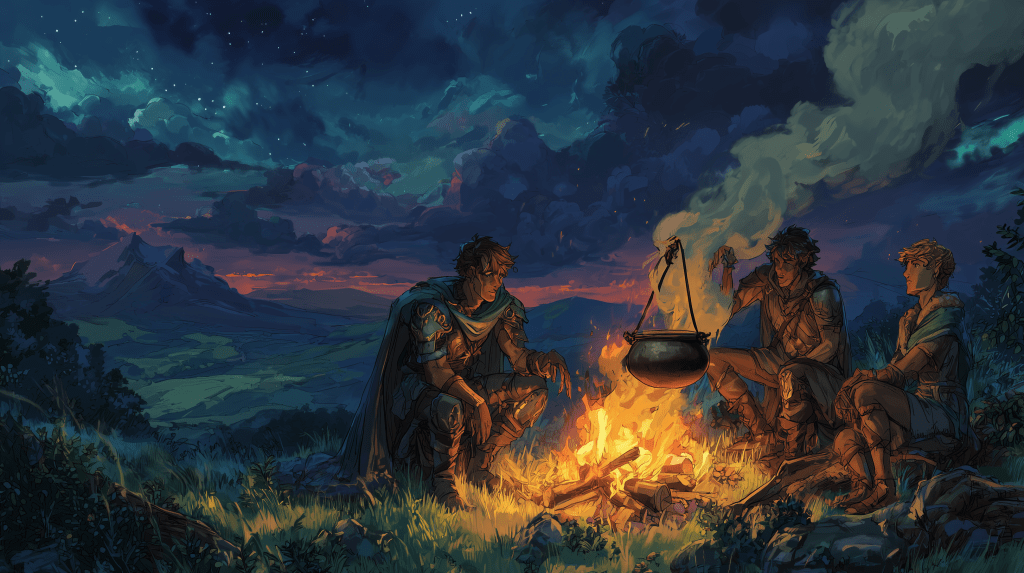


Castor Flamekeeper knelt beside the carefully arranged stones of their evening campfire, watching the flames dance against the twilight sky with the focused intensity of a scholar deciphering ancient runes. Around him, the rolling hills of Nomados stretched in gentle undulations toward the horizon, where the silhouette of Singing Ridge—one of the smaller walking mountains—moved with the patient grace of geological time made manifest.
The mountain’s evening song drifted across the landscape, a deep harmonic thrumming that resonated through stone and earth and bone. It was a sound that spoke of ages beyond human comprehension, of patience measured in millennia rather than moments. Tobias found it oddly comforting, this reminder that some things endured regardless of human folly or ambition.
His three companions had scattered to handle the mundane necessities of camp—Thea gathering deadfall for additional firewood, Brennan checking the perimeter for potential hazards, and Miren communing with the local earth-spirits to ensure they weren’t trespassing on sacred ground. Their efficiency spoke of years traveling together, a well-oiled machine of mutual dependence and trust.
All of which made Castor’s current project both more meaningful and more terrifying.
“I could help with that,” Thea called from where she’d been splitting kindling with mechanical precision. Her tone carried the carefully neutral inflection of someone trying very hard not to interfere with a friend’s deeply held ambitions. “The fire’s burning a bit hot for cooking. Might want to—”
“I’ve got it under control,” Castor replied, perhaps more sharply than he’d intended. The cooking pot suspended over the flames showed encouraging signs of progress—steam rising from the carefully diced vegetables he’d spent an hour preparing, the aroma of herbs and spices beginning to meld into something that actually smelled like food rather than mere ingredients.
Brennan emerged from the brush, his weathered face wearing the expression of a man who had learned to be diplomatically supportive of lost causes. “Smells… ambitious,” he offered, settling onto a fallen log that served as their communal seating. “Very… complex.”
The pause before ‘complex’ carried the weight of shared history, of previous culinary disasters that had become legend among their traveling party. Castor felt heat rise in his cheeks that had nothing to do with the fire’s warmth.
“It’s just stew,” he said, stirring the bubbling mixture with perhaps more vigor than necessary. “Meat, vegetables, seasoning. People have been making stew for thousands of years. How complicated can it be?”
The silence that followed was pregnant with unspoken memories, three companions carefully not mentioning the previous times Castor had asked that exact question. Miren returned from her spiritual consultation, her expression brightening with the dangerous enthusiasm of someone about to offer encouragement while simultaneously preparing for disaster.
“The earth-spirits are curious about your cooking,” she announced, settling gracefully beside Brennan. “They’re not familiar with… whatever you’re putting in that pot. Apparently, it’s creating some interesting harmonic resonances in the local stone formations.”
Castor paused in his stirring, suddenly aware that his stew was indeed producing sounds—small popping and hissing noises that seemed louder than they should, given the relatively low flame. “That’s… probably normal,” he said, adding another pinch of the exotic spice blend he’d purchased from a Nomadic trader three days earlier. “All the best stews make interesting sounds.”
“Remember the potato salad incident?” Thea asked conversationally, ostensibly addressing Brennan but speaking loudly enough for everyone to hear. “In the Whispering Woods? When Castor decided to ‘enhance’ the traditional recipe?”
“We don’t need to relitigate past—” Castor began, but Brennan was already chuckling with the fondness of someone recalling a disaster that had become amusing through the safe distance of time.
“Six pounds of perfectly good potatoes,” Brennan said, shaking his head with mock solemnity. “Six pounds of vegetables that could have fed us for three days, transformed into a weapon of culinary destruction through the liberal application of Pyrrhian fire-pepper flakes.”
“I asked for a pinch,” Thea continued, warming to the theme. “A small pinch, I said. Enough to add subtle warmth and complexity to the dish.” She gestured expansively, demonstrating the size of a proper pinch. “Instead, I got what appeared to be a declaration of war against every taste bud in the known world.”
Miren giggled, the sound mixing with the distant mountain-song to create something approaching musical harmony. “The tears,” she added helpfully. “Don’t forget about the tears. All of us, sitting around the campfire, crying like we were mourning the death of flavor itself.”
“It wasn’t that bad,” Castor protested, though the memory remained vivid in his own mind—the moment of horrified realization as he’d tasted the supposedly simple potato salad and felt his tongue burst into flames, followed by the desperate scramble for water, milk, bread, anything that might quell the inferno he’d accidentally created.
“The local wildlife avoided our campsite for three days,” Brennan observed. “I’m pretty sure we created a dead zone where nothing with functional taste buds dared to venture. Bears, raccoons, even the mosquitoes stayed away.”
“And then there was the bread incident,” Thea added with the relentless cheer of someone determined to catalog every culinary catastrophe. “When Castor decided he could improve on his grandmother’s biscuit recipe.”
This memory was even more painful, tinged as it was with the particular shame that came from ruining something sacred. His grandmother’s biscuits had been legendary—light, fluffy, perfect vehicles for honey or jam or simply eaten warm from the oven. The recipe had been written in her careful handwriting on a card yellowed with age and kitchen use, preserved through years of careful travel in Castor’s pack.
“The recipe was perfectly clear,” he said defensively, though even as he spoke, he could feel his confidence wavering. “Two cups flour, one cup buttermilk, half a cup of fat—”
“The ratio wasn’t the problem,” Brennan interrupted gently. “The problem was your interpretation of ‘fat.’”
The memory crystallized with painful clarity: Castor standing over the mixing bowl, reading his grandmother’s recipe and deciding that if half a cup of rendered bacon fat was good, a full cup would be twice as good. The logic had seemed unassailable at the time. Fat provided flavor, richness, the qualities that transformed simple bread into something memorable. More fat should logically produce superior results.
The actual results had been… memorable, certainly, but not in the way he’d intended.
“They came out of the Dutch oven looking perfect,” he admitted, his voice taking on the hollow tone of someone reliving trauma. “Golden brown, properly shaped, everything you’d expect from professional biscuits.”
“Until someone tried to eat them,” Thea added with devastating accuracy. “At which point we discovered you had somehow created edible rocks. Bread-shaped stones that could probably be used as siege ammunition.”
“I threw one at a tree,” Miren recalled with scientific precision. “It made a sound like an axe hitting solid oak. Left a dent in the bark.”
Brennan nodded solemnly. “We ended up using them as tent stakes. Worked better than the metal ones we’d been carrying—they held fast in the ground and nothing short of a crowbar could extract them.”
The current stew chose that moment to produce a particularly aggressive series of bubbling sounds, as if the ingredients were engaged in active warfare rather than peaceful combination. Castor peered into the pot, noting that the liquid had taken on an ominous dark color that seemed to absorb rather than reflect the firelight.
“Maybe we should—” Thea began, but Castor waved her off with the desperate determination of a man whose culinary pride had been thoroughly excavated and displayed for public examination.
“Third time’s the charm,” he declared, adding another ladle of water to the mixture. “I’ve learned from my mistakes. This time, I’m following the recipe exactly. No improvisation, no creative interpretation, just simple ingredients combined in traditional proportions.”
He lifted the wooden spoon for a preliminary taste, blowing gently to cool the sample before placing it carefully on his tongue. For a moment, his expression remained neutral, processing flavors and textures with the concentration of a professional food taster.
Then his eyes began to water.
“Oh,” he said quietly, his voice slightly strained. “Oh, that’s… that’s quite…”
The spoon dropped from suddenly nerveless fingers, clattering against the pot’s rim. Castor reached for his water skin with the desperate urgency of a man fleeing a fire, upending it over his mouth in a cascade that splashed across his chin and shirt.
“Spicy?” Thea inquired politely, though her tone suggested she already knew the answer.
“Just… just a little,” Castor gasped, his voice rough with the particular hoarseness that came from inhaling liquid fire. “Perhaps I was… overly enthusiastic with the seasoning.”
Brennan leaned forward, studying the bubbling stew with the clinical interest of someone observing a natural disaster from a safe distance. “What exactly did you put in there?”
Castor fumbled for the small leather pouch containing his spice blend, squinting at the trader’s label through eyes still streaming with involuntary tears. “Peak-rider mountain spice,” he read aloud, his voice carrying the dawning horror of belated understanding. “Blend of thirteen different peppers harvested from volcanic soil. Warning: use sparingly. Recommended dosage: one quarter teaspoon per gallon of liquid.”
“How much did you use?” Miren asked, though her tone suggested she was already bracing for the answer.
Castor held up the empty pouch with the gesture of a condemned man displaying the evidence of his own folly. “All of it,” he admitted. “I thought the trader was being conservative with his recommendations. I wanted to ensure the stew had proper flavor.”
The stew chose that moment to produce a sound like an angry dragon clearing its throat, followed by a gout of steam that rose from the pot in a distinctly menacing cloud. The aroma—if it could still be called that—had evolved beyond mere spiciness into something approaching chemical warfare.
“Well,” Brennan said philosophically, “at least we know the fire’s hot enough. That mixture could probably melt iron at this point.”
Thea stood and began unpacking their emergency rations with the efficient movements of someone who had learned to plan for culinary disasters. “Good thing I brought extra hardtack and dried fruit,” she said. “We’ll eat simple tonight, and tomorrow we can find a stream to dispose of… whatever that has become.”
“I could try to salvage it,” Castor offered weakly, though even as he spoke, the stew produced another ominous sound that suggested the ingredients had declared independence from all known laws of cooking.
“Some battles,” Miren said gently, placing a comforting hand on his shoulder, “are not meant to be won. Some victories come through knowing when to retreat and regroup for another day.”
Above them, Singing Ridge continued its eternal migration, its mountain-song carrying notes of patience and geological wisdom. The sound seemed to suggest that some processes required time measured in eras rather than hours, that true mastery came through accumulated experience rather than single moments of inspiration.
Castor looked at his failed stew—now producing occasional flashes of light that suggested chemical reactions had progressed beyond mere cooking—and felt something that might have been wisdom beginning to crystallize in his mind.
“Perhaps,” he said slowly, “I should focus on mastering simple dishes before attempting complex ones. Maybe start with… I don’t know. Porridge. Something that doesn’t require multiple ingredients or complex timing.”
“Porridge is good,” Thea agreed supportively. “Hard to ruin porridge. Water, oats, patience. Very straightforward process.”
“Though,” Brennan added with the gentle malice of a true friend, “knowing your history, you’d probably find a way to make porridge that could tunnel through stone.”
Despite everything—the failed stew, the wasted ingredients, the growing certainty that they would be eating trail rations for dinner—Castor found himself laughing. It started as a small chuckle, then grew into the kind of deep, cleansing laughter that comes from accepting one’s own limitations with grace rather than fighting them with futile resistance.
“You’re probably right,” he admitted, wiping tears from his eyes that now came from amusement rather than pepper-induced agony. “I have a gift for transforming the simple into the catastrophic.”
“It’s a valuable skill,” Miren said seriously. “Not everyone can create such memorable disasters with such consistent reliability. There’s something to be said for specializing in spectacular failure.”
The stew pot produced one final, aggressive bubble, then subsided into ominous quiet. The silence that followed was somehow more terrifying than the previous sounds of active rebellion.
“Right,” Thea said briskly. “Hardtack and dried fruit for dinner, and tomorrow we put as much distance as possible between ourselves and whatever that mixture evolves into overnight. With luck, the local earth-spirits will contain it before it achieves full sentience.”
As they settled around the fire to share their simple meal, the conversation gradually shifted away from culinary disasters toward other topics—the route they would take tomorrow, the weather patterns gathering around the distant peaks, the latest news from settlements they’d passed through. But Castor found his gaze returning periodically to the abandoned stew pot, watching the occasional wisp of steam that rose from its depths like incense offered to the gods of cooking disasters.
Perhaps, he reflected, there was wisdom in accepting one’s limitations rather than constantly fighting against them. His companions had learned to plan for his culinary catastrophes, packing extra rations and maintaining good humor in the face of repeated dinner disasters. They had transformed his failures into shared experiences, sources of laughter and bonding rather than division and frustration.
Maybe the problem wasn’t his cooking skills—though those were admittedly questionable—but his expectations. Maybe the goal shouldn’t be creating perfect meals but creating perfect moments, opportunities for friends to care for each other and share laughter over simple food and complex memories.
The mountain-song shifted with the evening breeze, carrying new harmonics that spoke of change and acceptance, of patience rewarded through perseverance rather than perfection. Above them, stars began to emerge in the clear sky, tiny points of light that had watched countless humans gather around countless fires, sharing food and friendship across the vast sweep of history.
Tomorrow, Tobias decided, he would attempt porridge. Simple, basic porridge that would either feed his friends or provide them with another legendary disaster to laugh about around future campfires. Either way, they would face it together, with good humor and backup rations and the kind of friendship that could survive even his most creative culinary catastrophes.
After all, some of the best adventures began with the worst cooking.

 Chadwick Rye
Leave a comment