
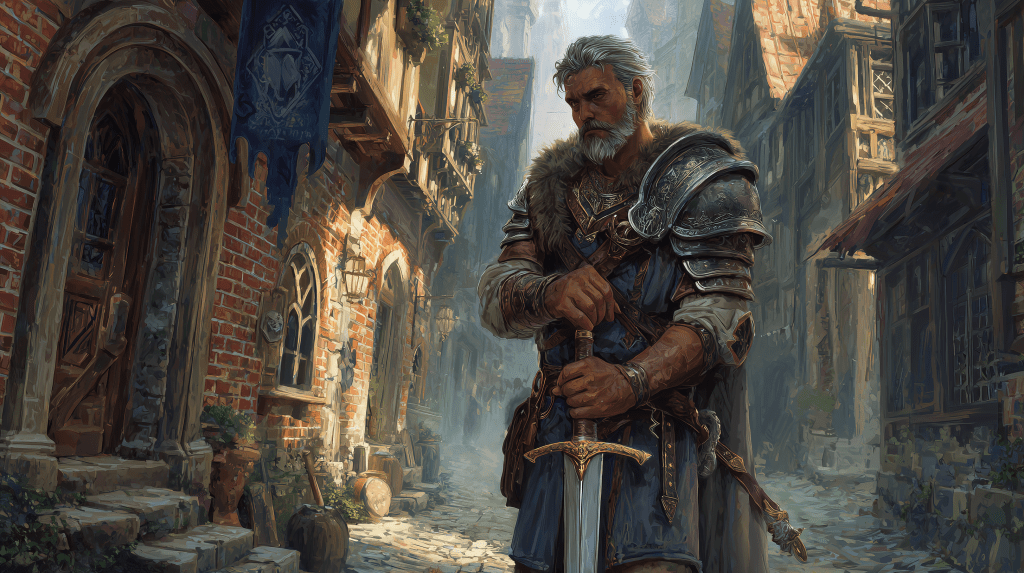


Devon Blackhand pressed his weathered shoulders against the cold brick wall of Merchant’s Alley, watching the morning mist curl between the narrow buildings of Millhaven like ghostly fingers seeking purchase on stone and mortar. At fifty-seven, his once-powerful frame had settled into the comfortable thickness of middle age, though his sword arm remained steady and his eyes still held the predatory sharpness that had made him legendary two decades past.
The alley stretched before him in familiar gray monotony—three modest shops huddled together like old women sharing secrets. Corwin’s Curiosities occupied the left corner, its windows filled with the kind of imported trinkets that convinced traveling merchants they were seeing exotic wonders. The middle establishment, Thorne’s Fine Leathers, actually lived up to its name, crafting boots and belts that would serve a man well for years. On the right sat Millhaven Metalworks, where old Henrik still hammered out horseshoes and kitchen knives with the patient rhythm of a craftsman who understood the value of honest work.
Devon’s job was simple: stand here from dawn until dusk, his scarred hands resting on the pommel of his battered longsword, and ensure that no enterprising thieves decided these particular shops offered easy pickings. For this service, he received three silver pieces per day and the privilege of sleeping in the small room above Henrik’s forge—a arrangement that barely covered his needs and left nothing whatsoever for the future he could no longer pretend wasn’t approaching with the inevitability of winter.
The irony wasn’t lost on him. Devon Blackhand, who had once commanded five hundred gold pieces for a single contract, now grateful for enough coin to buy yesterday’s bread and tomorrow’s porridge.
A young courier dashed past, his leather satchel bouncing against his hip as he navigated the alley’s uneven cobblestones. The boy couldn’t have been more than sixteen, all elbows and energy and the kind of reckless confidence that comes from never having been truly tested. He reminded Devon uncomfortably of himself at that age, though the resemblance went deeper than mere youth.
The courier wore expensive boots—not the practical, well-made kind that Henrik crafted, but the sort with silver buckles and unnecessary stitching that announced their cost to anyone with eyes to see. His belt bore an ornate buckle that probably cost more than most families spent on food in a month. His cloak, though functional, showed the kind of elaborate trim that spoke of someone determined to display his prosperity rather than simply stay warm.
Devon had worn similar clothes once, though his had been far more expensive.
The morning sun climbed higher, burning away the mist and revealing Millhaven in all its modest prosperity. The town wasn’t grand—nothing like the Crystal Spires of Lumen Vale or the marble districts of the capital—but it was solid, established, the kind of place where merchants could build comfortable lives through steady trade and careful investment. The sort of place where a wise man might have settled thirty years ago, bought property, established roots, prepared for the long slide toward old age and infirmity.
Instead, Devon had spent those years chasing glory across half the known world, his purse heavy with gold that he’d scattered like autumn leaves without thought for the winter that must inevitably follow.
“Morning, Devon,” Henrik called from his doorway, wiping metal filings from his hands with a rag that had seen better decades. The smith was perhaps ten years older than Devon, his hair gone completely silver and his back permanently curved from years bent over forge and anvil. But his small apartment above the shop was paid for, his larder well-stocked, and his old age secure through decades of careful saving and modest living.
“Morning, Henrik,” Devon replied, touching two fingers to his brow in the abbreviated salute that had become habit. “Quiet start to the day.”
“Aye, though I expect it’ll pick up once the merchant caravan arrives from Eastport. Word is they’re carrying silks and spices, the kind of goods that attract attention.” Henrik’s eyes crinkled with what might have been amusement. “Good thing we’ve got the famous Devon Blackhand watching over us, eh?”
There was no mockery in the older man’s voice, but Devon heard the gentle irony nonetheless. Famous Devon Blackhand, reduced to standing guard over a modest metalworking shop for wages a beginning apprentice might earn.
The caravan Henrik mentioned would indeed arrive today—Devon had seen the advance riders yesterday evening, their horses road-weary and their purses heavy with the promise of profitable trade. Such caravans had once sought his services as protection, paying premium rates for the security that came with his reputation. Now, he would watch from the alley as other guards—younger men with hungrier eyes and emptier purses—negotiated rates that would have seemed insultingly low in his prime.
A memory surfaced unbidden: the night he’d won eight hundred gold pieces in a single dice game in the taverns of Goldport. He’d felt invincible then, as if fortune itself bent to his will. By morning, he’d spent half the winnings on a sword he didn’t need—beautiful work, certainly, with a moonstone pommel and silver-wire grip—but no more functional than the perfectly serviceable blade he already carried. The rest had vanished over the following weeks on elaborate meals, expensive women, and the kind of ostentatious generosity that made other mercenaries speak his name with admiration.
The sword was long gone now, sold five years ago when his aging reflexes had finally cost him a lucrative contract and he’d needed money for food. He’d received perhaps a tenth of what he’d paid, and the buyer had grumbled about the impracticality of such ornamentation on a working weapon.
“Tell me, Henrik,” Devon said, surprising himself with the question. “When you were my age, did you ever wonder if you’d made the right choices? About money, I mean. Saving instead of spending.”
The smith paused in his cleaning, studying Devon with the careful attention he usually reserved for metal that might be flawed. “Can’t say I ever had enough money to worry about spending too much of it,” he replied eventually. “Always seemed to me that coins were like tools—useful when you needed them, dangerous when you treated them as toys.”
“Dangerous how?”
Henrik gestured vaguely toward the alley’s mouth, where the broader streets of Millhaven carried their steady traffic of merchants and craftsmen, farmers and traders. “Money makes a man think he’s smarter than he is. Luckier than he is. More important than he is. I’ve seen young smiths come into a bit of coin and decide they’re too good for honest work. Usually doesn’t end well.”
The observation hit closer to home than Devon cared to admit. How many times had he turned down smaller contracts because they seemed beneath the great Devon Blackhand? How many merchants had he ignored because their purses couldn’t match the legendary fees he’d convinced himself he deserved?
Midday brought the usual trickle of customers to the alley shops. Corwin sold a set of ceramic figurines to a traveling merchant’s wife, his salesmanship turning mass-produced nonsense into precious artifacts through sheer enthusiasm. Thorne fitted a young farmer for new boots, taking careful measurements and discussing leather treatments with the kind of professional attention that justified his prices. Henrik accepted an order for a set of kitchen knives, sketching designs while discussing delivery dates and payment schedules.
Honest work, all of it. The kind of steady, unglamorous labor that built comfortable lives one transaction at a time.
Devon watched it all from his post, his hand resting on a sword that had once drunk the blood of bandits and brigands across three kingdoms. Now it served mainly as a deterrent to petty thieves who might otherwise test their luck against elderly shopkeepers. The weapon felt heavier with each passing year, not because of its physical weight but because of everything it represented—a past that grew more distant and a future that loomed with increasing urgency.
The afternoon brought an unexpected visitor. Marcus Ironhold—no relation to the famous warrior of Lumen Vale, despite sharing the name—had once served alongside Devon in the Westmarch campaigns. Now he wore the comfortable prosperity of a successful trader, his clothes well-made but practical, his bearing that of a man who had learned to value substance over appearance.
“Devon!” Marcus approached with genuine warmth, though his eyes took in the modest alley setting with barely concealed surprise. “I heard you were in Millhaven, but I didn’t know you were…” He gestured vaguely at the alley, clearly struggling for diplomatic phrasing.
“Working security for local merchants,” Devon supplied, his voice steady despite the heat he felt rising in his cheeks. “Honest work, and the pay’s regular.”
“Of course, of course.” Marcus recovered quickly, his trader’s instincts smoothing over the awkward moment. “I was just passing through on my way to the capital. Business with the Merchants’ Guild.” He paused, studying Devon’s face. “You know, I could probably find you something more… substantial. I’ve got connections, and your reputation still carries weight in certain circles.”
The offer hung between them like a bridge to a different future, and Devon felt the familiar tug of temptation. Marcus dealt in high-stakes trade negotiations, the kind of work that required experienced security and paid accordingly. A few good contracts could restore not just his finances but his sense of self-worth.
But he was fifty-seven years old, his reflexes a half-beat slower than they’d been at forty, his endurance nowhere near what it had been at thirty. The kind of men who threatened Marcus’s business interests weren’t the opportunistic thieves who might threaten Merchant’s Alley—they were professionals, young and hungry and fully capable of exploiting any weakness they detected.
“Appreciate the thought, Marcus,” Devon said finally. “But I think I’m where I need to be.”
His old comrade nodded, though whether in understanding or disappointment, Devon couldn’t tell. They spoke for a few more minutes about mutual acquaintances and old campaigns, the conversation carrying the bittersweet weight of shared history and divergent paths. When Marcus finally departed with promises to look him up on future visits, Devon felt oddly relieved.
Evening brought its own rhythms to Merchant’s Alley. The shops began closing their shutters, the day’s earnings carefully counted and secured. Corwin emerged with a satisfied expression and a purse that clinked pleasantly—apparently the ceramic figurines had found several buyers throughout the day. Thorne locked his door with the methodical care of a man whose reputation depended on reliability. Henrik extinguished his forge and swept the day’s metal filings into a container for recycling—waste not, want not, as the old saying went.
“Another day, another three silver,” Devon murmured to himself, a phrase that had become something between mantra and mockery. Three silver pieces wouldn’t have covered his wine bill for a single evening in his prime. Now it represented security, modest but real.
As the sun set behind Millhaven’s modest skyline, painting the alley walls in shades of amber and gold, Devon found himself thinking not of the money he’d squandered but of the money he’d never earned. The investments he’d never made, the properties he’d never purchased, the simple discipline he’d never developed. Every gold piece spent on ostentatious display had been stolen from his future self—a younger man’s arrogance becoming an older man’s regret.
But regret, he’d learned, was a luxury he could no longer afford. Tomorrow would bring another day in the alley, another three silver pieces, another small step toward whatever future remained available to him. It wasn’t the retirement he’d once imagined for the legendary Devon Blackhand, but it was honest work honestly earned.
Henrik emerged from his shop carrying two steaming mugs of tea, offering one to Devon with the casual generosity that characterized their friendship. “Thought you might appreciate something warm before heading upstairs,” the smith said, settling against the wall beside him.
Devon accepted the mug gratefully, inhaling the simple comfort of common tea leaves steeped in hot water. No exotic blends or imported luxuries, just warmth against the evening chill. Somewhere in his wild years, he’d developed a taste for expensive teas from distant lands, convinced that ordinary varieties were beneath his sophisticated palate. Now he found that tea was tea—a moment of warmth and companionship shared between friends who understood the value of simple pleasures.
“Henrik,” he said after a long silence, “what would you tell a young man about money? About saving and spending, I mean.”
The smith considered the question while sipping his tea, his weathered face thoughtful in the dying light. “I suppose I’d tell him that money is like fire,” he said eventually. “Useful when controlled, destructive when it controls you. Every coin spent should buy something worthwhile—food, shelter, tools, experience. But when you start spending to impress others or to convince yourself you’re someone you’re not…” He shrugged eloquently.
“And if that young man had already made mistakes? Spent foolishly, lived beyond his means?”
“Then I’d tell him that wisdom usually comes too late to fix the past, but just in time to improve the future.” Henrik’s eyes held the gentle understanding of someone who had seen many men wrestle with their choices. “The important thing isn’t how much you’ve lost, but how much you’re willing to learn.”
They finished their tea in comfortable silence, two men who had found their places in the world’s modest corners. Above them, stars began to emerge in the darkening sky, tiny points of light that had watched over countless human struggles with money and meaning, pride and pragmatism.
Devon climbed the narrow stairs to his small room, his daily wages carefully counted and most already set aside for tomorrow’s necessities. The space was humble—a narrow bed, a small table, a single window that looked out over the alley where he spent his days. But it was clean, warm, and paid for through honest work.
On the table sat a ledger where he tracked his modest expenses and savings. The numbers were small, painfully so compared to the fortunes he’d once commanded, but they grew steadily with each passing week. In five years, if his health held and his employment continued, he might have enough set aside for a truly comfortable retirement. Not the mansion and servants he’d once dreamed of, but a small cottage perhaps, with a garden and enough coin to ensure he’d never go hungry.
It wasn’t the life he’d planned, but it was the life he’d earned through choices both wise and foolish. And perhaps, Devon reflected as he prepared for sleep, there was a kind of victory in learning wisdom even when it came too late to matter as much as it might have once upon a time.
Outside his window, Millhaven settled into evening quiet, a modest town full of modest dreams and the kind of steady prosperity that came from understanding money’s true value. Somewhere in those streets, young men and women were making the same choices Devon had made decades ago—some wise, some foolish, all carrying consequences that wouldn’t fully reveal themselves for years to come.
He hoped they would learn sooner than he had that the money earned through honest effort was precious beyond its mere purchasing power, and that the discipline to save and invest wisely was perhaps the greatest skill any warrior could master. Not as dramatic as swordplay or as glorious as battle, but infinitely more valuable in the long campaign that was a human life.
Devon Blackhand, once famous throughout three kingdoms, now guardian of Merchant’s Alley, closed his eyes and slept the sleep of a man who had finally learned to value what he had rather than mourn what he’d lost.

 Chadwick Rye
Leave a comment