
Do you see yourself as a leader?
Meren Ashbrook had never considered herself a leader.
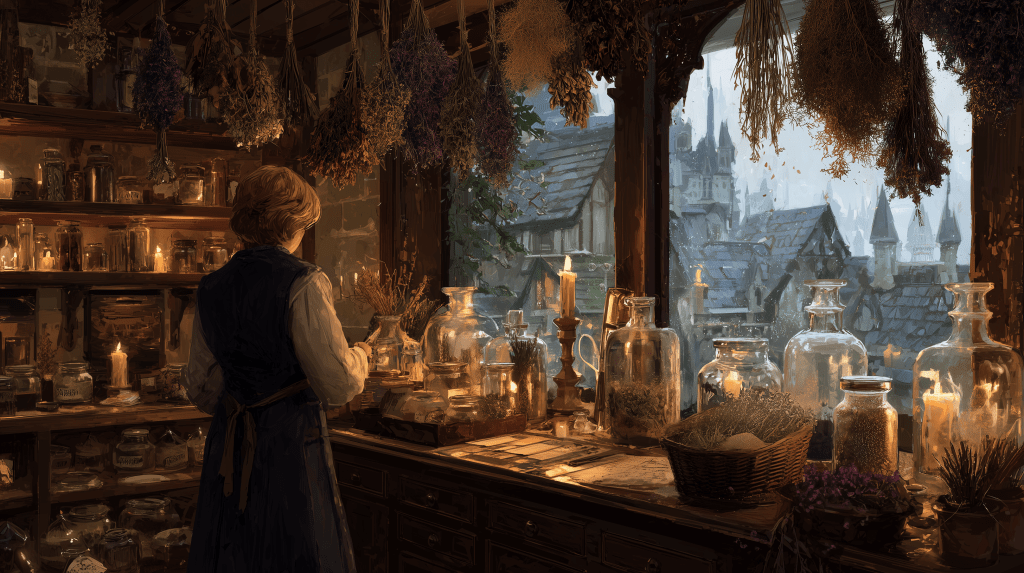
She stood in the doorway of her family’s apothecary, watching the evening shadows lengthen across Herbalist’s Lane in the heart of Lumen Vale’s Merchant Quarter. The familiar scent of dried lavender and ground moonstone powder drifted from the shop behind her, mingling with the crisp autumn air. Through the window, she could see her husband Tomás carefully measuring doses for tomorrow’s remedies, while their twins—fifteen-year-old Kira and Jorin—sat at the worn wooden table, bent over their studies.
Leadership, to Meren’s thinking, belonged to those who stood before crowds, who commanded respect through grand gestures and stirring speeches. People like Councilor Brightwell, who addressed the masses from the steps of the Crystal Spires, or Captain Valdris, who led the city guard with unwavering authority.
But as the bells of Eventide chimed across the terraced city, Meren felt the familiar weight of a different kind of responsibility settle around her shoulders like a well-worn cloak.
“Mama?” Kira’s voice carried from inside, touched with the particular tone that meant worry. “Mrs. Thornwick was by again today while you were at the Herb Gardens. She looked… troubled.”
Meren stepped back inside, closing the door against the growing chill. Elara Thornwick was their neighbor, a widow whose husband had died the previous winter in a mining accident in the Lower Caverns. Since then, Meren had found herself quietly ensuring that Elara’s herb garden was tended, that her windows were properly sealed against winter drafts, and that she never wanted for company during the long evening hours.
“What did she need, little star?” Meren asked, settling into her chair by the preparation table.
“Medicine for her cough,” Jorin replied, not looking up from his careful lettering practice. “But I think she mostly wanted to talk. She stayed for tea and asked about our winter preparations.”
Tomás glanced up from his work, catching Meren’s eye with that look of quiet understanding they’d perfected over eighteen years of marriage. He’d seen her earlier today, organizing the neighborhood families for their annual preparation gathering—ensuring everyone had sufficient firewood, sharing preserved foods with those who’d had poor harvests, and quietly arranging for the older residents to have help with winter tasks.
“I told her about the community supper next week,” Kira continued. “She seemed pleased.”
The community supper had been Meren’s idea, born from watching too many neighbors struggle alone through the harsh mountain winters. What had started five years ago as a simple shared meal had grown into a monthly tradition that brought together families from three different quarters of the city. Meren never stood up to make announcements or organize committees—she simply appeared wherever help was needed, carrying an extra loaf of bread or staying late to help clean up.
“That’s good, dear heart,” Meren murmured, beginning to sort through the day’s collection of herbs. Her fingers moved with practiced familiarity through bundles of silverleaf and dried phoenix moss, but her mind wandered to the dozen small decisions she’d made that day without really thinking about them: suggesting that young Marcus Copperfield might enjoy helping old Henrik with his forge, noticing that the Millwright family needed help repairing their roof before the first snow, quietly ensuring that pregnant Lynne Goldstream knew she could depend on extra help during her confinement.
“The harvest celebration committee asked if you’d help organize the children’s activities again,” Tomás said, his voice carefully neutral.
Meren paused in her sorting. Every year, the same request came, and every year she hesitated. Standing before groups of people, directing activities, being the visible center of attention—it felt wrong, somehow. Unnatural.
“I suppose I could help Helena Brightwater,” she said finally. “She has such good ideas for the games.”
But even as she said it, Meren knew what would happen. Helena would defer to her experience, others would ask her opinion on this detail or that arrangement, and somehow she’d find herself at the center of it all without quite understanding how it had occurred.
Jorin looked up from his writing, ink still wet on his quill. “Mama, why do people always come to you when they need things figured out?”
The question caught her off-guard. “What do you mean, little wolf?”
“Like… when the Weatherby family couldn’t decide how to divide their inheritance, they came to you. And when the baker’s guild had that disagreement about pricing, they asked your opinion. Even Captain Valdris asked you about the new patrol routes through our quarter.”
Meren felt heat rise in her cheeks. “Those were just… conversations. People talk to their neighbors.”
“Not the way they talk to you,” Kira said, setting down her stylus. “They listen differently when you speak. They get that look like… like they’re really hearing something important.”
Tomás chuckled softly, catching a strand of silver-touched hair that had escaped from Meren’s simple braid. “Your mother has a gift, little ones. She sees what people need before they know they need it. And she has a way of helping them find their own strength.”
“That’s not leadership,” Meren protested. “I’m not telling anyone what to do.”
“No,” Tomás agreed, his dark eyes warm with affection and something deeper—pride, perhaps, or recognition. “You’re doing something better. You’re showing them what’s possible.”
Outside, the first stars were beginning to emerge above the Crystal Spires, their light refracting through the magical structures to cast gentle rainbows across the city’s terraced streets. The apothecary felt warm and secure around them, filled with the comfortable rhythm of family life: the soft scratch of the twins’ writing implements, the whisper of Tomás grinding dried herbs with his marble pestle, the distant sound of neighbors calling goodnight across garden walls.
This was her domain, Meren reflected—not the grand stage of public leadership, but the intricate web of connections that bound a community together. She thought of Elara Thornwick, whose eyes brightened whenever she saw Meren approaching. Of the dozen families who’d found solutions to their problems through quiet conversations over tea. Of her own children, who were learning through observation what it meant to care for others without fanfare or expectation of reward.
Perhaps leadership wasn’t about commanding from the front, but about nurturing from within. Perhaps it wasn’t about having all the answers, but about helping others find their own questions. Perhaps it wasn’t about being followed, but about creating spaces where people could follow their own best instincts.
“The autumn market is next week,” she said eventually, returning to her herb sorting. “Mrs. Goldstream will need help managing her stall with the baby coming soon. And I noticed young Timothy Brewster looking lost during the harvest—his family could use guidance on preserving their surplus.”
“I’ll help with Timothy,” Jorin offered eagerly. “Father’s been teaching me about root cellars.”
“And I can assist Mrs. Goldstream,” Kira added. “I’m good with the account ledgers now.”
Meren smiled, watching her children claim their own small pieces of responsibility. This was how it worked—not through grand proclamations or formal appointments, but through the daily choice to notice what needed doing and to do it. Through teaching by example that caring for one’s community was as natural as tending one’s own garden.
As the evening deepened and the family settled into their bedtime routines, Meren stood again in her doorway, looking out over the quiet street. Tomorrow would bring new challenges, new neighbors in need of quiet assistance, new opportunities to strengthen the invisible bonds that held their community together.
She might never command armies or address crowds from the steps of the Crystal Spires. But here, in the gentle space between her family and her neighbors, in the careful tending of relationships and the patient cultivation of trust, she had found her own form of leadership.
It was quiet leadership, humble leadership—but no less powerful for its gentleness. And as she locked the apothecary door and climbed the stairs to join her sleeping family, Meren Ashbrook understood that some of the strongest leaders were those who never thought of themselves as leading at all.
They were simply the ones who stayed, who noticed, who cared—and who trusted others to find their own way forward, one small step at a time.

 Chadwick Rye
Leave a comment