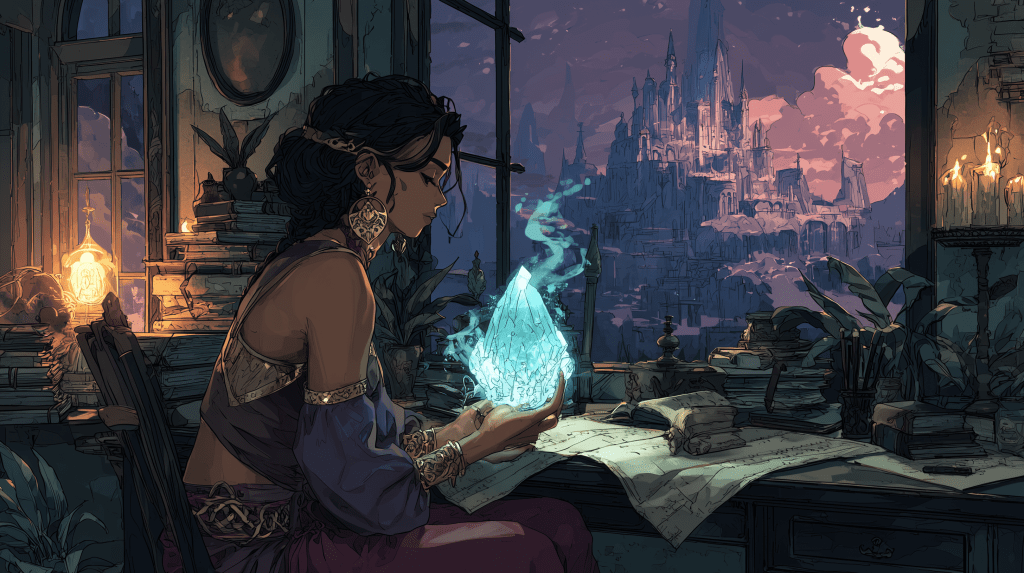


The crystalline communication node hummed with gentle energy as Silvana Wordweaver pressed her palms against its faceted surface, feeling the familiar tingle that meant her thoughts were about to join the vast network that connected storytellers and readers across Lumenvale. The device—barely larger than her fist but infinitely more precious than gold—sat on her writing desk like a captured star, its inner light pulsing in rhythm with the stories that flowed through the Ethereal Web.
Three years ago, she had been just another unpublished writer in the city’s literary district, carrying her handwritten manuscripts from publisher to publisher, accumulating rejection letters like a collector of fine disappointments. The traditional printing houses had no interest in her tales of ordinary people discovering extraordinary magic within themselves, her stories about kitchen maids who learned to speak with fire, or blacksmiths whose hammers could forge time itself.
“Too whimsical,” Master Cornelius Goldleaf of Prestige Publications had declared, returning her manuscript without so much as opening the leather binding. “Our readers prefer established genres. Epic quests, court intrigue, the adventures of titled heroes. Stories about… bakers and seamstresses… well, they simply don’t sell.”
But everything had changed when the Academy of Ethereal Arts had unveiled their revolutionary communication network—a web of crystal nodes that allowed thoughts and stories to travel instantly between attuned minds across vast distances. What had begun as a scholarly tool for sharing research had quickly evolved into something far more democratic: a way for anyone with talent and determination to reach readers directly, without gatekeepers or traditional publishing barriers.
Silvana had saved for six months to afford her first communication node, working extra shifts at the Scribe’s Guild to earn the silver crescents necessary for such an investment. The day she’d finally connected to the Ethereal Web, her heart had hammered against her ribs like a caged bird desperate for freedom. Her first story—a simple tale about a lighthouse keeper who could see the dreams of passing ships—had found just twelve readers.
But those twelve had become twenty-four, then fifty, then hundreds as word of her unique voice spread through the web’s interconnected pathways. Readers shared her stories with friends, discussed her characters in the network’s social chambers, and most importantly, began to eagerly await whatever she would publish next.
Now, three years later, her most recent story had reached over three thousand minds across Lumenvale and beyond. The communication node’s surface glowed more brightly as she prepared to upload her latest tale—a story about a traveling merchant who discovers that maps can be rewritten by those brave enough to walk new paths.
“Another late night, Silvana?” called Tobias from the apartment next door, his voice carrying through the thin walls that separated their modest dwellings in the Writers’ Quarter. A fellow storyteller who had found his own success through the network, he understood the peculiar addiction of watching reader numbers climb and comment crystals pulse with responses to freshly published work.
“The inspiration struck,” she replied, her fingers dancing across the node’s interface as she prepared her story for transmission. “I couldn’t let it fade.”
The Ethereal Web had taught her that timing mattered almost as much as content. Stories published during the evening hours, when most citizens had finished their daily labor and settled into comfortable chairs with warming tea, reached larger audiences than those uploaded during the busy daylight hours. She had learned to watch the network’s rhythm patterns, to understand when her particular style of intimate, character-driven fantasy would find the most receptive minds.
As her story began its journey through the crystalline pathways that connected thousands of communication nodes throughout the city, Silvana felt the familiar mixture of excitement and terror that accompanied each publication. Would readers connect with this new tale? Would they find depth in her merchant protagonist’s journey, or would the story feel too simple compared to the grand epics that dominated traditional publishing?
The first response crystal chimed within minutes—a warm golden pulse that indicated not just approval but genuine emotional resonance. Then another, and another, as readers across the city discovered her latest work and added their reactions to the growing constellation of feedback that surrounded every story in the network.
But more than individual responses, Silvana had learned to read the deeper patterns that revealed how her work was spreading through the web. Stories that truly captured readers’ imaginations didn’t just receive immediate praise—they generated what network scholars called “propagation cascades,” where engaged readers shared the work with others, who shared it further, creating expanding ripples of audience growth that could continue for days or even weeks.
Her communication node glowed brighter as the cascade began, indicating that readers weren’t just enjoying her story but actively recommending it to others. This was the phenomenon that traditional publishers could never replicate—the organic growth of readership driven by genuine enthusiasm rather than marketing campaigns or established reputation.
“The way you write ordinary magic makes me see wonder in my own daily routines,” appeared one comment, transmitted directly to her node by a reader whose identity remained anonymous but whose appreciation felt startlingly personal. “Your stories remind me that extraordinary things happen to people like me, not just heroes with ancient bloodlines and legendary destinies.”
This was exactly why she wrote, exactly why she had abandoned the traditional publishing route for the uncertain but democratic world of the Ethereal Web. Her stories reached people who had been told, implicitly or explicitly, that tales about characters like themselves weren’t worth telling. Kitchen workers and stable hands, apprentice mages struggling with basic cantrips, clerks and seamstresses and all the other ordinary people who kept Lumenvale functioning but rarely saw themselves reflected in published literature.
Another response crystal pulsed, this one carrying not just approval but a request for more stories featuring similar themes. Then another, and another—readers asking when her next tale would appear, sharing how her work had affected them, even requesting specific types of stories that addressed particular aspects of their own experiences.
“Please write about someone like my sister—a healer who works with animals but dreams of treating dragons,” suggested one reader.
“I’d love to see a story about a bridge keeper who’s afraid of water,” requested another.
Silvana carefully noted each suggestion in her idea journal, understanding that these requests represented something more valuable than traditional publishers offered: direct connection between storyteller and audience, the ability to write for real people with specific hopes and interests rather than abstract market demographics.
As the night deepened and more responses accumulated around her latest story, she found herself reflecting on the peculiar intimacy that the Ethereal Web created between writer and readers. Traditional publishing created distance—authors wrote in isolation, submitted work to gatekeepers, and if fortunate enough to be published, rarely heard directly from the people who read their stories. But the network collapsed those barriers, creating direct relationships between storyteller and audience that felt more like conversation than one-way communication.
Her readership had grown not just in numbers but in loyalty. Many of the same names appeared regularly in her response crystals, readers who had been following her work for months or even years. They had watched her style develop, celebrated her successes, and offered encouragement during the inevitable periods when inspiration ran dry or self-doubt clouded her creative vision.
“I’ve been reading your stories since ‘The Lighthouse Keeper’s Dreams,’” wrote one of her longtime followers. “Watching your writing evolve has been like watching a garden grow. Each new story adds something to the overall beauty of what you’re creating.”
Such comments reminded Silvana why she had originally been drawn to the network despite its challenges and uncertainties. Building a fanbase through the Ethereal Web required patience, consistency, and resilience in the face of occasional harsh criticism or stories that failed to find their intended audience. But it also offered something that traditional publishing could rarely provide: the knowledge that her work was reaching exactly the people who needed to read it, creating genuine connections between her imagination and their experiences.
The communication node’s glow had settled into a steady rhythm by the time Silvana prepared for bed, indicating that her story had found its initial audience and was now spreading through the network’s secondary pathways. Tomorrow would bring new responses, new readers discovering her work through recommendations from friends, and the ongoing process of building the community of readers who had come to trust her voice and eagerly anticipate whatever story she would share next.
As she finally extinguished the lamp and prepared for sleep, Silvana reflected on how the Ethereal Web had transformed not just her publishing strategy but her understanding of why stories mattered. She wrote not for fame or fortune—though the network had begun providing enough income to support her writing full-time—but for the privilege of reaching minds hungry for tales that reflected their own potential for magic and wonder.
Each story she published was simultaneously a gift to her existing readers and an invitation to new ones, an addition to the growing library of work that defined her voice and attracted those seeking exactly the kind of intimate, hopeful fantasy that traditional publishers had deemed unmarketable. The network had proven them wrong, revealing an enormous audience for stories that found the extraordinary within the ordinary, that celebrated the magic available to anyone willing to look for it.
Tomorrow she would begin work on another tale, inspired by the suggestions and responses her latest story had generated. The cycle would continue—writing, publishing, building connections with readers, using their feedback to create even better stories that spoke to even more people who had been waiting their entire lives for someone to tell tales about characters who looked and lived like them.
The Ethereal Web hummed softly in the darkness, carrying dreams and stories between minds across the sleeping city, and Silvana fell asleep knowing that somewhere in that vast network of connection and possibility, her words were still finding their way to readers who needed them, building the fanbase that was so much more than mere numbers—a community of people who had discovered that magic was not reserved for heroes, but available to anyone with courage enough to recognize its presence in their own extraordinary, ordinary lives.

 Chadwick Rye
Leave a comment