
What is your favorite genre of music?
The breathing apparatus felt alien against Nerida’s face as she descended through the crystal-clear waters of Sylvenmere’s outer reaches, each meter of depth taking her further from the familiar realm of air and sunlight into something that defied every assumption she’d held about music’s true nature. The bubble-city that enclosed her—a marvel of Sylvenmerian engineering that maintained a pocket of breathable atmosphere while allowing complete submersion—shimmered around her like a soap-film dream, its iridescent walls filtering the ocean’s blue-green luminescence into patterns that danced across her vision.
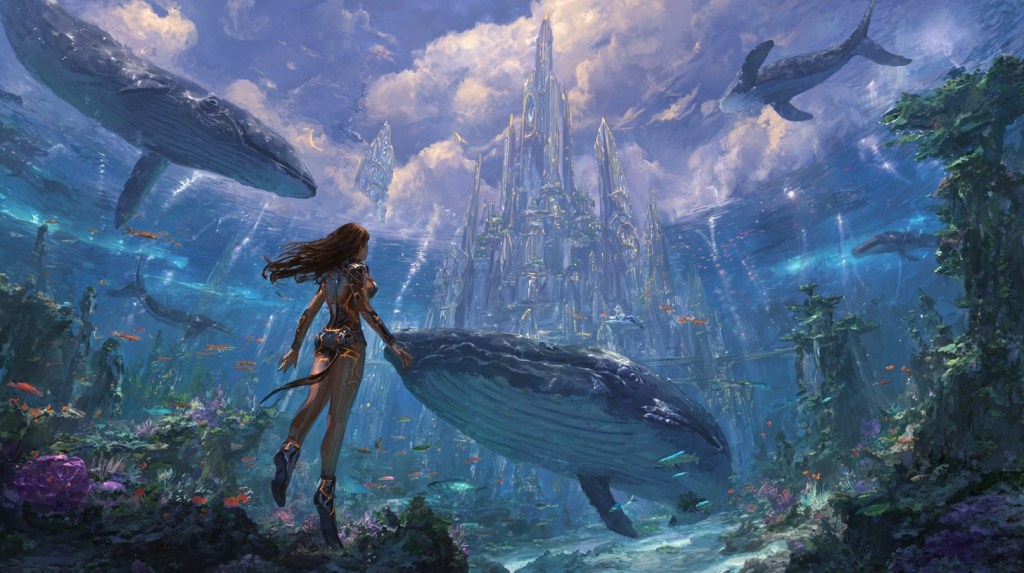
Below, the coral city of Pearlheart sprawled across the seafloor in organic curves that seemed to grow from imagination itself. Spiraling towers of living coral reached upward like frozen melodies, their surfaces pulsing with bioluminescent rhythms that spoke of a civilization built upon principles entirely foreign to land-dwelling understanding. Gardens of kelp swayed in currents that moved like breathing, while schools of luminescent fish wove between the structures in patterns so intricate they resembled written music given three-dimensional form.
Nerida had come to Sylvenmere as part of a cultural exchange delegation from Lumenvale’s Academy of Harmonics, her official purpose to document the underwater realm’s acoustic traditions for academic study. As a composer whose terrestrial works had earned recognition throughout the crystal cities, she had expected to encounter interesting but ultimately translatable musical forms—perhaps percussion created through controlled water displacement, or vocal techniques adapted for aquatic environments.
She had not expected to discover that everything she understood about music was merely a pale shadow of what sound could become when freed from the constraints of air.
Her guide, a Sylvenmerian named Thalassa whose scaled skin shifted through gradients of deep blue and silver as they descended, moved through the water with the fluid grace of someone born to liquid existence. The breathing apparatus she wore was clearly concession to Nerida’s air-lung limitations—Sylvenmerians could process oxygen directly from seawater through specialized gill-slits that opened and closed along their necks in patterns that reminded Nerida of musical notation.
“The Deep Resonance begins at sunset,” Thalassa explained, her voice carrying clearly through the water despite the medium’s supposed acoustic limitations. Nerida was still adjusting to the way sound traveled in Sylvenmere—not muffled and distorted as she had expected, but somehow richer, more complex, carrying harmonics that air could never sustain. “It is… difficult to translate the concept into air-words. Your language has no equivalent for what we experience.”
They settled onto a viewing platform carved from living coral, its surface warm and slightly yielding beneath them. Around the platform, other Sylvenmerians had begun to gather—beings whose beauty transcended the merely physical to achieve something approaching the sublime. Their scales caught and reflected light in patterns that seemed to respond to emotion, creating a visual accompaniment to whatever musical experience was about to unfold.
As the last rays of sunlight filtered down through the water’s surface far above, transforming from golden beams to ethereal blue-green streams, the coral city began to change. What Nerida had initially perceived as random bioluminescence resolved into something far more intentional—a vast network of living organisms communicating through patterns of light and chemical signals that created rhythm, harmony, and melody on scales that dwarfed any terrestrial composition.
The kelp forests swayed in unison, their movements generating currents that carried subsonic frequencies through the water. Schools of fish began to move in formation, their synchronized swimming creating acoustic effects that resonated through Nerida’s body rather than simply reaching her ears. The coral structures themselves began to pulse with coordinated light-patterns, each polyp contributing to a symphony of illumination that painted music directly onto the retina.
But it was when the whales arrived that Nerida truly understood why she had spent thirty years seeking something she hadn’t known was missing from her musical vocabulary.
They emerged from the abyssal depths like living cathedrals, their massive forms moving with impossible grace through the water surrounding Pearlheart. These were not the simple marine creatures she had studied in natural history texts, but conscious participants in a musical tradition that spanned millennia. Their songs—for songs they truly were—carried frequencies so low they vibrated through bone and tissue, creating resonances that transformed the listener’s entire body into a musical instrument.
Thalassa’s scales had shifted to deep purple shot through with veins of gold, colors that Nerida was beginning to recognize as indicators of profound emotional response. “This is why we call it Deep Resonance,” she explained, her voice carrying new harmonics that seemed to emerge from the water itself rather than her throat. “It is not music that you hear—it is music that you become.”
The whale songs wove together in patterns of staggering complexity, each voice contributing to harmonies that existed in three dimensions rather than the linear progression of terrestrial composition. Low frequencies provided foundational rhythms that pulsed through the seafloor, while mid-range calls created melodic lines that spiraled through the water column. High-frequency clicks and whistles added percussive elements that sparkled through the composition like audible starlight.
But more than the technical complexity, it was the emotional depth that overwhelmed Nerida’s carefully constructed professional composure. The whale songs spoke of things that had no equivalent in surface languages—the patient wisdom of geological time, the fierce protection of pod-family bonds, the mysterious joy of diving into darkness so complete it became its own form of light. Each phrase carried the weight of oceanic consciousness, intelligence vast and alien yet somehow familiar to anyone who had ever felt small beneath an infinite sky.
The Sylvenmerians around her had begun to add their own voices to the composition, not in the way terrestrial choirs supported a musical piece, but as integral participants in a living artwork that recreated itself moment by moment. Their vocalizations created complex interference patterns with the whale songs, generating combination tones and harmonic series that had no equivalent in air-based acoustics. Some voices provided rhythmic foundations through precisely timed exhalations that sent bubble-streams cascading upward in visual accompaniment to the audio experience. Others contributed melodic elements that seemed to emerge from the water itself, as if the medium had become a musical instrument capable of infinite expression.
Nerida found herself crying—tears that the water immediately absorbed, becoming part of the vast liquid medium that carried this impossible music. Everything she had ever composed, every melody she had crafted with painstaking attention to harmonic progression and rhythmic development, seemed suddenly crude and limited. How could air-bound music compare to this three-dimensional tapestry of sound and light and emotional resonance that transformed the listener into an active participant rather than passive recipient?
“You understand now,” Thalassa said, though her attention remained focused on the continuing performance. Her scales had shifted again, now showing patterns of deep green edged with luminescent white—colors that spoke of satisfaction and shared revelation. “Why those who experience Deep Resonance struggle to find meaning in surface music.”
The composition continued for what felt like hours, though time seemed as fluid as the medium through which it traveled. Themes emerged and evolved, individual whale voices taking prominence before blending back into the collective harmony. The bioluminescent displays of the coral city pulsed in synchronization with the acoustic patterns, creating a synesthetic experience that engaged every sense simultaneously. Fish schools formed and reformed in patterns that provided visual rhythm sections, while the kelp forests swayed in complex polyrhythms that generated their own subsonic accompaniment.
As the performance reached its conclusion—or perhaps simply paused, since Thalassa had explained that Deep Resonance continued in various forms throughout Sylvenmerian society—Nerida realized that her understanding of her favorite musical genre had been forever altered. She had come to the underwater realm expecting to catalog interesting variations on familiar themes. Instead, she had discovered that music itself was far more vast and varied than terrestrial experience could suggest.
“In your air-words,” Thalassa said as they began their ascent toward the surface, “how would you describe what you have experienced?”
Nerida struggled with the question, her mind still reeling from the implications of what she had witnessed. How could she explain to her colleagues at the Academy that everything they understood about music was limited by the medium through which they experienced it? How could she describe the sensation of becoming part of a composition rather than simply listening to one?
“Symphonic,” she said finally, then immediately recognized the inadequacy of the term. “But not symphonic as we understand it on the surface. This was… symphonic consciousness. Music that includes the listener as an active participant, that transforms the medium itself into an instrument, that operates in three dimensions rather than linear time.”
She paused, watching a school of luminescent fish weave patterns of living light through the water around them. “I think… I think I’ve been composing shadows of music my entire life. Echoes of something far more complete that I never knew existed.”
Thalassa’s scales shifted to warm amber streaked with gold—approval, Nerida had learned, mixed with something approaching affection. “Many surface-dwellers leave Sylvenmere with similar realizations. The question becomes: what will you do with this knowledge?”
As they broke through the boundary between water and air, returning to the breathing-world that had once seemed sufficient for musical expression, Nerida carried with her more than academic observations and cultural documentation. She carried the memory of becoming music rather than simply hearing it, of participating in composition that existed in space as well as time, of harmony so complex and complete that it redefined her understanding of what art could achieve.
Her favorite genre of music, she realized, was no longer something that could be categorized within terrestrial understanding. It wasn’t classical or folk or any of the surface categories she had studied and mastered. Her favorite music was the kind that transformed the listener into an active participant, that used the medium itself as an instrument, that created beauty too vast and complex for any single perspective to fully comprehend.
It was, quite simply, the music of conscious immersion—the recognition that art achieved its highest expression when it dissolved the boundaries between creator, performer, and audience into something unified and transcendent.
Back in Lumenvale, she would spend months attempting to translate her experience into forms that air-breathing musicians could understand. She would experiment with resonance chambers filled with water, with compositions designed to be experienced through bone conduction rather than simple auditory reception, with harmonic structures that mimicked the three-dimensional complexity of Deep Resonance. Some attempts would approach success; others would fail completely.
But always, in the quiet moments between earthbound compositions, she would remember the sensation of becoming music itself—of existing for precious hours as a living note within a symphony vast as oceans, complex as consciousness, and beautiful beyond the power of any single heart to fully contain.
Her favorite genre of music, she had discovered, was the kind that reminded listeners they were not separate from the art they experienced, but essential participants in its ongoing creation. Everything else, no matter how technically accomplished or emotionally moving, was merely preparation for that profound recognition.

 Chadwick Rye
Leave a comment